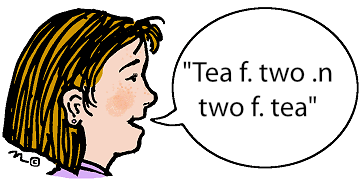
One of the most difficult things for native speakers of other languages about English is the pattern of stressed and reduced syllables in English words. In most languages the vowel in every syllable is clearly heard. So speakers of Spanish, French, Italian are very puzzled when they hear English speakers saying things like:
‘Tea for two and two for tea’
Which in normal speech comes out more like: ‘Tea f. two .n two f. tea’
Or
‘A quarter to two’
Which in normal speech comes out more like: ‘.quart. t. two’
where the dots represent almost non-existent, very low energy sounds.
It turns out that about 50% of speech sounds in normal English have this character, being weak, very low energy and often almost non-existent. So one of the jobs of a teacher trying to give our students good pronunciation is to teach how to make these sounds and this curious rhythmic pattern.
One of the best ways of teaching stress and reduction in English is to get the students to stutter. For example, if they practice saying ‘ttttttttt two’ and then reduce the number of stutters down to three they will get ‘t.t.two’ which is exactly what they need for the end of ‘A quarter to two’.
What’s particularly important about this, is that once students have experienced the existence of these reduced sounds and produced them themselves, they are equipped to hear them and thereby understand better what these English natives are saying and doing when they ‘swallow their words’.
I was really pleased when I tried this with the students in the East Lothian elementary English class. We were working on the sentence ‘We all yelled for bananas and cream’ which should be ‘Wi all yell.d f. b.nan.s .n cream’. Getting them to practice stuttering from ‘f’ to ‘b.’ ie ‘fffffffb.’ did exactly what was needed to make this very tiny sound.
This technique for teaching stress and reduction and the examples, I learnt from the online course Teaching Pronunciation Differently (Electronic Village Online Jan-Feb 2019) which I highly recommend.