From Noises to Words

I have always hated ‘listening exercises’ in language classes, but I thought it was the right time to improve my listening skills in Spanish. Find out what I did and some of the surprising results I discovered.

I recently started listening to a podcast series ‘La Historia del Mundo’ (The History of the World) in Spanish. This podcast is simply one person speaking for nearly an hour each time on whatever topic she has chosen, with occasional interruptions with relevant music. It’s not a podcast for learners.

I had two main reasons for starting this project:

  • it seemed like more or less the right time in my progress in Spanish to focus on ‘listening’
  • I was interested in understanding how to teach this aspect of learning a foreign language.

The right time for me

I thought it might be the right time for me because I’ve done a lot of work on my pronunciation, and I thought I had reasonably accurate criterion for the sounds of Spanish and the relationship between sounds and spelling.

But, I’d noticed last time I had a conversation in Spanish, that I needed to ‘up my game’ in picking up the details of what the other people were saying to me.

So these two things suggested to me that it was time for me to practice these skills.

My experience of listening exercises in language classes

I knew from my experience that ‘listening exercises’ were aspects of language classes I found difficult and didn’t really like. I recall one of my a Italian teachers putting on a tape from time to time and asking us to answer some pre-prepared questions about what we’d heard.

The main thing I remember about these experiences was that I hated it, picked up almost nothing from the tape, was completely demotivated when it came to answering the questions and any answers I happened to get right felt like complete guesses.

I found the whole thing humiliating and confusing: how could I be so bad at this aspect of Italian, when I could chatter happily in what was probably very bad Italian, but obviously getting my message across?

And more to the point, there was no attempt on the part of the teacher to actually teach this skill. We were simply exposed to it and expected to be able to do it. And if we couldn’t, or couldn’t do it very well, there seemed to be nothing on offer to help us improve other than repeat the process (and associated humiliation) a few days later, plus … of course, more grammar and more vocabulary in between.

I’m not unusual in this experience

Knowing what I know now, I realise my experience was not particularly unusual and, on the whole, there is a lack of tools or practices available, and used by teachers, to help students get better at this skill.

I suspect that part of the reason for this is that it is assumed, incorrectly, that listening is a passive process that any hearing person does automatically, and that therefore the problem is a cognitive one to be primarily solved by the student mastering more grammar and more vocabulary.

But this doesn’t match my experience. My experience of those Italian tapes was that I was faced with a jumble of incomprehensible sounds out of which hardly any recognisable syllables or words emerged. How is it possible to comprehend anything of what has been said until these sounds are resolved into syllables and words?

Towards a solution (for me at least)

My hypothesis therefore was that:

  • the first difficulty in ‘listening exercises’ will simply be recognising the sounds and syllables of the foreign language. And once that has been reasonably overcome …
  • … the second difficulty will be coming across unknown words and phrases. And if the missing vocabulary is not too extensive or crucial then context and guessing will carry me through …
  • … and over time, if I manage to train myself to recognise the sounds of the language, then simply through listening, I will start to acquire new vocabulary.

My experiments

I chose this particular podcast because I’m interested in this type of history and recent episodes seemed to be about the history of Russia in my lifetime: something very important and relevant for today. I aimed to listen to about 30 mins of the podcast every day, whilst I was doing something else – walking, on the bus, doing chores etc.

I kept a diary of what I noticed or discovered and I’m drawing on this diary to write up this experience. There were three fairly distinct phases:

Phase 1: mostly just noises

To start with I seemed to be listening to mostly noises, rather than words. I was recognising some words, enough words to get a broad sense of what was going on, supported by the fact that I knew roughly what the podcast was on about, having lived through the times the podcasts I’d chosen were about.

Over a few days I found myself recognising gradually more of the words, and having an idea that there was some pattern to what I couldn’t recognise, albeit I couldn’t identify what the pattern was.

I hypothesised that the pattern I was sensing indistinctly was likely to be something to do with the passages I found hard to hear as anything other than noises, probably containing a lot of the Spanish sounds that English-speaking people find most difficult to say.

Therefore, I consciously stepped up my pronunciation practice on these sounds, paying particular attention to what I was doing in my mouth to make sounds like /β̞/, /ð̞/, /ɣ̞/, /ɾ/ and redoubling my efforts to eliminate English /v/ and English /d/ from my speech.

I did none of the often recommended things, such as slowing down the audio, or pausing the audio and repeating small sections. And I listened to each episode only once: I simply listened from start to finish for however much time I had available, usually 30 minutes, just as I would for a podcast or radio broadcast in English. All I actively did to improve my listening skills was, in fact, to try to improve my own pronunciation of Spanish.

After a few days, my recognition of sounds and words in the podcast was improving, and therefore my comprehension was too.

I noticed that my immediate recall of what I had listened to wasn’t particularly good, but that one day later it was much better. I decided therefore, that the day after listening to each podcast, I would handwrite ten sentences noting anything I happened to recall in my notebook. I wanted to do this so that I consolidated my memory of the history I was hearing about, rather than, initially, as a linguistic exercise. After all:

[History] is what you can remember

1066 and all that : a memorable history of England
WC Sellar and RJ Yeatman

So, the first time I made these notes, I wrote in English. But it immediately became obvious that I would be much better writing in Spanish, and that is what I did thereafter. I made no effort to write complex sentences, or write a coherent account in any order: I simply wrote ten sentences of whatever I happened to remember.

By this point:

  • I felt I was recognising quite a lot of words, and getting the gist of more than half of the podcast
  • but there were substantial passages where I was still hearing noises rather than sounds
  • I found myself getting distracted either by sounds I didn’t recognise, or stopping listening while trying to ‘work out’ a word or phrase or construction I thought I had heard, and
  • while I was in this distracted state, I was missing whole chunks of the podcast and when I returned to listening again it was hard to pick up the narrative – often I’d missed crucial information about what the narrator was now talking about.

Phase 2: silent shadowing

After listening about 5 times over a week in phase 1, I discovered myself ‘silently shadowing’ what the narrator was saying. By this I mean that I found myself making the speech movements of what she was saying, but without making any sound. It felt as if I was making these movements at exactly the same time as she said something, though there must have been some delay.

The thing I noticed was that when I was doing this, my comprehension shot right up, to what seemed like close to 100%. I also noticed that I could not maintain this shadowing continuously: there were passages where my mouth didn’t ‘know what to do’, and for these passages I understood nothing. It seemed to me that I was comprehending what was being said, as much through recognising the physical movements in my mouth, as by what I was hearing.

This seemed to me to corroborate the hypothesis that improving my production of Spanish sounds would improve my listening, and I hypothesised that this was a stage that I would rapidly work through.

Indeed, over the next few days, I consciously initiated ‘silent shadowing’ whenever I lost track of what was being said or got distracted. All the time, I felt my comprehension was increasing.

After about 3 times working like this, I noticed that the ‘silent shadowing’ was itself becoming a bit of a distraction that I could dispense with, and only use sparingly for a word or two to get myself back on track when I had got distracted, or after a particularly difficult passage.

I still found there were passages where the sounds just defeated me and I understood nothing for a short time, but these were getting less. And I came to associate part of the problem with the rhythm of what the narrator was saying: it was as if a combination of strange sounds and the ‘machine gun’ rhythm of Spanish just turned everything back into noise.

So, in addition to focusing on producing accurately those ‘difficult’ sounds (‘difficult’ for English-speaking people, of course) , I added to my pronunciation practise, making extra-sure that whatever I happened to be working on, was practised with that characteristic Spanish rhythm.

Phase 2 lasted about 8 days with me listening about 5 times

Phase 3: It’s all words

And then, suddenly, I started noticing clearly two sorts of words: words I knew, and words I didn’t know. And then it dawned on me that what I was listening to was, in fact, all words … just words, not noises and some words … just words I knew, and words I didn’t know!
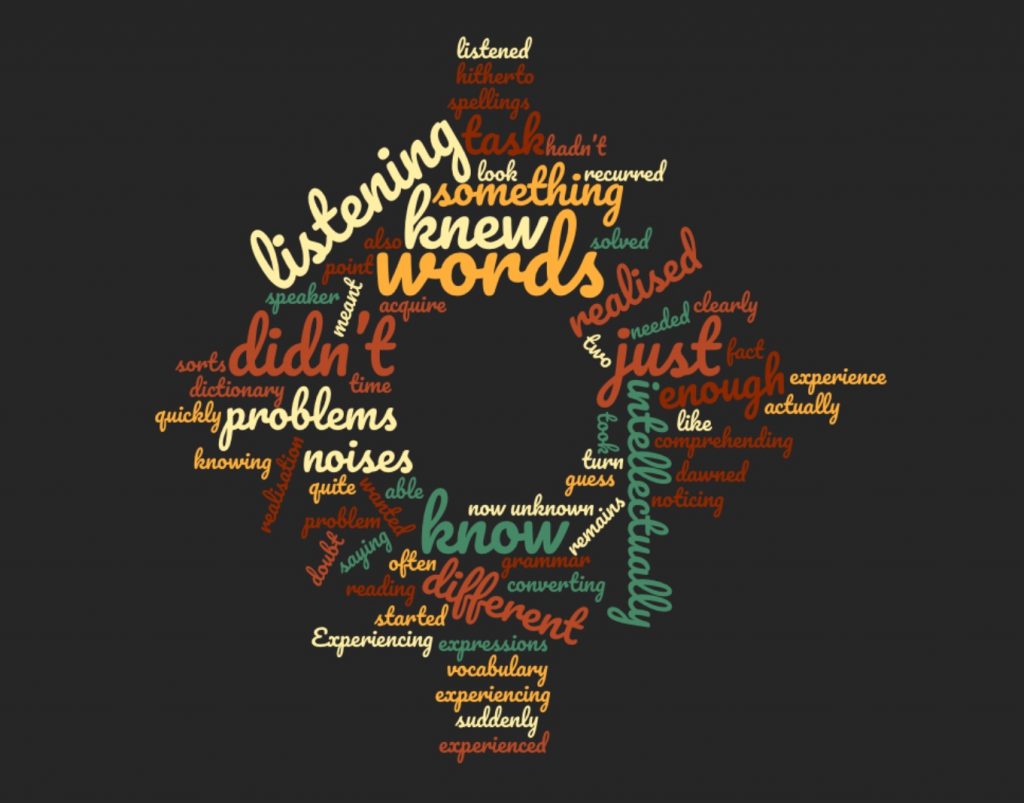
This was some realisation. I was experiencing what I knew intellectually – that the speaker was only saying words – but that hitherto I hadn’t actually experienced. Experiencing something is not at all the same as intellectually knowing something: there is no doubt in experience.

I also quickly realised that now, just like reading, if I listened enough, and if those words I didn’t know recurred often enough, I would be able to guess what they meant and acquire them. And that, if I needed to, and wanted to, and took the time to, I could turn some of those unknown words into spellings and look them up in a dictionary.

And then I realised that at this point the problem of listening was solved for me. What remains are problems of vocabulary, expressions and grammar: these are different problems. But listening itself is the task of converting noises into words: comprehending those words is a quite different task.

So what next?

Now, I suspect that I need to do a little more with pure listening. I haven’t tested my new listening skills:

  • with a different speaker with a different accent. I’m sure I will need to train myself to hear a range of voices
  • in real life, possibly noisy, environments
  • with shorter utterances, where there isn’t time to get used to the voice and there are fewer contextual clues

But I can now work on this: try another podcast, try with my friends, try in casual encounters in shops and cafes etc

Just 17 days work

I’m impressed. I started this work on 20 February 2020 and it’s now 9 March : that’s 17 days. And over that period:

  • I’ve realised what the task of listening in a foreign language is: to resolve noises into words; comprehension is something completely different
  • I’ve confirmed that, at least for this student, working on my own production of Spanish sounds has unlocked my listening skills
  • I’ve created a new tool (well it’s new to me at least): ‘silent shadowing’
  • I’ve learnt some Russian history through Spanish
  • I’m excited now to extend my listening skills to new voices and situations.

And one thing more …

There is one other thing that I did during these 17 days that I haven’t mentioned. And it may be the most important thing of all. It is that every night, during this period, I slept …

… and on the next day, every time I started to listen to my podcast, I was aware of the progress that I had made overnight. It’s a well established fact that we develop and consolidate skills, through the work that is done within ourselves during sleep.

I have been training myself for some time to notice the changes, the consolidation, the integration, the automatisation that happens to me overnight with things I practice on a daily basis: principally music and languages at the moment.

This sleep effect seems to happen automatically, certainly with things I practice every day, or nearly every day, especially if I am fully present to whatever I am working on.

Of course, to have a noticeable effect, this really does require sustained, focused, daily or almost daily practise: focused to create a sufficiently intense ‘charge’ in the mind each night; and regular to allow every small step to build on every previous small step.

Conclusions

Here are my tentative conclusions:

  • it’s good to be clear what ‘listening’ actually is: turning noises into words. Comprehension is something quite different, and therefore most ‘listening tests’ don’t actually test ‘listening’.
  • just doing ‘listening exercises’ doesn’t directly teach actual ‘listening’ and something a little more active is required
  • if ‘producing sounds in a language’ => ‘being able to recognise them’, then the best way to teach ‘listening’ skills is to improve a students ‘production’ skills. The better your ‘production’ skills in the language the easier ‘listening’ will become
  • ‘Silent shadowing’ seems to help connect together ‘production’ skills and ‘listening’ skills leading to improved recognition of syllables and words
  • Sleep really is a magic ingredient

Why I hate ‘gap-filling’ exercises

‘Filling in the gaps’ exercises are incredibly common. Here’s just one example: one of my a Spanish text books has a page with some exercises headed: ‘Utiliza el Pretérito Pluscuamperfecto de Subjuntivo en las siguientes frases’

‘Filling in the gaps’ exercises are incredibly common. Here’s just one example: one of my a Spanish text books has a page with some exercises headed:

‘Utiliza el Pretérito Pluscuamperfecto de Subjuntivo en las siguientes frases’

Followed by fourteen or so sentences like:

Me parecía raro que (ver, ellos) __________ a Jaime por el parque.

The student is meant to work out the form of the verb required and slot it into the gap, and then proceed onto the next example.

But, why would a teacher use these exercises?

What is the educational theory that this type of exercise is based on? And how do students actually react to this?

A ‘good’ student, presumably will work through each example diligently applying the rules which are laid out in a previous page in the book. But the whole exercise is so disjointed and boring that it’s almost impossible to do anything other than get through the exercise completely mechanically, and as quickly as possible.

If you try and do anything else, eg interpret its meaning, then you’re likely to go crazy, because sentence 1 starts talking about a visit to the theatre, sentence 2 sounds like a teacher telling students they can go when they’ve finished their exercises. By sentence 5, we’re discovering that it’s strange that there’s no one at home yet. Sentence 6 expresses a worry about the air-conditioning. By sentence 7, there’s been an accident. Sentence 9 is a warning to take care when cooking otherwise you’ll mess up your clothes. And so it goes on until sentence 12, when we’re commenting on how odd it is to see Jaime in the park.

There is no rhyme nor reason to this. Nor is there intended to be – and it isn’t even a Dadaist poem. But how is the student supposed to react to this ragbag of ideas and situations in any human or coherent way? How can anyone be interested in it?

No, but really, why would a teacher use these exercises?

Now if you start from the perspective that students need to practice a particular grammatical structure you’re almost certain to come up with something as mental as this, especially when your working with something like the ‘Pretérito Pluscuamperfecto de Subjuntivo’.

In fact treating this verb form (or any verb form for that matter) in this way is a real shame. This structure is one of the many wonders of the Spanish verb system that should be savoured and relished – on the fairly rare occasions that it comes up – for the psychological condition that it is used to evoke.

I can only speculate on what educational rationale a teacher might have for ever using this type of gap-filling exercise. Presumably, the theory is that students need to practice the mechanics of verb forms and they’d better knuckle down and slog through it? And the exercise is easy to mark and show students what they got wrong …

If this is the reason, then I have so many problems with it.

Firstly, as a student, this kind of thing means I will certainly be absent as much as possible, even if I am physically in the classroom. At best I will be disruptive and try to come up with as perverse as possible interpretation of the exercise … and then I’ll start playing up, asking impertinent questions and clock-watching till the end of class etc etc.

The whole chain of language

Secondly, as a teacher, it cannot be right to try to teach grammatical mechanics outwith the context of something meaningful being expressed.

The whole chain from meaning => words and grammar => vocalised syllables (or written letters) needs to be complete. Sure, it may make sense to temporarily isolate an element of a sentence a student is trying to say and work on that and then put it back in the context of the whole, now much improved, utterance.

But an incoherent set of mechanical exercises like this, even if they don’t actually send the students crazy, just leaves students with the message that meaning, and, in fact, in this case, shades of meaning, are not important and that mechanical manipulation is the route to success.

And, I would argue that unless the chain of language from meaning right through to sound (or letters) is complete then we aren’t really teaching people to speak or use a language. In this case, all we are actually teaching is ‘how to do (almost meaningless) boring “filling in the gaps” exercises’.

It can’t be emphasised sufficiently: anytime students are not working in the context of the whole chain that leads from meaning to sounds they’re not working on how to speak or use the language.

Work on the real thing

Wouldn’t it be better for us to work on the real thing? Start from whatever students actually want to say about their perceptions, experiences, ideas or feelings and help them find the language to say it.

It might be argued that there’s a danger the students might never come up with a situation that needs the ‘Pretérito Pluscuamperfecto de Subjuntivo’. And, of course, this is possibly true, but then equally, if they don’t need this structure to say what they want and need to say, then why ram it down their throats?

And in my experience, as students gradually expand their mastery of parts of the language, they find themselves naturally needing some of the less common aspects of the language. And at the stage that these parts of the language are actually needed, they’re much easier for the students to work on because, by then, all the rest of how the language ‘works’ is already established.

Eliminate gap-filling exercises

So, my advice is: eliminate these gap-filling exercises entirely from the classroom and find a way of working that starts from what students want and need to say. All that’s needed is to ask them a question and then work to perfect whatever answer they give.

And there are ways to manage the classroom time just as productively, in fact more so, than with these type of exercises.

Otherwise, the truth is, we’re not really teaching the language, we’re teaching something else.

A quotation to ponder

In conclusion, I was delighted the other day when a colleague shared this quote with me:

It can’t be said too often: we get better at using words, whether hearing, speaking, reading, or writing, under one condition and only one—when we use those words to say something we want to say, to people we want to say it to, for purposes that are our own.

Holt, J. (1967) How Children Learn, London: Penguin.

A perfect lesson

At the end of November 2019 I was fortunate enough to be in Andalucía again and I had the opportunity to try my Spanish in a new situation and at a new level. 

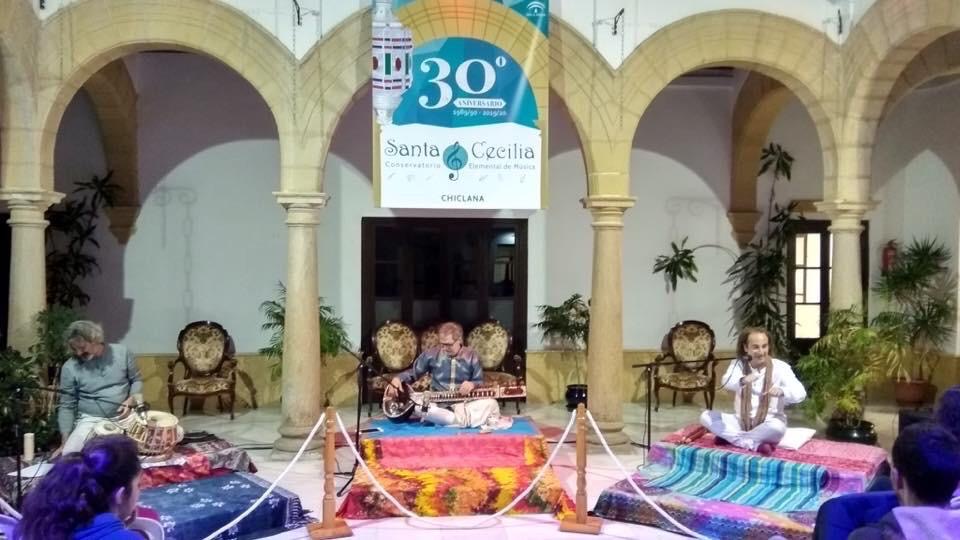
I was leading a concert with some Spanish colleagues in the Conservatorio Elemental “Santa Cecilia” de Chiclana de la Frontera: an amazing opportunity to play in the moorish patio of the Conservatorio.  Here’s a picture of us on stage at the venue (I’m in the middle with my sitar).

So I had the chance, or perhaps, the duty of introducing the concert to the audience of 200 or so people. It crossed my mind for about 10 seconds to chicken out and do it in English, asking one of my colleagues to translate … but it seemed too good an opportunity to miss.

The concert was on the Wednesday evening, so Tuesday evening I wrote in Spanish what I wanted to say, relying on whatever Spanish came into my head.  I’m guessing that because my Spanish had been ‘activated’ by the few days I’d spent in Cádiz I had little difficulty finding words for what I wanted to say.

I left it for a few hours and then came back to it, immediately spotting some ridiculous errors and then read it through to my colleague Nico – who is a teacher of both English and Spanish. 

Sentence by sentence, whenever he heard an error or had a suggestion he stopped me and minimally drew my attention to whatever needed fixing.  And that one read-through and our work on corrections was sufficient – I felt totally prepared for the speech and when the time came surprised everyone with the quality of my Spanish.  

What I wasn’t prepared for though was the effect that this work would have on my general Spanish.  

The day after, Nico pointed out a significant and immediate step up in the quality of my spontaneous Spanish. Interestingly, I, myself, was not aware of this improvement – for me it was just ‘how I function in Spanish now’. Though once he had pointed it out to me I had to accept objectively that there was a change, even though my own experience was that I was simply in a ‘new normal’.

I can’t help seeing this whole experience as corroborating evidence for some principles for teaching and learning language.  For example:

  • language really is learnt from use and feedback. In this case I had almost the perfect feedback combination: sentence by sentence correction and the felt response from a large supportive audience.
  • anything actually spoken (as opposed to written or read or heard) by a student has a special power. The act of actually saying these correct, meaningful sentences out loud to someone seems to have a transformative effect. It’s as if the act of speech activates and energises our language assimilating powers.
  • its important to work on every sentence until every sentence is correct and as good as it can be in terms of pronunciation. Everything we say leaves a trace in the mind and the process of correcting a sentence gives the mind new material to work on as it constructs a more perfect and more coherent mental model of the language. After all, the purpose of correction is to help students build that better mental model (and not to show how clever the teacher is … or to judge the student …). So its a bit of a waste in class if we don’t work on every sentence to this level of accuracy – what will the mind do with the trace of a sentence that’s only half-correct (or not correct at all)?.
  • let the student do the work and choose what they want or need to talk about – it’s them who has the burning need to express themselves and establish relationships with their auditors. That energy is theirs and our job as teachers is merely to help them channel that desire into more perfect language – perfect in terms of words, grammar, pronunciation and melody.

Finally, back to this curious fact that, once we’ve changed how we function in the new language we lose any awareness that there was a time when we didn’t ‘just know’ how to speak like this.  A ‘new normal’ is established almost immediately and the human mind seems to be unable to return to or recall the previous state.  

This is, of course, what babies do: we none of us have any recollection of a time before we could speak our native language nor of the steps to achieve our mastery of it.  It is a rather satisfying and reassuring feeling to be following the course that babies do in learning language, since babies ought to be our role models in language learning : they do seem to be rather successful at it …

Workshop on teaching English pronunciation, Cádiz, August 2019

Our workshop on pronunciation in progress.

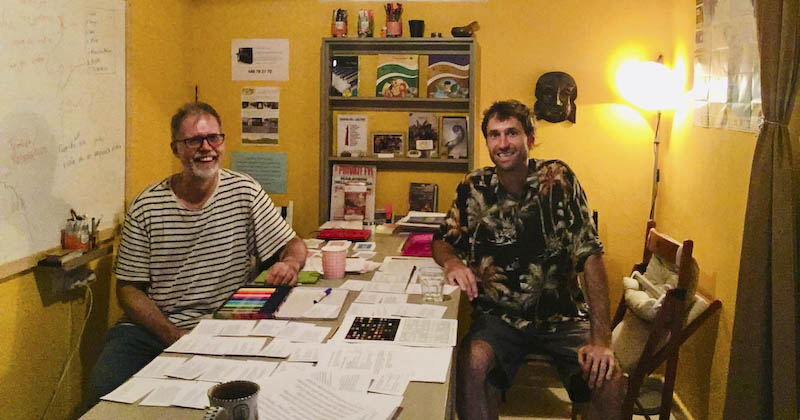
I was privileged to visit Nico Argentato’s language school in Cádiz again at the end of August 2019.  The main purpose was to share with Nico some approaches to teaching pronunciation in general, and specifically English.  We also took the opportunity to continue our research in how to teach Spanish pronunciation.  And, of course, I was privileged to work with some of the students there on their English.

The workshop was based around about roughly 85 ‘Questions without Answers’.  By that title I meant that the ‘answers’ have to be found by the participant or participants either because they have to find them for themselves (perhaps with some guidance) within their own mouths or bodies or from their own experience.

Some of the questions were very specifically to do with pronunciation, such as ‘Make an extended ‘ssssssss’ in Spanish and then make the similar sound in English … notice the difference in your mouth, the placement of the tongue, the point of constriction with the palate etc … and notice the difference in the sounds.’

The purpose of exercises like this is to sensitise oneself to how the similar but different sounds are made in the different languages by native speakers.  And thereby as a teacher be able to help students change what they do in their mouths – once they change what they do, they start to ‘escape the grip’ of their native pronunciation and step by step can sound more English (or whatever language they are learning).

Some of the questions were more general – how do we acquire skills and knowhow.  For example, how did we learn now to walk as babies? or how to ride a bicycle?, or how to play a sport? or a musical instrument?   Reflection on our own experience is incredibly valuable even if, as usually happens, we have little memory of the process by which we learnt these things.  And, of course, we can’t really say we ‘remember’ how to ride a bicycle or whatever – once we have learnt this knowhow we can simply do it when the situation arises.

What we find for knowhows like this is that they are learnt through doing and feedback from the results of our attempts, they are improved and made habitual through practice, and they are refined through use.  We also find that often a coach is needed to help us on our journey towards excellence, with the coach provoking awarenesses that there is something to be learned by the student, and providing guidance on things like: where to focus their work, specific exercises or practice to improve particular aspects of their performance, and how to keep in balance their overall development.  Above all the coach isn’t the one creating the learning or the knowhow – that is simply the person themselves. 

Since language, and specifically pronunciation, is clearly a knowhow, reflecting on matters like this helps us as teachers rethink our practice.  Languages should be taught as practical skills and absolutely not as academic subjects.  And teachers should stop ‘teaching’ and start ‘coaching’ instead.

Learning pronunciation and learning how better to teach pronunciation isn’t a linear task.  So we ran the workshop in a completely non-linear way – each ‘Question’ was printed on a card, and once we’d finished with working on a particular question we said ‘OK what aspect do we feel we should work on next?’ and then we looked for a card with a question that seemed relevant to that particular aspect.  And so we continued ranging freely over the entire subject.  A couple of times we reviewed the remaining cards and found we’d covered some of them already in our reflection on other questions.  And towards the end of our weekend we repeated this review to identify what still needed to be covered (which was surprisingly little).

An incredibly valuable weekend … hard work but very enjoyable.  We’re thinking of perhaps offering the workshop to others in the future.  But for now …  ¡Gracias a Nico por la oportunidad!

Discovering grammar – investigating Spanish texts

I’ve been following up this quote from Caleb Gattegno about how to discover the ‘functional vocabulary’ of a language:

… the functional vocabulary ie the items which generate the grammar of the language.  These items are the ones we find in any article or passage when we cross out most of the nouns, many of the adjectives and a number of the verbs; what is left refers to one’s self and to others in the numerous relationships of everyday life.  We can therefore decide fairly easy what to put on our list.

The Common Sense of Teaching Foreign Languages, C Gattegno 1976 p75

I was particularly interested in this idea because I wanted to discover what the functional vocabulary for Spanish was and how it related to the currently available Silent Way Charts with view to expanding those charts to support students to learn a wider range of the language (see also here).

I also thought it might help improve my Spanish, by showing me the grammar in practice, in actual texts.

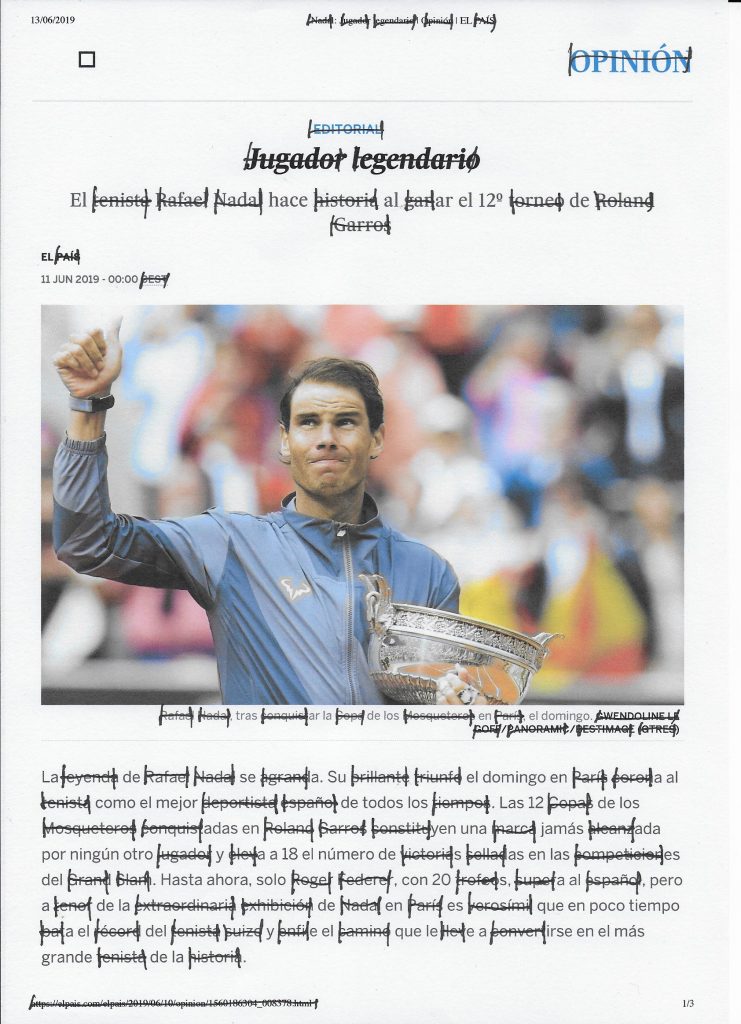
So I selected a series of articles from various sources and simply followed the advice given by Gattegno. I interpreted his suggestion as including treating as grammatical entities things like: the endings of verb conjugations, the endings of adjectives and nouns, and various prefixes and suffixes. I also decided to maintain some of the key triggers of grammatical elements eg numbers, days, time triggers etc. Here is the result for the first page of an article from El País

An article from El Pais analysed to find the functional vocabulary

What I found really interesting in doing this was:

  • how drawing attention to the grammar in this way did indeed improve, with almost no effort, my confidence and ease with Spanish grammar, helping me to connect together naturally and intuitively things like agreement between nouns and adjectives, causal relationships between parts of a sentence, the ‘internal climate or mood’ associated between different verb forms and time or mood ‘triggers’ elsewhere in the sentence.
  • where there were things appearing that I wasn’t sure of what was happening, I used my grammar book to confirm that these were indeed grammatical elements and not vocabulary elements and to lightly note the grammatical category they seemed to belong to. I didn’t particularly try to memorise these items, relying instead on the fact that if I saw something a few times, I would retain it automatically anyway.
  • extracting the elements that are left gives a fairly small set of words, prefixes, suffixes and endings, that enable the language to function and that we can use to test what words should be on a word chart
  • that the first text I analysed in this way gave me most of the functional vocabulary, the second added a relatively small set of additional elements, and by the time I reached the eighth or ninth texts, whilst there were new items cropping up, they were fairly few and far between.

On its own, this would be a useful exercise for anyone wanting to improve their skills in any foreign language, because it would give them an intuitive sense of the totality of the grammar of that language in real life use. It’s also enjoyable if you pick texts that you’re interested in. For exactly this reason, I’m planning, when I have time, to do exactly the same thing for French and for Hindi.

For me, the main benefit was the list of grammatical elements that I now have which will inform my understanding of what should be on a set of Silent Way charts for Spanish. A huge amount of learning for a very small amount of enjoyable effort!