A tool to help students practise their sentences

Read this blog post to see a new tool to help students practise and build an intuitive sense of a foreign language, one sentence at a time. In this case the foreign language is Japanese but the principles apply to any language.

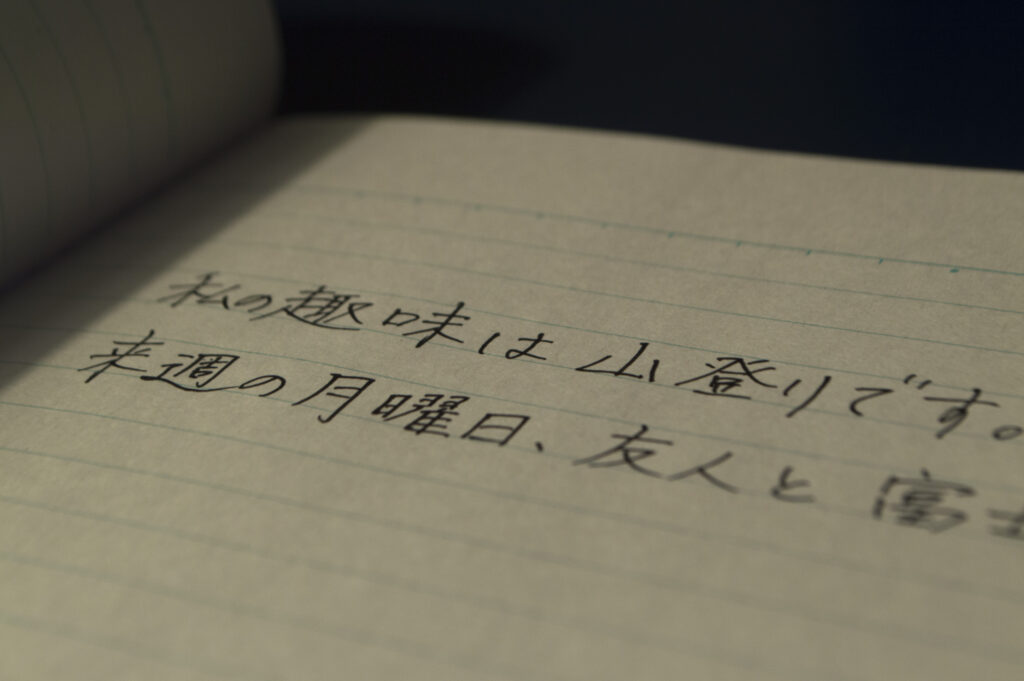
Once a student’s sentence is correct they need to practice that sentence a few times to consolidate the work they’ve done, and to improve their control over the muscular actions’ needed to actually say the sentence. And once they reach the stage of working on writing, the tool described in this blog can increase the learning they gain from each sentence, whilst still keeping the emphasis on speaking.

A tool for Japanese

This video illustrates a simple app which students and teachers can use to support this kind of practice in Japanese lessons. This app is a development of a similar one for roman script languages (see here) but with special features necessary for Japanese. These apps work in the online whiteboard application Miro but could easily be adapted to other environments.

Experience of using the app

I’ve used this app in several lessons now. I really like using it to get extra practice with each sentence.

  • I launch a sentence and then with help from my teacher, I get it correct orally. And then I say it again a couple of times till it’s feeling a bit easier.
  • Then I try to write it, giving me further practice getting the sentence right as well as getting some Japanese writing practice.
  • Then I can add furigana where I need them giving a little more practice relating kanji characters to their pronunciation in the particular context of each sentence.
  • Then I can hide the sentence and try to recreate it, with the tool’s features giving me help if I need it.
  • Then we can work on the melody of the sentence.
  • I can visually ‘draw’ my hypothesis as to that particular sentence’s melody and get feedback from my sentence. ‘Committing’ to a hypothesis and getting feedback is a really fast way to make progress.
  • Once the melody is correct then I can try to say the sentence and get more feedback – it is more than possible to have the correct mental image for the sentence but still not be able to actually produce that melody.
  • Sometimes I manage to produce the correct melody, but it is over-careful and sounds a bit robotic, so my teacher can give me feedback and I can try it again.

As you will have seen from the video, we spent some ten minutes on this one sentence in my lesson. I don’t think this was too long! As the video shows I was focussed, interested and working the whole time. At this stage of my learning I want to get the maximum value out of everything we do in my lessons. And practising everything properly really helps me build an intuitive sense of the language, one sentence at a time. My experience with using the app is that it has markedly accelerated my progress, certainty and confidence in the language.

What’s more once the students have generated a series of sentences, you can use this tool to help students recreate a whole ‘paragraph’ – the collection of coloured sentence boxes can be obscured and individual parts revealed to ‘jog’ their minds about the story. And then they can try to retell a whole story more fluently and more expressively further consolidating their learning and moving from working on individual sentences to more extended speaking.

Tools like this one also work well in classes with several students since when someone else is trying to write and practice a sentence that they have created everyone can see their work, any problems they have, and collaborate to fix things. Also others can then try to recreate the sentences, adjusting the grammar to their perspective, as needed.

Some caveats

It is tempting for students to reach for writing a bit too early. It’s better to really establish the sentence orally first and only then use writing to consolidate what has already been worked on. Writing and reading should always be secondary to the spoken language.

This is definitely not the best way to learn kanji (Chinese characters) or the Japanese writing system more generally, though it does support that process. Separate work is certainly needed to learn the skills involved.

Retelling a story for fluency and ease

Speaking a language is a skill, ‘procedural knowledge’, so like all skills we have to practise it if we want to achieve fluency and ease combined with accuracy and precision. Watch this video to see an example of the process at work.

One of the best ways of expanding your speaking skills is the Class Conversation. It’s a very simple technique. You and your classmates talk about whatever’s on your minds, and your teacher works with you until every sentence is correct, well said and properly practised. Nothing is written down – all the work is entirely oral and aural since improving speaking is the goal. If you want to get extra value out of this, you can add another step. In your next lesson, tell again whatever you recall of last time’s stories.

This isn’t an exercise in ‘memorisation’, nor even ‘recall’ really – though there is an element of recall in it, of course. It’s more re-creation: you already have recent mental images of whatever was talked about, and you have to create sentences that express those images. You can build on, and build from, what was achieved last time and thus consolidate and extend the learning.

Watch this video to see how this worked out in a recent Japanese lesson. In my lesson the week before, I’d found out about my teacher Sumiyo’s recent trip to Paris. And that had led to me talking about the problems that the Musée de Louvre had recently had. And then, as conversations do, I’d digressed to talking about a trip to Paris that I hoped to make in 2026.

The week after, I decided I wanted to practise by re-creating what I’d worked on the previous time. Here’s the video showing extracts from that second lesson:

Work like this cumulates. Practising talking well about one thing means that the next conversation becomes just a little bit better and a little bit easier. And gradually your skills build, leading to better quality speaking and improved fluency. It doesn’t happen overnight, but it doesn’t take for ever.

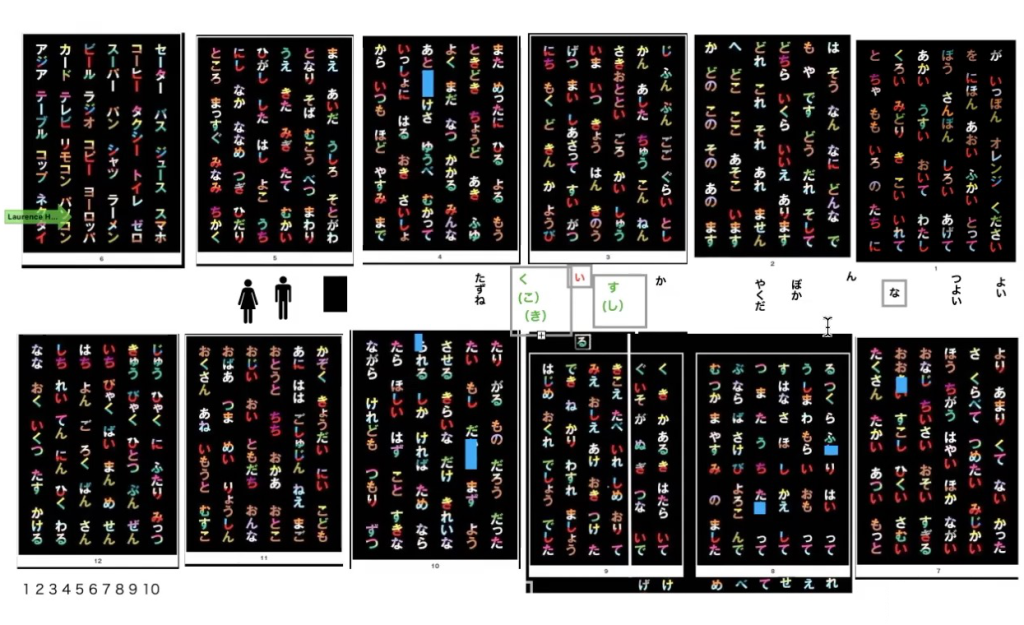
This video also illustrates another useful technique. At about 2 mins 21s into the video I use the word charts (these show the functional vocabulary of the language) to stabilise a sentence I’m working on by pointing on the charts. This pointing process slows everything down and makes sure that my grammar is accurate and secure: there’s no fudging or slurring over details when you do this. And this means I have an accurate, stable platform from which to build towards fluency, ease and speed ie the ability to say my sentence well, and with less conscious control.

Visiting Japan, Autumn 2025 

Find out about our latest project which will showcase efficient and innovative techniques to teach students to speak a foreign language confidently and well. And, of course, I’ll also tell you about the opportunities I’ve had to speak Japanese whilst I’ve been here!

It’s my last day in Hiroshima. I’ve been here for just over three weeks, working on a project filming some of the English classes that Don Cherry gives at Hiroshima International University. The aim is to document how he teaches spoken English in this context: ie to large groups of students who have studied English at school for several years but never really spoken it. 

Hiroshima Heiwa Kinen Kouen (Peace Memorial Park, Hiroshima)

You can’t come to Hiroshima without visiting the Peace Park (Hiroshima Heiwa Kinen Kouen) and thinking about what happened here 80 years ago. So here’s a little video from the Park. 

Speaking Japanese

Of course, being in Japan means I’ve had more chances to speak Japanese. And its been great. For practical, everyday purposes I seem to be able to say whatever I want, people seem to understand me, and with a slight mental delay I seem to understand them. 

I’ve had extended conversations in Japanese with several people on interesting topics like art, learning languages, teaching music, growing trees etc. And in shops and restaurants; or catching trains and street cars; or visiting museums, parks and gardens; the words these situations call for seem to arise quite naturally and easily. Things like: 

  • ‘Is there an ATM here?’ 
  • ‘Is this the South gate, or the North gate?’ 
  • ‘How do I pay for my ride?’ [on a street car] 
  • ‘Either is fine’ [when asked if I want a window or aisle seat on the Shinkansen]
  • Q: ‘Is it winter in Scotland now?’ My answer: ‘No it’s Autumn, the same as here.’
  • ‘Is everything in this restaurant really gluten free?’ [The answer was ‘Yes, except for the beer’]
  • ‘Is this restaurant open every day?’ ‘Which days are you open?’ [The answers were: ‘No only three days each week’, ‘Saturday, Sunday and Monday’]
  • ‘Which of these houses is this address? (Pointing to the address on my phone) etc

I don’t suppose I could talk about the political thought of Karl Marx or Kantian philosophy in Japanese but then I probably couldn’t do that particularly well in English.

It all feels very natural and familiar

None of this is particularly surprising. It all feels very natural and familiar because for the last couple of years our online Japanese lessons with Silent Way Tokyo have all been about expressing well whatever happened to spring spontaneously to mind: things that had happened either recently or long ago, things that interested me or I’d recently discovered, current problems or challenges, news of friends or relatives etc. Our lessons aren’t led by the teacher or a textbook; the content comes entirely from us, the students. And the teachers help us sentence-by-sentence, until we can say what we intend to say, accurately and well. And then they make sure we practise, so that what we’ve worked on begins to ‘stick’. And we’re always working on speaking: we never read out sentences or dialogues, or memorise little set speeches or routines.

So that’s why I’m ready to spontaneously start talking and responding, in the moment, to whatever crops up.

Here’s a brief video of me speaking impromptu to one of the classes we video’d, thanking them for giving us the opportunity to film them. It’s not the most elegant speech, and there are several things I meant to say that I forgot to: exactly as I would in English if I stood in front of thirty two 18-year old university students to speak without notes, at the end of their last class, on a Friday afternoon.

What’s next for our project

There’s a lot of work now to do on the footage we took. We filmed eleven full, 90 minute lessons each with several cameras to give multiple points of view on the action and we interviewed the teacher six times to find out what he was trying to do in each lesson, why he emphasised certain things, what things he was less happy about, how he managed and organised teaching some 180 students in several classes and, more generally, to understand his whole approach to teaching English.

One of the most interesting things that we did was to film the same class over three consecutive lessons. This means we’ll be able to show how the teacher built the work from lesson to lesson over three weeks, how the students’ speaking progressed over the series, and how these three lessons will fit into the direction of the whole course.

What we’re aiming for

The goal is that other teachers can see Don Cherry’s approach and the techniques he uses, in practice, in real classes. This will give the viewers practical ideas that they can borrow, develop, adapt and apply in their own courses and their own context. Whilst we’ve filmed English classes, this approach and the techniques Don has developed over his 30 years of experience teaching in this context can be adapted, re-invented and applied to teaching any language.

The edited video series will start appearing early in 2026.

Thanks to Don Cherry, colleagues at Hiroshima International University and all the students involved.

Working on bonsai

Learning how to express your ideas well in a foreign language takes time, but if the work is done well then your skills accumulate, and the range of what you can say gradually expands

This video logs my progress in Japanese. The footage comes from a ‘tell me’ lesson I had last week (August 2025).

The idea of these lessons is that:

  • I talk about whatever springs to mind at the moment
  • My teacher gives me immediate feedback sentence by sentence and we work on that sentence until I can express my thought well.
  • And then we move on to the next idea that occurs to me

This video edits together these final sentences to show the story that I told in the lesson.

Often, the work on each sentence is improving pronunciation, especially my ‘pitch accent’, or melody and flow.

Or, especially with more complex ideas, I go through a series of attempts to formulate and reformulate my sentence, until we are both satisfied that it expresses my idea well. And then I practise it by saying it again a couple of times: speaking a language is as much a physical as a mental act, and this kind of practice helps secure the ‘mental trace’ of the work we’ve done.

My teacher guides me in my experimentation, gives feedback on my attempts and provides missing vocabulary. This lesson was typical in that there was hardly any new vocabulary – I think there were probably only two words I needed that I didn’t already know (ie ‘orientation’, and ‘to plant a cutting’).

The functional vocabulary

Because we’ve done so much work on the functional vocabulary the grammatical work was either correcting slips, or, mostly, finding the best grammatical form for the nuance of what I want to say.

The functional vocabulary is special – it’s the little words and endings that express every type of relationship. These form the majority of words in any sentence (whatever the language) and mastering their use is the key to making coherent, correct, accurate sentences. They are best learnt through use – translation, rules and explanations don’t help and probably hinder. But there aren’t many of these words, and they are so common that working on them first when we learn a language gives us a head start over content-vocabulary-heavy approaches.

Here’s the chart with the functional vocabulary of Japanese (plus some common adjectives, verbs and English loan words) that we’ve been using in our lessons since I started learning a few years back: as you can see there aren’t many of them.

The skills to express yourself accumulate

It’s in the work I do on each sentence so that it expresses my ideas well that the learning takes place. Each sentence worked on gives my mind new material to integrate with what I already know; and everything accumulates so that week by week I can venture a bit further.

Thanks a lot to Silent Way Tokyo for teaching me!

The best sentence ever said in a language class

It’s always tempting to push the conversation on even though what’s just been said could still yield some more important learning. After all: the learning happens in the gap between incorrect and correct sentences.

In my Japanese lesson earlier today, I’d said a sentence and with help from my teacher I’d corrected it and the conversation had been about to move on. But my classmate stopped the action by saying what became, after a bit of work, the following:

さっきの間違った文をもう一度いいて下さい。

(Please repeat the incorrect sentence from earlier.) 

I’d vote this the best sentence ever said in a language class because:

a) the repetition of the original version of the sentence made absolutely clear what the difference between the incorrect and correct sentences was.  

b) by ‘stopping the action’ we were able to extract just that bit more learning from what had just happened. 

c) not only that, of course, the work to say correctly this rather complex new sentence itself yielded a lot of new learning.

It’s always tempting to push the conversation on to the next thing even though what had just been said could still yield some more important learning.  

After all: the learning happens in the gap between incorrect and correct sentences.

In praise of illiteracy in a foreign language

The experience of learning to speak a language which you cannot read or write is suprisingly liberating — childlike, even. And seems to bring with it an enhancement of our memory capacities.

Japanese writing – Takashi Mukoda (see below)

What does it feel like to be illiterate in a language you begin to speak quite well?  This must be what young children feel like, when they chat away in their native language before they start reading.  And this must be what everyone feels like in a community whose language isn’t written down, or isn’t usually written in normal daily life.

As most of us in literate societies, I’m so used to writing and reading in English, and find it so easy to do without thinking, that it is hard to mentally place myself back in that pre-literate state. 

Learning through speaking

But, I’m lucky!  Learning Japanese with Silent Way Tokyo means I’ve learnt it almost exclusively through the spoken language.  This means I that even though I’m beginning to be able to express myself reasonably well in Japanese, I am almost illiterate in the language.  

Which feels surprisingly liberating – childlike even! In my lessons, I get to tell my stories, ask questions of others about things I’m curious about, and describe everyday events.  All without the need for note-taking, writing down of phrases or sentences, or reading of texts, dialogues or articles. 

And I’m surprised at how most of the words and patterns that I experience in this illiterate state stick in my mind, and how the memory of them seems to strengthen, rather than decay over time.  In fact it feels as if, learning this way, I’m experiencing something akin to the much-admired memory capacity of unlettered peoples, albeit on a smaller scale.

All this makes me even more inclined to advise language learners to throw away their notebooks, and immediately become more childlike as a result.  You don’t need to write things down to remember them. Indeed as Plato has Socrates argue:

You … have … attributed to [writing] quite the opposite of its real function.  Those who acquire it will cease to exercise their memory and become forgetful; they will rely on writing to bring things to their remembrance by external signs instead of their own internal resources.  

Plato and Walter Hamilton. 1973. Phaedrus. Harmondsworth: Penguin. 275

Afterword on Japanese

Japanese has one feature that makes it particularly well suited to getting this ‘illiteracy experience’: its writing system is extraordinarily difficult to learn.  Difficult even for Japanese kids, and they start with the advantage of already knowing the language.

So for the student of Japanese, offered the opportunity to learn the spoken language by speaking, there’s not much temptation to try reading and writing.  At the initial stages of learning the language, why would anyone give themselves the exhausting, frustrating and seemingly endless task of learning thousands of kanji and how they combine to represent vocabulary?  

Especially if you are given the alternative of learning how to express yourself freely and spontaneously orally?  In other words, the opportunity to behave just like children in that society do: learn to speak and only then learn writing and reading.

Actually, I do intend to learn to write and read in Japanese — indeed I’ve already experimented with how to do it (see here) — and I know it’s going to be easier, less exhausting and more efficient to do once I’ve learnt how to express myself orally at roughly the level of the average six-year-old. At which point, I’ll start to work on it more consistently.

And other languages?

The difficulty of the Japanese writing system creates a big incentive for people to learn with a ‘speaking first’ approach … but, of course, the other benefits — a childlike experience and improved memory — are available to anyone learning any language no matter what it’s writing system is like.  And it really is worth the experience …

So, throw away your notebooks and text books and guided readers and start really learning through speaking!

Image by Takashi Mukoda https://www.flickr.com/photos/138667019@N07/25162292173/in/dateposted-public/, CC BY-SA 2.0, https://commons.wikimedia.org/w/index.php?curid=47528402

Using our muscles the way natives do

Changes of pitch are essential in Japanese in just the same way as stress is in English.  And, for me, it’s the hardest thing to learn.  I get more feedback from my teachers, by far, about this aspect of my Japanese than any other.

On the face of it, it shouldn’t be too difficult.  Broadly there are only two pitches to worry about — higher and a lower.  

Nevertheless, my pitch accent tends to be inaccurate even when I’m certain of what I’m supposed to be doing.  And I find it hard to retain a mental image of the pitch pattern for a particular word.  Probably the reason it’s difficult is that Japanese pitch accent is alien, or perhaps even contradictory, to English.

I’ve been helping myself by using my finger to ‘conduct’ the ups and downs of my words and phrases. ‘Embodying’ the patterns like this has helped me get closer to what I’m aiming for.  Here’s what that looks like:

Using the finger for pitch accent – not recommended!

But … 

A few weeks ago I decided I was still too inaccurate, and I felt I was continually getting ‘stuck’ half way through a phrase and  that I’d reached a ‘speed block’.  By ‘speed block’ I mean the same thing that musicians experience when they can’t increase the speed of a passage without errors creeping in.  Usually this happens because they are using the wrong physical mechanism — one that might work at slow speed, but is impossible at the target tempo.

Knowing this made me think that perhaps I’ve been doing the same thing. Maybe I’m using a mechanism which is poorly-adapted to the task of stringing together Japanese-shaped sounds and syllables?

Now it’s blindingly obvious that no Japanese speaker uses gestures with their finger to control the pitch of their voice.  And it is equally blindingly obvious that they probably use the same mechanism as we all use when we sing.  

So, I decided to stop using my finger as ‘conductor’ and instead use the kinaesthetic sense of my vocal cord muscles to ‘embody’ the pitch patterns I’m aiming for.  And after a bit of practice several curious things emerged.

I realised that I had been using more than a hint of English ‘breath push’ to raise the pitch on the high syllables.  Something that is impossible to sustain: these breath pushes are designed to stress one syllable and allow the rest of the utterance to be mumbled.  Trying to use it for Japanese pitch is certain to be exhausting.  Also the pitch changes that resulted were a lot wider than they needed to be, making my voice seem choppy and spoiling the flow.

I couldn’t help thinking that the apparently-helpful hand gesturing was occluding my awareness of the language and what I was actually doing.  And once that was out of the way, I might see things more clearly.   

Did it work?

For my next lessons I decided to relocate my pitch awareness from my hands, to where it ought to be — in my vocal cord muscles. And, yes, I got far less feedback on pitch accent from my teachers. What’s more, I noticed that more cognitive capacity seemed to be available to me to think about what I wanted to say.

I noticed that the ‘mental trace’ left by hand gestures was weak and vague compared with that left by consciously-exercised vocal chord gestures, which seem very definite, very efficient and clear.

One thing that should be said.  I suspect that many people might find it difficult to locate and become aware of their vocal cord muscles.  I was lucky because I had already trained myself in this skill for singing.

It isn’t completely straightforward to control the voice in real-time in this way.  It requires a degree of heightened concentration but once its been practised I’m expecting it should start to operate automatically.  And I should only need to exercise conscious control for new things or things I find difficult.

Some things to think about

  • putting our attention on physical/muscular gestures can help us improve our pronunciation 
  • it’s better to seek the actual mechanism that natives use (or one close to it) to ‘embody’ those patterns
  • concentrated work over a period is needed to establish new patterns of use like this
  • hand gestures especially should be kept for what they are actually for — helping organise our ideas, empathetic gestures, pointing, accompanying our meaning with mime-like movements, emphasis etc

Learning Japanese with the Silent Way: ‘Tell me’ lessons

‘Tell me’ lessons are one-to-one lessons where intermediate language students talk about whatever occurs to them, and the teacher helps the student express their ideas in correct and natural language.

In my case, usually the topic is completely spontaneous and I always talk about something that’s real and important for me at that moment.

My teacher works with me sentence by sentence.  She uses the feedback cycle to help me correct my sentences.  And sometimes I ask for vocabulary that I don’t know. That means that at the end of that process for each sentence, I can express what I wanted to in correct, well-pronounced Japanese, and do so with a degree of facility.

It’s worth saying that my sentences don’t get written down: each sentence remains something spoken—ephemeral and created in the moment. 

One of my teacher’s jobs is to keep pushing me forward, so, if she notices that I’ve become reasonably confident with a basic way of expressing an idea, then that’s probably the moment she’ll decide to ‘version up’.  Or, as my pronunciation improves, she will ratchet up the standard she’s looking for.  That way I’m always expected to move forward.

The process of moving from initial attempt to final version can take a considerable amount of time, but this is to be expected, and this is where the learning lies.  It’s the work I do to correct my sentences, reassemble them and practise saying them that drives my learning.

One of the main advantages of working this way is that the content of the lessons is provided by me, and the language—grammar and vocabulary—is entirely driven by what I happen to decide to talk about.  Another advantage is that the standard of what I’m expected to achieve keeps rising, so I’m always moving forward.

But these advantages also make it difficult to have a sense of my progress.  (Having said that most of the text book ways of students judging their progress are a bit stupid “we’ve ’done’ the present perfect”; “we’ve ’covered’ unit 3”; “I got 6/10 in a grammar test”.)

So the purpose of producing a series of videos of these lessons is to make it easier to see my progress.  

By editing the final versions of each sentence into a watchable video, and omitting all the work of correction and practise, I’ll show just the final ‘story’ that I told in each lesson.

What I hope is that, over the months and seasons, this will show how, gradually:

  • I can speak more and more freely about a widening range of things
  • the expressive range of what I can talk about widens and deepens
  • that I can use the more complex sentences that genuinely talking about these things requires
  • that my pronunciation and my facility improves

As a by-product, editing these videos will mean I get to review each of these lessons and it’s likely that this will help to further embed the learning from each one.

I’ll be adding these videos as I make them to the series ‘Learning Japanese with the Silent Way’. Please check them out!

Does ‘immersion’ advance your language skills or consolidate what you’ve already learnt?

I reflect on the experience of visiting Japan for a documentary we’re making and the effects I think it’s had on my Japanese.

Street scene with Tokyo Tower

For most of October I was in Japan working on a documentary project we have in hand. This gave me an opportunity to see how I could manage my everyday business in Japanese – buying basics, talking to the host of my Airbnb room, getting from A to B, buying tickets, asking for directions, conversations with friends and strangers.

I was pleased that I managed to get by quite well in Japanese for these everyday practical things. Summing it up, I got lots of opportunities to practise my Japanese, I had to think on my feet and I gained some confidence from experiencing that my Japanese did actually ‘work’ in practice.

But there aren’t many new things that I feel I learnt from the experience … a few new words, some new uses of words I’d used before, and familiarity with a few new kanji (Chinese characters).

In fact talking Japanese in Japan felt pretty unremarkable—just something I seemed to know how to do—not particularly hard work or demanding. Thanks to the way I’ve been taught by Silent Way Tokyo.

So, this makes me question the commonly held view that ‘immersion’ is the way to improve your foreign language skills. Is ‘immersion’ as efficient as it’s made out to be? It feels to me much more like my experience was what Anders Ericsson described as ‘naive practice’ ie just doing what you do anyway, as opposed to ‘purposeful’ or ‘deliberate’ practice.

I suspect this might be because I didn’t get much, if any, linguistic feedback from natives—they either worked out what I meant from what I said (sometimes after a couple of tries), or they didn’t. And if they didn’t, then mostly they resorted to body language and pointing or they ventured into English … Except for rare occasions, I don’t think I got much of the kind of feedback that would be needed to ‘version up’ my Japanese.

That’s not to say that visiting a country or this kind of ‘naive practice’ is a bad thing—it clearly isn’t—it’s just that if your goal is to improve, then there probably are more effective ways of using your time.

Why getting things wrong is a great way to learn

Trying and getting things wrong – even things students couldn’t possibly know – is a great way of learning. Trying first, potentiates deeper learning: providing students get immediate feedback and the chance to correct what they first tried.

Watch this video (3m 42s) from one of my Japanese lessons (click here).  You’ll see me trying to say a sentence, and making various attempts until I arrive at a correct version.  You don’t need to know Japanese to see what’s going on.  

What you’ll see is a process of trial and error, intelligent guessing and immediate feedback.  This is potent, far more potent than a teacher just giving a model and the student copying a correct sentence, or being given the correct answer straight away, or not getting any feedback on the grounds that the first attempt was ‘comprehensible’ anyway.

Intriguingly, research findings show that trying to answer a question powers learning, even when the student provides a wrong answer, and even if they could not possibly know the correct answer.  Just trying to answer is sufficient – if, but only if, feedback is provided immediately, and the student gets the chance to correct their attempt.  On the other hand, it seems that if feedback is delayed then the student’s error is strengthened (Hays, Kornell, & Bjork, 2012)

As Roediger and Finn stated in Scientific American (2010):

‘Getting the answer wrong is a great way to learn—as long as you receive the correct answer shortly afterward.’

This research helps to explain why one of the cornerstones of teaching languages using the Silent Way – trial and error and immediate feedback  – works so well.  And why delaying (or not even giving feedback) is a poor idea.

It is sometimes argued that teachers shouldn’t correct students’ attempts, presumably because people think this will stop students’ ‘flow’ and may demotivate them.  And Krashen argues that error correction is ineffective for acquisition and should only be used in very limited circumstances (written work and grammar exercises). 

‘Acquisition occurs, according to the input hypothesis, when acquirers understand input for its meaning, not when they produce output and focus on form.’

Krashen (1982, p117)

But done the right way it is the most powerful tool in a teacher’s pedagogic tool kit.  

Have another look at the video.  And ask yourself questions like: What was the teacher doing? What was the student doing? What was the other student doing? How much time was being taken? Was it well spent?

For example, you might see some of the following:

  • in the space of about 3 minutes, I launched my sentence and over the course of eight attempts eventually arrived at a correct version
  • As well as body language and tone of voice, my teacher used her fingers to pinpoint where the problems were, showed me where to look on the wall charts to find a word I needed, and hummed the rhythm and melody of a phrase
  • The process of arriving at the correct sentence was one of discovery, with me sometimes introducing new incorrect possibilities as we proceeded
  • Nothing was written down and my teacher didn’t give me a model to copy

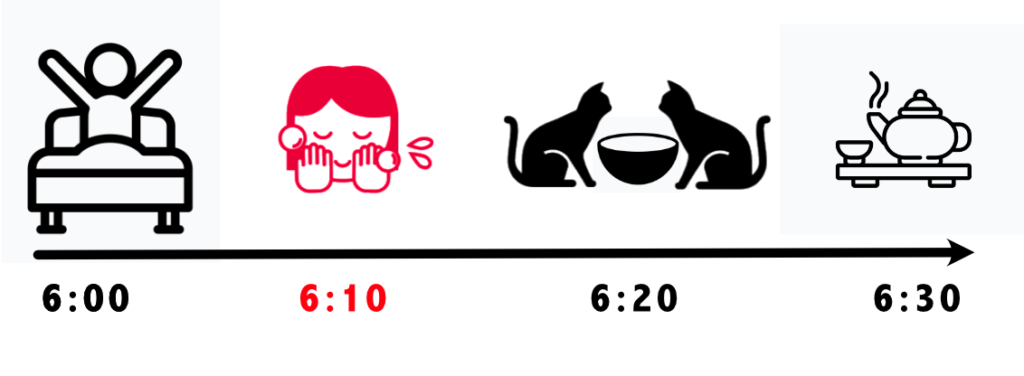
What you don’t see in this short extract is what happened afterwards.  As a result of this few minutes work, both my fellow student and I were confident saying this kind of thing, and we easily extended the descriptions to encompass all the items of Yoko’s typical morning and our own.

What’s more, my fellow student then felt emboldened to try experimenting with ‘before drinking Japanese tea …’.  Which meant that we discovered this doesn’t work in quite the same way.  But it didn’t take long, through exactly the same kind of process, for us to grasp how to say things like ‘before drinking Japanese tea/before feeding the cat/before washing her face …’.

All of this is now ‘obvious’ to me – indeed, watching the video again it seems weird to me that a few days ago I should have had such bizarre ideas about how this kind of thing might be said. In other words, the process of exploration, feedback and discovery has added another firm detail to my Japanese mental equipment.

References:

Hays, M. J., Kornell, N., & Bjork, R. A. (2012, May 14). When and Why a Failed Test Potentiates the Effectiveness of Subsequent Study. Journal of Experimental Psychology: Learning, Memory, and Cognition.  https://bjorklab.psych.ucla.edu/wp-content/uploads/sites/13/2016/07/Hays_Kornell_RBjork_inpress.pdf (accessed May 29 2023)

Krashen, S.D. (1982). Principles and Practice in Second Language Acquisition. The Modern Language Journal, [online] 67(2). doi:https://doi.org/10.2307/328293.

Roediger H. L. III, Finn B., Scientific American, (March 1, 2010) https://www.scientificamerican.com/article/the-pluses-of-getting-it-wrong/ (accessed May 23 2023)