This blog entry illustrates what can be achieved in about a year and a half of learning Catalan from scratch using the Silent Way.
This video extract comes from an English lesson I gave to a group of colleagues from Catalonia. I started the lesson by telling them something in Catalan about my plans. It’s not something I would normally do – our lessons are about them expressing themselves and their lives in English, so usually I avoid taking up time speaking.
On this occasion I made an exception because:
I needed to be absolutely certain that everyone had understood the practical message – ie that our regular weekly lesson was cancelled for the following Thursday. And I thought a good way to do that would be to tell them in Catalan, and then make sure they’d understood by getting them to explain what I’d just said in English. I hadn’t prepared a ‘speech’; I just relied on the Catalan skills I’ve developed so far through our Catalan course.
I could have explained in English, but that would have made their task a lot easier – they’d have already heard these ideas expressed in English. So the good memorisers in the group could simply repeat back the words and phrases I’d used. I didn’t want them copying – I wanted them to create their own English sentences.
The lesson then proceeded as normal – the students generated sentences about the situation and posed questions they were curious about. We worked on each of these sentences until they were correct and natural and well-pronounced and then the students practised saying them. I answered their questions in Catalan. And then they explained the new information about the situation in English.
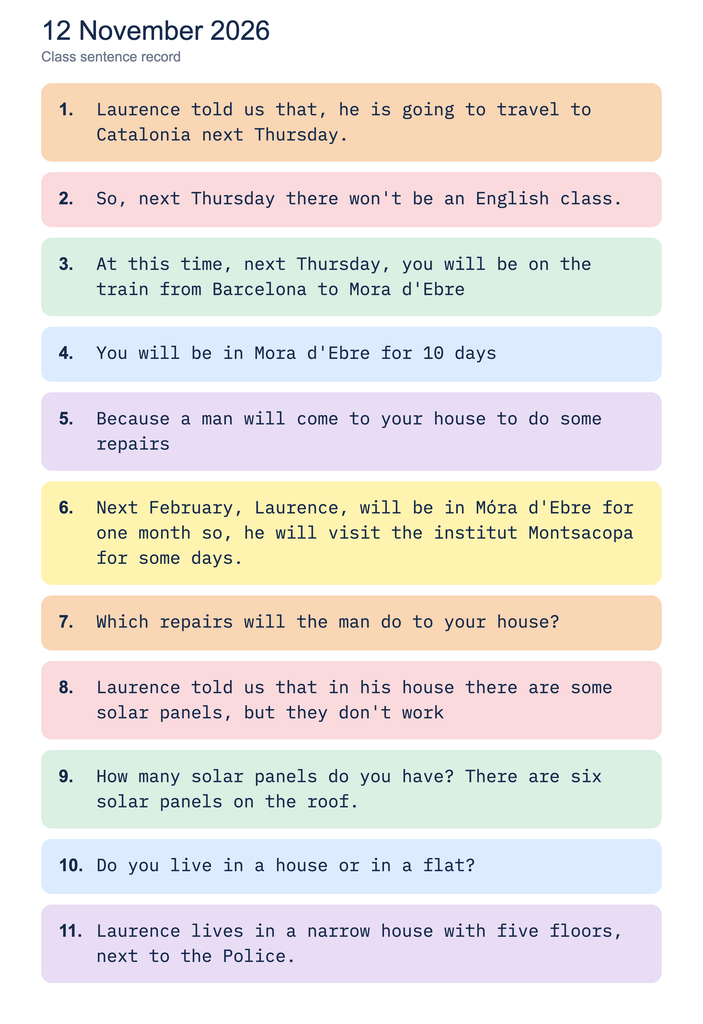
Once their sentences had been well-practised orally they wrote down most of them, getting a little more practice in the process. Here’s the record of the sentences from the lesson.
What can be achieved if you focus on quality
Here’s the video extract of me talking in Catalan which started off this English lesson. It illustrates what can be achieved in about a year and a half of learning a foreign language starting from scratch.
Three of us have been following this Catalan course together and we’ve had 65 hours of lessons, all online, using the Silent Way. All of us show the same degree of spontaneity and ease in speaking the language. (For another example, check out this blog entry from last week.)
For me the reason this approach has worked so well is that:
we’ve focused on quality all the way through – this means that students develop inner certainty about the language and this frees them to express themselves orally with confidence
we’ve practised saying every sentence several times – practice like this means that students’ muscles and mouths and minds get used to assembling their sentences and ‘getting them out’ with ease
It’s quite straightforward: skills have to be practised to become easy and fluent, but it only makes sense to automatise things that are correct.
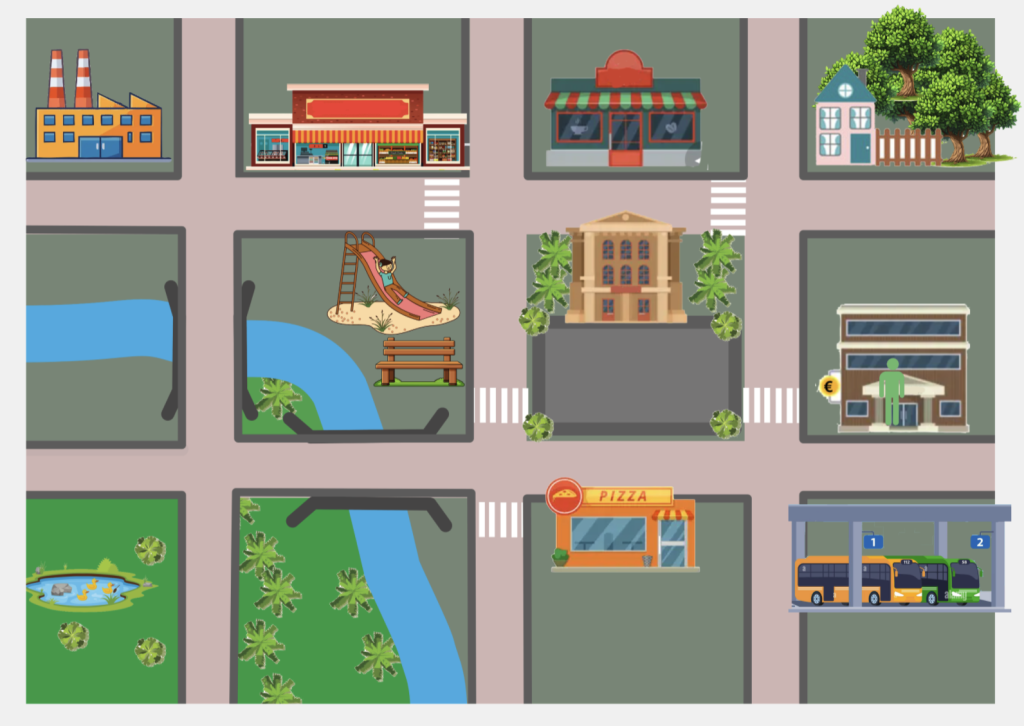
Read this article to find out how we’ve been using a simple floor plan of a town to help students express themselves creatively in a foreign language
This plan provides a useful focus for a language class at intermediate level. We used it with our classes at school in Catalonia a few weeks ago. One of the great things about this is that you can work at whatever level the particular class can handle. Things like:
‘What’s in this town?’ ‘There is a river and a park in this town’
‘Where is the town hall?’
‘Jaume goes out of his house, turns right, crosses the zebra crossing, goes through the square in front of the town hall etc’
‘The streets are dangerous, so you have to cross using the zebra crossings’
‘There isn’t a school in this town so the children have to take the bus every morning’
‘Usually Jaume goes to work in the factory on foot, but if it’s raining he takes the bus’
The town plan has advantages over a static picture, because, simply by moving things around on the plan, the meaning of what’s being said can be made clear. What’s more students can be active by illustrating the actions on the board, by giving instructions, and by asking questions of each other.
Using the plan in the classroom
We used ‘El Poble’ (the town) in our classroom at school in Catalonia a few weeks back producing some impressive language.
Here’s an example led by one of the students:
“Soc en el bar. Estic pensant que fer al llarg del matí. Aniré al banc per treure diners, i després aniré a l’Ajuntament per fer els documents, i després tornaré a casa.”
Q: Perquè treuràs diners? A: Per comprar un cotxe nou Q: On aniràs amb cotxe nou? A: Aniré a Xina
“I’m at the bar. I’m thinking about what to do all morning. I’m going to the bank to get some money, and then I’m going to the city hall to get the paperwork done, and then I’m going home.”
Q: Why are you going to get some money? A: To buy a new car Q: Where are you going to go with the new car? A: I’m going to China
This conversation then continued with everyone else in the class telling us where they would go with a new car …
Using the plan online
We’ve also used the plan online in our lessons. Watch the video to see how we took the conversation in our own completely different direction.
In fact what we did in this example built directly on the work we’ve been doing recently with the Catalan verb system – our conversation naturally got us to tell a story ranging across a series of different tenses and verb forms.
Conclusion
This is an example of how you can use really simple tools like this to help students expand their range to express themselves better in a language – it’s completely different from exercises and filling in the blanks and learning grammar.
Read this post to find out how we’re developing a visual model to help students get to grips with the Catalan verb system
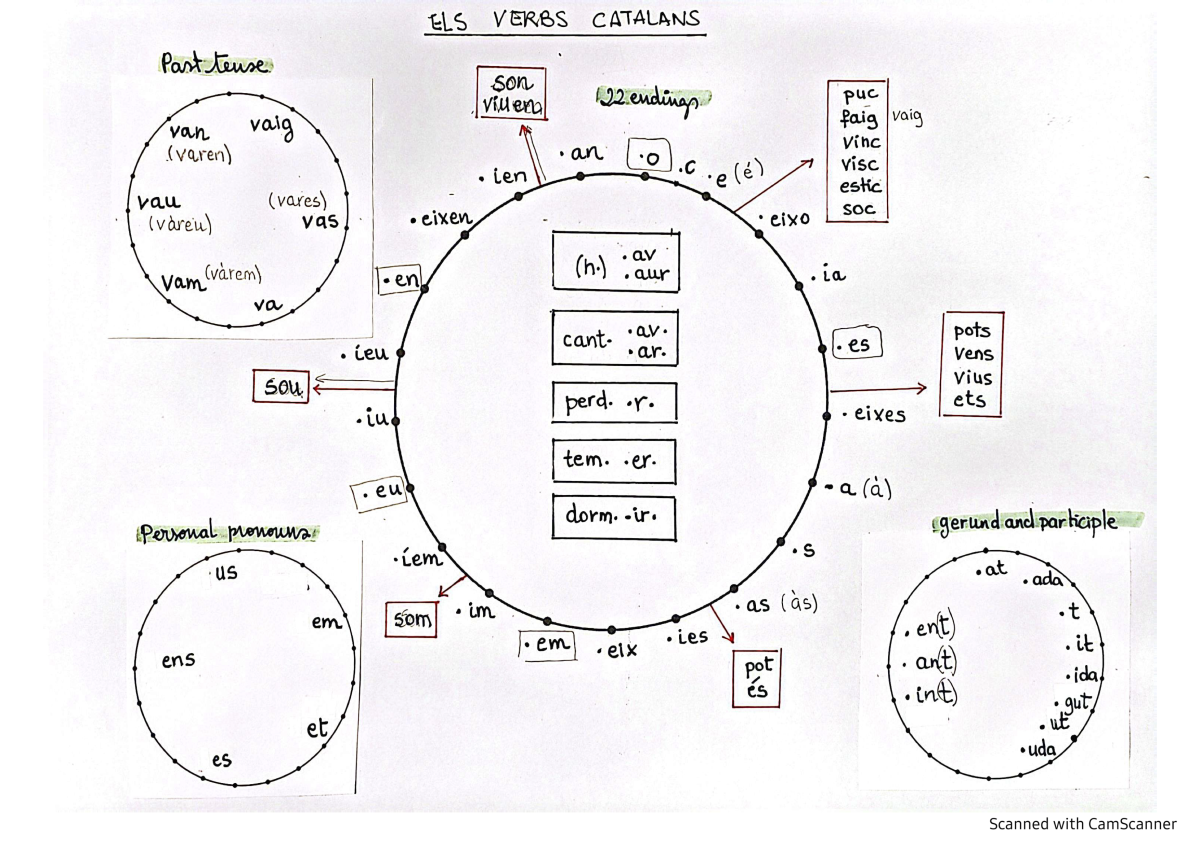
Recently we’ve been developing tools to help teach the verb system of Catalan. We want students to develop an intuitive sense for:
how verbs conjugate
the different tenses
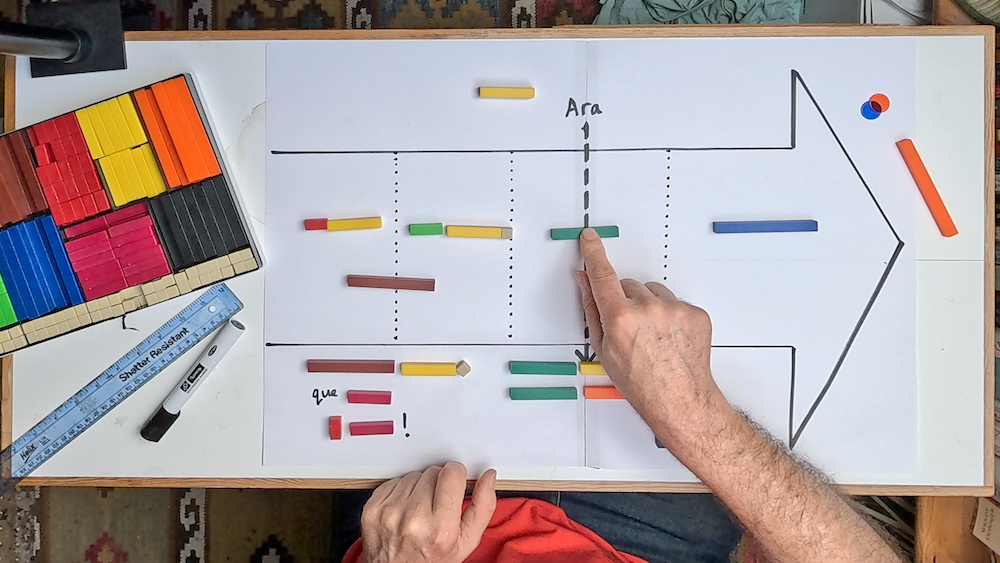
At the moment we’re experimenting with this ‘arrow’ model to work on the tenses (we’ve already developed a verbs ‘wheel‘ to work on conjugation). Each of the rods represents one of the tenses, and their arrangement symbolises something about how they relate to each other and to the passage of time. It’s not a grammarian’s or a linguist’s description of the language. It’s a teaching tool, to help students develop, intuitively, a sense for how the different tenses are used, their relationships and their differences.
The idea is to enable students to tie together the tenses and their usage without grammatical terminology and explanations. Apart from anything else this avoids students intellectualising about the language – which tends to hinder the development of their speaking. Because the model is visual, we and our students can simply point on the model when we want to analyse a sentence a student has said, or when we need to give feedback or when a student needs a hint about where to start.
For example, in this model the green rod in the middle on the dotted ‘ara’ (now) line represents the so-called ‘present’ tense, the blue one on the right the ‘future’ tense and the yellow one at the top, the infinitive.
As with everything else in this Catalan project, we’re developing this tool by trial and error: by using it, seeing what works well and what doesn’t, and adapting as we go.
In this video you’ll see us using this model in a recent lesson.
For anyone who’s interested, similar models have been developed for English, French and for Spanish. Of course, each of these models are rather different, reflecting each language’s unique character.
A key part of our Catalan project has been building classroom materials to teach students to speak the language. This post shows us beginning to work on tools to teach the verb system.
We’d been discussing how to help students master the Catalan verb system, and how we could devise classroom materials to help with this. In the film below, you’ll see us trying out a first draft of a new chart designed by our two Catalan teachers to help teach verb conjugations.
We were looking for something that:
minimizes the need for memorisation. Memorisation saps students’ energy—something they need an abundance of to learn well. What’s more, even when students work hard at memorising things like verb endings, the results are usually unreliable
avoids intellectualisation, which all too often leads to ‘knowledge about’ the language rather than the ‘know how’ to speak
helps students uncover the patterns in the language, and helps them to see that the system isn’t endless—there are always only a limited number of possibilities to choose from
would be easy to use in the classroom to introduce new verbs and new forms, and to give students immediate feedback
would support students’ practise in class so that using the verbs would gradually become easier, more fluent and more accurate.
A verb conjugation chart
The teachers built on work done over the years for other languages, and, of course, their knowledge of Catalan. And they continued our use of ‘rapid prototyping’ when developing materials—create something, try it out quickly, consider how it worked and then try again.
The first sketch of the chart our teachers created is above in this blog post and the film below shows extracts from a couple of lessons where we tried it out:
When to introduce this kind of chart?
This kind of work needs to come at the right time in a course. We’d already had a fair amount of experience of the language, and in our previous lessons we’d worked with these verbs, albeit solely in the third person. That gave us a solid stock of experience speaking the language and of using verbs to build on. It wouldn’t be wise to try to use a chart like this with students with much less experience of the language and of this way of learning than we already had.
We took it step by step. In the first lesson illustrated in this film we started with talking in the 1st person about a morning routine. And then in the subsequent lesson we extended that until we were using 1st, 2nd and 3rd persons.
This slow build up is important: students need practice and time to assimilate every new stage properly. The benefit of this step-by-step approach shows in the second lesson in the video: we were noticeably less hesitant and much more fluent with these new verb forms even after just one lesson.
It’s a teaching tool, not a reference work
The charts we’re aiming to build are teaching tools, designed for use in the classroom. We’re not creating reference works, although once students have got used to this kind of chart they often like to take copies home to jog their minds when they practise.
There’s more work to be done, but its a good start.
You can teach students to speak a foreign language without text books, work sheets, exercises, reading or note taking. Watch this film to see us doing exactly that with students recently arrived in Catalonia.
Our Catalan project started in July 2025 with two intertwined goals:
we two students wanted to learn to speak Catalan, and
our teachers wanted to develop better ways to teach Catalan to the students in their school
These goals were intertwined by design: the teachers would develop their skills using the Silent Way by teaching us; and, in parallel using ‘trial and error’, we would develop the materials needed to teach efficiently.
We students were later joined by two colleagues who also wanted to learn the language. I’ve reported on the first goal in past entries on this blog, but now I’m reporting on the second—applying the approach and what we had developed in school.
Visiting the school
I visited the school in February 2026 to learn more about the students and what they were finding difficult about the language; to offer any advice I could about how to help students with these difficulties; and to discuss face-to-face with the teachers the next steps for our project.
The students come from around the world and have been living in Catalonia for various amounts of time, some shorter, some longer. They need to work on their Catalan so they can participate in normal school and social life. They come to these Catalan language classes for various amounts of time each week depending on each student’s circumstances. The teachers have been using the Silent Way with these students since October 2025.
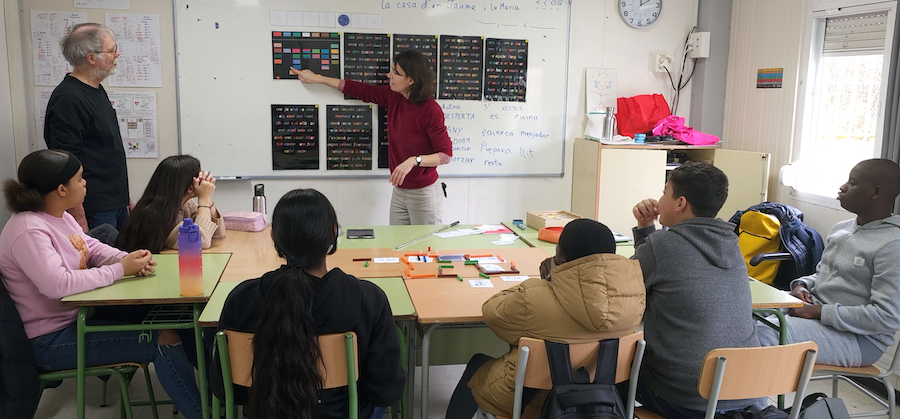
On the Monday of my visit one of the teachers and I taught the classes together. I provided the structure of the lessons and the teacher provided the Catalan – words, grammar, pronunciation, stress. Some parts of the lessons were filmed and we’ve made this short film documenting the work.
The sound-colour chart
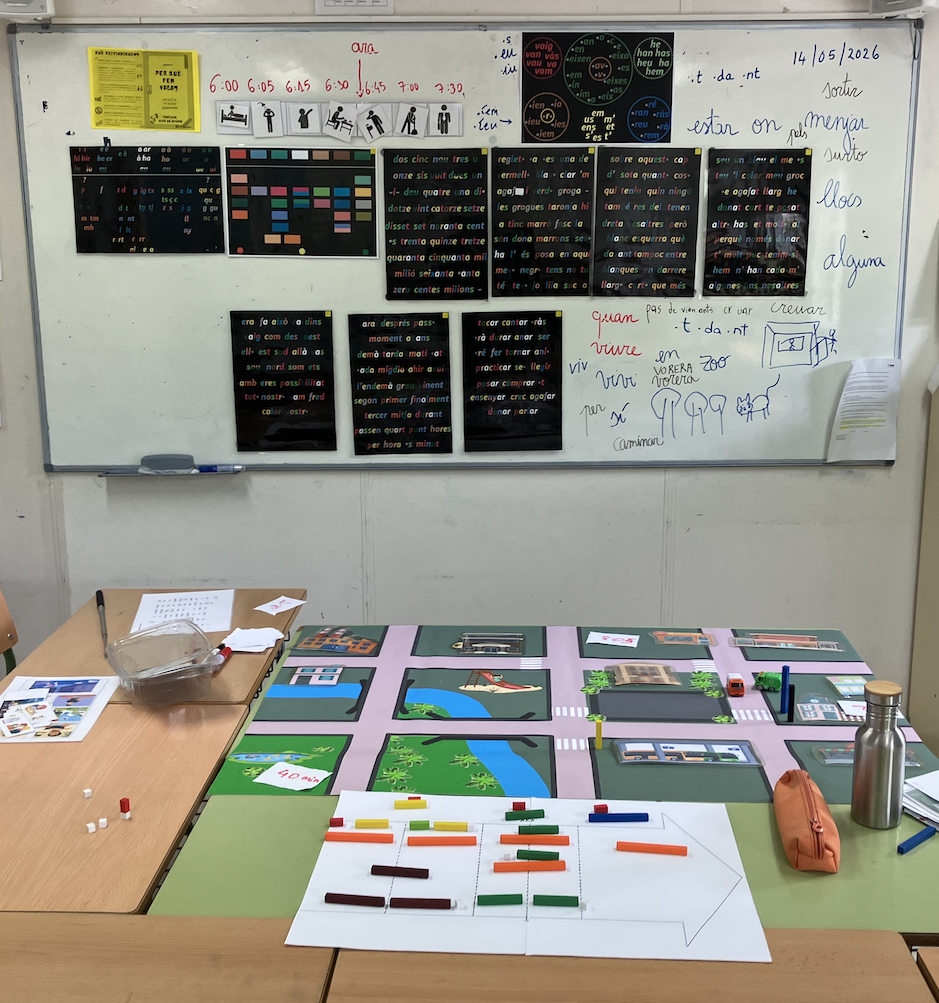
Since October the teachers have been using the sound-colour chart in all their lessons to introduce new words and work on pronunciation. This chart is designed to give a precise way to refer to the sounds of a language in the classroom without using letters. Letters are often ambiguous, unhelpful for students from different linguistic backgrounds and a barrier for non-readers. The chart also gives a quick, precise way to give students feedback on their pronunciation by simply pointing to the coloured rectangles on the chart.
The teachers and I had built the chart through trial and error in our online lessons since July 2025. And since they’d been working with it since October 2025, the students were familiar with it.
Speaking is the priority
The spoken language is our priority, so we don’t use text books or worksheets or reading in our classes. And the students don’t take notes. Our goal is that they develop the skills to speak spontaneously and well. For that they need to store the language in their minds, not on paper.
The students spoke and got immediate feedback for the whole of the lessons illustrated in the film. There was no ‘teacher talk’ or explanations. Any talking that we teachers did, was minimal: just what was needed to direct and guide the activities.
The words on the board
In the film you’ll see various words written on the board. We introduced new words to the students using the sound-colour chart, and then worked on that word’s stress. This meant that the students first met these words by saying them and working on their pronunciation.
Only once the students could say them well, were the written forms shown. Either we, the teachers, or one of the students wrote them on the board. That meant we had something to point to if we needed to refer to them, and it eliminated any pressure on students to try to memorise these words. We wanted them to store this everyday vocabulary in their minds for the long term, by use, familiarity and practice.
Responsive teaching
Because the students were speaking all the time, we, the teachers, always knew what they could do well and where they needed more help or more practice. In other words we had the information to judge, moment-by-moment, whether to move on or whether to consolidate.
And because the lesson wasn’t pre-planned in detail or text book-based, it was easy to spontaneously adjust, vary or replay some of the action. And, if we judged the students were ready, to push them one step forward.
Feedback on students’ attempts
We gave feedback sentence by sentence, either by gesture or by pointing at a word or rectangle on the sound-colour chart. This meant students could immediately correct what they said and practise it. It also meant that everyone else could see and hear each mistake and its correction—so they could also learn from that process.
There are a couple of things in how we gave feedback that we could improve for the future:
the first is practical. The room was cramped and with two of us working together sometimes we obscured some of the students’ view of the board.
the second is a bit more subtle. We might have been over-helpful sometimes—perhaps partly because I was working with these students for the first time. As a general rule it’s better to give less help, provided the students stand a chance of fixing the problem themselves: the less we do, the more they do. And the more they do, the more likely that the learning will stick for the long term.
We’ve tested the approach … but there is more to do
As you can see from the entries about Catalan in this blog to date, our specific application of the Silent Way approach to teaching Catalan has been tested with two groups of students in two different contexts: a group of adult beginners in online lessons since July 2025 and groups of immigrant teenagers at school since October 2025.
But there is more to do: our next steps will tackle how best to work with students on the Catalan verb system. This was the main issue we teachers discussed when I visited the school and we came up with some promising ideas which we are developing and testing over the coming weeks and months.
Overall
The film illustrates a series of lessons where students were talking Catalan virtually the whole time, were enjoying themselves, and were learning at the same time. This way of working can be applied to any language.
The film demonstrates an important fact: you can create courses to teach students to speak a foreign language without text books, work sheets, exercises, readings or note taking.
Indeed, I’d make a stronger claim: we were able to get all the students speaking like this because we’d dispensed with all this language class paraphernalia.
Speaking a language is a skill, ‘procedural knowledge’, so like all skills we have to practise it if we want to achieve fluency and ease combined with accuracy and precision. Watch this video to see an example of the process at work.
One of the best ways of expanding your speaking skills is the Class Conversation. It’s a very simple technique. You and your classmates talk about whatever’s on your minds, and your teacher works with you until every sentence is correct, well said and properly practised. Nothing is written down – all the work is entirely oral and aural since improving speaking is the goal. If you want to get extra value out of this, you can add another step. In your next lesson, tell again whatever you recall of last time’s stories.
This isn’t an exercise in ‘memorisation’, nor even ‘recall’ really – though there is an element of recall in it, of course. It’s more re-creation: you already have recent mental images of whatever was talked about, and you have to create sentences that express those images. You can build on, and build from, what was achieved last time and thus consolidate and extend the learning.
Watch this video to see how this worked out in a recent Japanese lesson. In my lesson the week before, I’d found out about my teacher Sumiyo’s recent trip to Paris. And that had led to me talking about the problems that the Musée de Louvre had recently had. And then, as conversations do, I’d digressed to talking about a trip to Paris that I hoped to make in 2026.
The week after, I decided I wanted to practise by re-creating what I’d worked on the previous time. Here’s the video showing extracts from that second lesson:
Work like this cumulates. Practising talking well about one thing means that the next conversation becomes just a little bit better and a little bit easier. And gradually your skills build, leading to better quality speaking and improved fluency. It doesn’t happen overnight, but it doesn’t take for ever.
This video also illustrates another useful technique. At about 2 mins 21s into the video I use the word charts (these show the functional vocabulary of the language) to stabilise a sentence I’m working on by pointing on the charts. This pointing process slows everything down and makes sure that my grammar is accurate and secure: there’s no fudging or slurring over details when you do this. And this means I have an accurate, stable platform from which to build towards fluency, ease and speed ie the ability to say my sentence well, and with less conscious control.
Find out about our latest project which will showcase efficient and innovative techniques to teach students to speak a foreign language confidently and well. And, of course, I’ll also tell you about the opportunities I’ve had to speak Japanese whilst I’ve been here!
It’s my last day in Hiroshima. I’ve been here for just over three weeks, working on a project filming some of the English classes that Don Cherry gives at Hiroshima International University. The aim is to document how he teaches spoken English in this context: ie to large groups of students who have studied English at school for several years but never really spoken it.
Hiroshima Heiwa Kinen Kouen (Peace Memorial Park, Hiroshima)
You can’t come to Hiroshima without visiting the Peace Park (Hiroshima Heiwa Kinen Kouen) and thinking about what happened here 80 years ago. So here’s a little video from the Park.
Speaking Japanese
Of course, being in Japan means I’ve had more chances to speak Japanese. And its been great. For practical, everyday purposes I seem to be able to say whatever I want, people seem to understand me, and with a slight mental delay I seem to understand them.
I’ve had extended conversations in Japanese with several people on interesting topics like art, learning languages, teaching music, growing trees etc. And in shops and restaurants; or catching trains and street cars; or visiting museums, parks and gardens; the words these situations call for seem to arise quite naturally and easily. Things like:
‘Is there an ATM here?’
‘Is this the South gate, or the North gate?’
‘How do I pay for my ride?’ [on a street car]
‘Either is fine’ [when asked if I want a window or aisle seat on the Shinkansen]
Q: ‘Is it winter in Scotland now?’ My answer: ‘No it’s Autumn, the same as here.’
‘Is everything in this restaurant really gluten free?’ [The answer was ‘Yes, except for the beer’]
‘Is this restaurant open every day?’ ‘Which days are you open?’ [The answers were: ‘No only three days each week’, ‘Saturday, Sunday and Monday’]
‘Which of these houses is this address? (Pointing to the address on my phone) etc
I don’t suppose I could talk about the political thought of Karl Marx or Kantian philosophy in Japanese but then I probably couldn’t do that particularly well in English.
It all feels very natural and familiar
None of this is particularly surprising. It all feels very natural and familiar because for the last couple of years our online Japanese lessons with Silent Way Tokyo have all been about expressing well whatever happened to spring spontaneously to mind: things that had happened either recently or long ago, things that interested me or I’d recently discovered, current problems or challenges, news of friends or relatives etc. Our lessons aren’t led by the teacher or a textbook; the content comes entirely from us, the students. And the teachers help us sentence-by-sentence, until we can say what we intend to say, accurately and well. And then they make sure we practise, so that what we’ve worked on begins to ‘stick’. And we’re always working on speaking: we never read out sentences or dialogues, or memorise little set speeches or routines.
So that’s why I’m ready to spontaneously start talking and responding, in the moment, to whatever crops up.
Here’s a brief video of me speaking impromptu to one of the classes we video’d, thanking them for giving us the opportunity to film them. It’s not the most elegant speech, and there are several things I meant to say that I forgot to: exactly as I would in English if I stood in front of thirty two 18-year old university students to speak without notes, at the end of their last class, on a Friday afternoon.
What’s next for our project
There’s a lot of work now to do on the footage we took. We filmed eleven full, 90 minute lessons each with several cameras to give multiple points of view on the action and we interviewed the teacher six times to find out what he was trying to do in each lesson, why he emphasised certain things, what things he was less happy about, how he managed and organised teaching some 180 students in several classes and, more generally, to understand his whole approach to teaching English.
One of the most interesting things that we did was to film the same class over three consecutive lessons. This means we’ll be able to show how the teacher built the work from lesson to lesson over three weeks, how the students’ speaking progressed over the series, and how these three lessons will fit into the direction of the whole course.
What we’re aiming for
The goal is that other teachers can see Don Cherry’s approach and the techniques he uses, in practice, in real classes. This will give the viewers practical ideas that they can borrow, develop, adapt and apply in their own courses and their own context. Whilst we’ve filmed English classes, this approach and the techniques Don has developed over his 30 years of experience teaching in this context can be adapted, re-invented and applied to teaching any language.
The edited video series will start appearing early in 2026.
Thanks to Don Cherry, colleagues at Hiroshima International University and all the students involved.
There isn’t any other way to learn practical skills than by doing, and there isn’t any other useful way to teach them either: what you have to do is make sure the students are safe, let them try, give them feedback as soon as possible after they’ve tried and steer them in what you think will be helpful directions.
Last weekend I painted (some of) the front of our house in Spain. I’ve done a fair amount of painting in my time but never a south facing, rough cast wall in the mediterranean sun. But just like any other practical skill there are things to be learnt to do it well in this particular context.
Things like: what preparation to do? How to protect the floor from drips? Where best to put the ladder? How much water to add to thin the paint? What’s the most convenient size container to carry that paint up the ladder? How deep to dip the brush? What kind of stroke applies the paint best? What angle is best to hold the brush? How far to reach out safely when at the top of the ladder? etc etc
None of these things can be learnt from a book or watching someone else do it or thinking about it. You just have to do it, notice what happens and try different things out. And a helpful voice from the person on the ground saying ‘You’ve missed that bit out!’ or ‘There’s a massive drip over there!’ or ‘Careful! Don’t lean too far out! Move the ladder instead!’ helps the work to go better.
Speaking a language is also a practical skill, albeit one too often thought of as an intellectual skill: a conception that I think is an error. We’re much better thinking of learning a language as something practical: a function of the body and the muscles.
And this gives a clue to how we should work as teachers. The students are the ones up the ladder, acting: moving their muscles, making sounds, trying to express meanings. We’re the ones on the ground offering feedback, guidance and helpful advice.
It’s obvious that what we teach isn’t what’s learnt, so we have to change our focus. We aren’t teachers of language, we’re teachers of people. And the people are the ones doing the work on the language.
It’s obvious that what we teach isn’t what’s learnt. Indeed when you think about it the two activities don’t have much to do with each other. ‘Teaching’ is commonly words and explanations coming out a teacher’s mouth and ‘learning’ is some mysterious transformation in students’ minds and bodies.
So when we’re teaching we have to make educated guesses about what’s going on in students’ minds and then act to provoke some kind of change in the right direction and then help them make that change more stable and ideally permanent.
So we aren’t teachers of a language, we’re teachers of people. We can only act in this way if the students are doing nearly all the talking: the only evidence we have of what might be going on in students’ minds when they try to speak a foreign language is what they say.
We have to get good at observing students at work – what they say, the mistakes they make, their confidence or hesitancy – and intuiting how to act to help them improve. But the first step is getting them talking, because then we have something to work on – they’re active and the process of trial & error and feedback can begin. And that’s how we learn.
Outsourcing our memory to pieces of paper is all very well for things we don’t want to remember long-term. But for things like language, I think it’s a mistake.
I read something the other day that advised language learners:
‘Take down notes to remember things’
The trouble with this is we usually write notes of things we don’t want to bother remembering: shopping lists, today’s to-do-list, packing lists etc. And something in our notebook is in completely the wrong place for language: words and phrases need to be in our minds..
Perhaps, noting something gives us the illusion of permanence; but permanence on paper isn’t much use. Perhaps it also makes us think we’ll re-read our notes (we probably won’t) and that that process will make the language lodge in our minds (which it probably won’t).
Personally, I don’t make any kinds of notes when learning a language, and I don’t let my students do so either. I think it’s much better to try to ‘encode’ the words into long term memory directly as soon as we encounter them. And taking notes distracts from that process.
Our time and energy is much better spent practising what we’re working on, trying to retrieve the words from our minds, and saying them out loud. These are the things that strengthen long term recall.
And the more you work like this, the better you’ll get at storing words more-or-less permanently in your mind in a place where you can pull them out when you need them. And if it takes a couple of encounters with something to store it long term, that’s still more efficient than writing it in a list and then putting it out of your mind.
In fact, I’d say notebooks and vocabulary lists are mostly counter-productive and simply encourage forgetting. So my advice is the opposite:
‘If you want to remember things, don’t take notes’