‘Free recall’ and writing with Journaly

I’m a little surprised to find myself extending my ‘free recall’ practice to include writing, but, so far, I’ve found it’s made the practice a bit more valuable, and not much more work … and free feedback on French orthography is something I might as well have even though writing isn’t my priority.

One of the things that is particularly useful after my lessons is ‘free recall’.  It’s a very simple technique – I say again any sentences that I happen to recall from my lessons.  It’s something I do whenever I feel like it, often the day after the lesson, to take advantage of the natural improvement in skills that comes after sleep.

In my case, I simply picture whatever situation we were talking about in the lesson, reconstruct some of the sentences that I said, and say them again out loud.  What this does, is make more automatic, fluid and easy the whole process:  creating, assembling correctly, and saying these sentences.

For ‘free recall’ I stick to sentences that I’ve worked on in my lessons and am confident I know how to say correctly.  That’s because I want to automate saying things properly, and avoid, as far as possible, ingraining bad habits.  

Taking it a stage farther

Recently, an email arrived in my inbox recommending the website Journaly.  There are several sites like this, but I thought that perhaps I would try it to take ‘free recall’ a step further.  (I’m not particularly recommending this particular site — I ended up using it for no reason other than the serendipity of an email turning up.)

This is what I’ve been doing:

  • I recreate in my mind any sentences that happen to occur to me from my last lesson and say them out loud a few times
  • I stick to sentences I’m confident I can say correctly
  • Once I’ve said them a few times I write them down on my computer or iPad
  • I set my computer or iPad language to French and allow it to autocorrect and add accents.  This just makes the whole process of turning what I’m saying into text easier
  • I leave what I’ve written for an hour or so, and then re-read it and get rid of any obvious mistakes 
  • I don’t worry about making what I wrote ‘interesting’ or ‘dramatic’ but I do try to make it a coherent piece
  • I post it and wait for feedback

Results 

With Journaly, I’ve been getting feedback very quickly which is nice.  I’m interested in the kinds of feedback I’ve been getting: it’s nearly all to do with French orthography.  And almost nothing to do with the language itself.

Which is, in a way, not surprising: since I’m only writing sentences I’m confident I’m saying correctly from my lesson it’s the step of writing them down that’s new and needing to be worked on.

Benefits

Since reading and writing aren’t really a priority for me, I was a bit sceptical that there would be much benefit for me personally when I started doing this. 

But I find I work a little bit harder on my ‘free recall’ than I otherwise would do, mostly to make sure I produce a coherent piece of writing.  And getting feedback confirming that my sentences are fundamentally correct is really encouraging. 

So this all seems worth the little extra work, since it’s improving my ‘free recall’ a bit, and since I might as well get the extra benefit of sorting out the patterns of French orthography through free feedback!

Conclusion

I like writing and do a lot of it in English anyway, so doing a bit in French doesn’t feel like a chore.  There’s no way I’d swap it for work on the spoken language, but for anyone already working on speaking, who already has a secure foothold in the Latin alphabet then it’s a nice way to get a little extra value out of ‘free recall’.

Afterword 

Personally, given my experience with illiteracy in Japanese, I’d rather be illiterate in French a bit longer too – it’s such a good feeling – but trying this writing experiment out has helped me realise that I can’t be.  

Knowing the Latin alphabet so well and having read stuff in French before, my eye gets pulled to any text and automatically tends to interpret French writing through an English ‘lens’.  Returning to a ‘state of innocence’ isn’t possible.  And so, I might as well take advantage of this opportunity to start with the spoken language and then turn my speaking into marks on paper (actually on a screen), and as a by-product, hopefully, learn to read through a French ‘lens’ also.

We learn to speak by speaking

Once you have a reasonable command of the function words, pronunciation and melody in a language, then all you need to do is speak … providing you get good sentence-by-sentence feedback.

Talking about the everyday things that occur in your life, and how you feel about them and what you want to do next is the stuff of everyday conversation.  And this is the ideal content for your language lessons once you have reached a reasonable command of the function words, pronunciation and melody in a language.

At this stage, all you need to do is try to talk about whichever of these things that happens to occur to you.  Very likely you will make mistakes but if your teacher gives you sentence-by-sentence feedback about where your mistakes are, helps you to fix them and gets you to practice the correct version, then that is all you need to improve.

The syllabus emerges from the process

This process seems to be self-regulating:  students seem to have a natural sense of the sentences they can have a reasonable stab at saying at any particular stage.  And so they rarely try to say things that really are too far beyond them.  

And, as their skills develop, they seem to naturally feel the urge to be more ambitious: to add more detail, to add shades of meaning or emotion and to express more complex ideas on a wider range of topics.  So in this way, they end up continually working at level i + 1 (to steal Krashen’s formulation, though he was talking about ‘input’ and a very different, and incompatible, set of ideas about language learning, see Payne, 2011 for one critique of Krashen’s theory). 

So, like this, we keep progressing but without the need for a pre-planned syllabus.

Just one example

For example, in a recent French lesson one of my fellow students expressed the opinion that people with gluten intolerance find it ‘difficult to digest gluten’.  Of course he said that in French.

Now I could easily have accepted this statement, indeed I might well have done so in a conversation in English, depending on the context.  But, since it’s not quite true for me, I felt the need to try to reply with something like ‘No!  It’s an autoimmune condition.  So when coeliacs take something with gluten in it, it causes their bodies to attack themselves.’ (In French, of course) 

And with a bit of help from my teacher about word choice, order and pronunciation, I got to be able to say this reasonably well in French.

My ‘i + 1’ at that moment

The point is that, at this stage in my gradual progress in French, I felt (intuitively, of course) that I stood a chance of expressing this real thought in that moment.  It was, in fact precisely at my ‘i + 1’ — neither impossibly hard nor too easy – just a small step beyond what I could do correctly and accurately myself. Moreover, as would be the case if I tried to say it in English, I started the utterance with no idea of how it was going to end. 

Then the process of working with my teacher on this, enabled me to turn it from halting, incorrect French into something that after a few minutes’ work came out as correct and, reasonably fluid, speech.  What’s more, it was never written down, so I had to hold it in my mind for the time it took to formulate and practise.

And so, because I had to be present continuously, and mentally engaged every step of the way over a sustained period of time; at the end of the process, I was left with much more than just ‘I know how to say this particular sentence’. 

In the language class things don’t have to be artificially ‘interesting’

Now, I doubt that others in the class were especially interested in the detail of this topic, except that, as in any good conversation, it revealed something about my life and concerns.  And perhaps something about the topic might have resonated with some parallel experience of illness or disease in others’ lives.  As social beings we are inherently interested, curious about, even nosy about the lives of the people we meet.

This is one of the problems that text-book authors face: whatever topics they pick, they’re never going to be anyway near as interesting to its members as what each group of students will come up, with given the chance — no French language textbook includes anything on the difficulties coeliacs face, why would it?  Fortunately text books are unnecessary, if we run our lessons in the right way.

So what should the teacher do?

The teacher needs to get the class talking about their actual lives and concerns, occasionally nudge the conversation to keep it going or to move the level up, and make sure everyone gets a chance to contribute. But, keep out of the content – that’s not his or her job.  

His or her job is to focus on the language and make sure that what the students say gets corrected, and do that in such a way that they develop better implicit criteria for correctness and accuracy.

What the student is left with afterwards

If we work this way, everything in the process of making the students’ sentences correct is available for their minds to work on afterwards: the things that weren’t correct or accurate and therefore they got feedback on; the variations they tried out on the way to their final sentences; the physical experiences of practising saying out loud something detailed, correct, and accurate.

All of this feeds into the stock of experiences students’ minds draw on to abstract the patterns inherent in the language and construct implicit know-how of how to speak it.  The mind hypothesises like this automatically and continuously — we don’t need to do anything more than feed it these kinds of rich experiences.

And so we learn

To advance in a foreign language all we need to do is: try to say things and make mistakes; don’t play safe; pay attention to sentence-by-sentence feedback from our teachers; and practise the correct versions a few times.

The rest will take care of itself: the mind will automatically construct and refine hypotheses about the patterns of the language; and as we grow in the language we’ll continually push our boundaries.  

To put it at its most succinct:  we learn to speak by speaking.

Payne, M Exploring Stephen Krashen’s ‘i + 1’ acquisition model in the classroom, Linguistics and Education, 2011, Volume 22 Issue 4, p 419 https://www.sciencedirect.com/science/article/abs/pii/S089858981100057X, Accessed 4 march 2024

Writing and reading in a foreign language

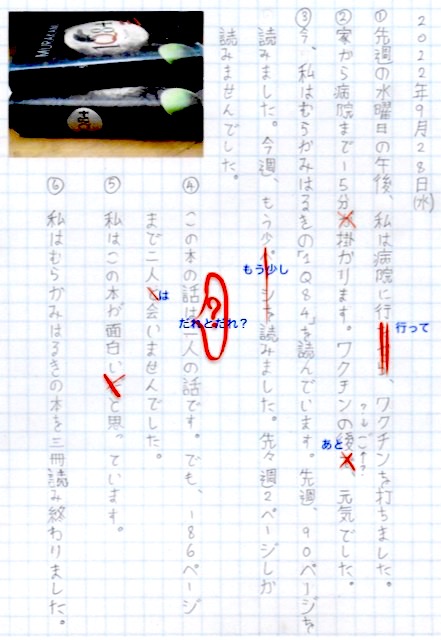
Speaking comes first; and writing lags behind. Writing sentences I have already worked on in my lessons helps me to learn Japanese writing painlessly

In my lesson, we’d been discussing my progress reading (in English) Murakami’s 1Q84. That’s what this writing is mostly about. Feedback like this, shown in red and blue, helps me improve every aspect of my Japanese.

In a previous blog entry, I wrote about how I was working on writing (and therefore reading) in Japanese.

I’ve continued working on this, by writing sentences based on things I’ve talked about in each of my Japanese lessons. I email this work to my teachers, who give me feedback. I usually write something after each lesson. (Incidentally, I never write any notes or anything during lessons. It’s better to give the lesson one’s full attention and that is impossible when you take notes.)

The process

I freely use the online dictionary to remind me of any kanji characters that I’m not certain of, thus reducing any memory burden. (Kanji characters are the ideographic characters originally from Chinese that Japanese uses as part of its writing system.) But:

  • because my writing desk is a couple of meters away from my computer I have to hold the characters in my mind for a moment or two after I have looked them up
  • to help me ‘encode’ these symbols I pay attention to the ‘radicals’ they contain—’radicals’ are subparts of these characters that are reused in different combinations across many different kanji
  • to help this process I also ‘write’ them in the air with my finger. This seems to help me hold the whole shape in my mind whilst I’m getting familiar with them
  • because I’m writing by hand I have to look carefully at the shapes and can’t cheat that process
  • before I email them to my teacher I read what I’ve written, making any necessary changes that I notice. And I read my work again when I get feedback.
The characters for ‘read’, ‘talk’ and ‘language’. Note how the ‘radical’ shown in red repeats

Benefits

This way of working means that:

  • because I’m sticking with vocabulary and grammar from my most recent lessons, I’m always reinforcing the oral work in class
  • I’m certain that I’m practising characters for familiar words and that any new characters are guaranteed to be limited in number, and relate to words that I already know how to say and know what they mean
  • as this work cumulates day-by-day and week-by-week I gradually discover that there are more and more characters I now ‘happen to know’
  • the more characters I know the easier it is to learn new ones because I’m already more familiar with more of the ’subparts’ (radicals)
  • I’m practising both writing and reading.

In fact I’m avoiding the process of ‘memorisation’—which is hard work, tedious, frustrating and yet unreliable—and instead using the process Gattegno called ‘retention‘. This is the same mental power that we use to remember without any special effort where the things are in our local supermarket, or the shops on the high street of a town we are familiar with, or the layout of our primary school etc etc.

Progress

I’m very happy that I can write anything that I can say, and I can read anything that I can write! This feels in balance. What I would like, though, is to improve my Japanese handwriting … it doesn’t yet ‘flow’ … but I console myself with the thought that when I was 6 or 7 my English handwriting didn’t ‘flow’ either.

You can see more of my progress by watching my video series Learning Japanese using the Silent Way.

Whilst Japanese is an extreme case, with its particularly difficult writing system, in fact, for an English native speaker, similar problems—in principle, if not in degree—crop up when we try to write French, for example, with its unfamiliar spelling system.

As it happens, I know that the same remedies apply to French as well, because I’ve adopted exactly the same approach to practise my French after each of the French lessons I’ve also been taking. Here’s an example of my practise for French:

Screen shot from a recent French lesson with my French writing practice … I got feedback separately by email

Course for teachers and volunteers working with migrants – Grenoble

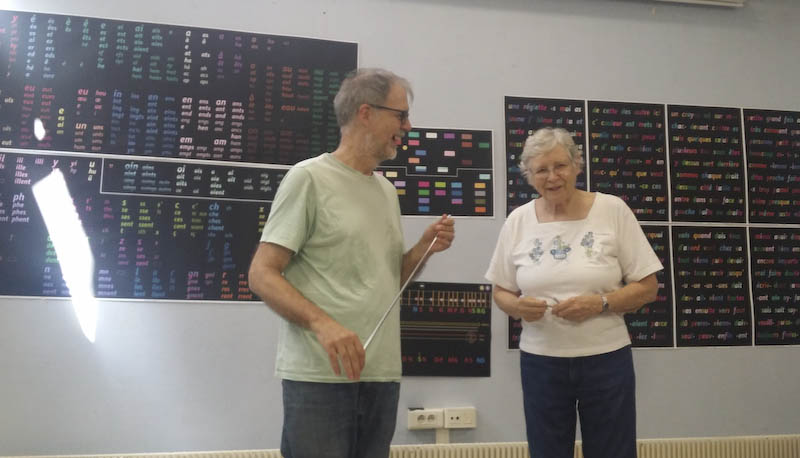
Ros Young and I with Silent Way materials on the course for teachers and volunteers working with migrants

What a privilege to work with Dr Roslyn Young at the 4 day course she gave in Grenoble on the Silent Way for teachers and volunteers working with migrants, especially those who are non-readers and non-writers!

We started with some Hindi taught using the Silent Way to remind us all of the experience of starting from scratch in a language we know nothing about and which uses a completely unfamiliar script. And, of course, to give everyone the experience of the Silent Way and the power of its key foundations: provoking awarenesses rather than distributing knowledge; and retention rather than memorisation.

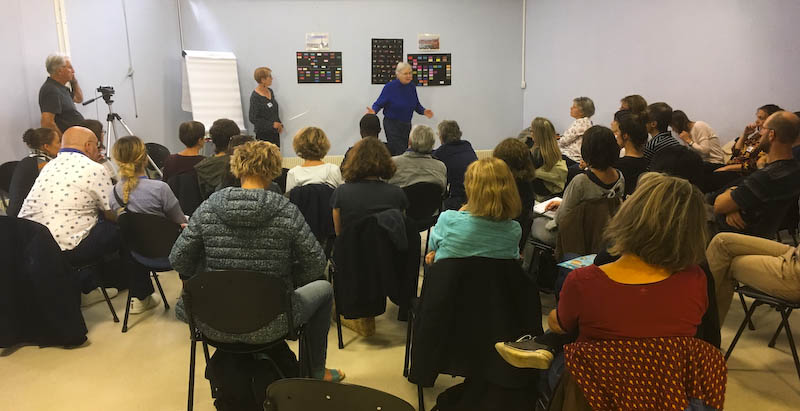
Ros working with the class helping them to learn how to better teach French to migrants

We then explored the tools available for Silent Way teachers.  For example:

  • ‘silence’ – through the precise use of silence we throw the responsibility back on the student to produce the language and allow the teacher to take up their proper role as coach, guide and guardian of quality. All this means the student is far more likely to build far more quickly accurate criteria for the language. Silence also entirely eliminates a common sin of teachers of any subject – ‘teacher talk’ and explanation.
  • ‘Sleep’ – through teaching language as a knowhow rather than knowledge we ‘charge’ the human mind with experiences which the mind is ready, and supremely able, to integrate and install during our periods of sleep.
  • ‘Mental images’ – all of our charts and how we use them are designed to enable the students to build mental images of whatever they are learning. For example, working with a sound-colour chart will leave the student with a mental image, both visual and kinaesthetic) of the complete inventory of the sounds of French.
  • ‘Meaning not translation’ – by starting with tangible objects in unambiguous situations we ensure that meaning comes before the language, and therefore students and teachers escape from any need for translation – everyone can see that there is a red rod in front of them, or that Clara is taller than Juan, or that the chair is behind the table etc. We need to escape from translation in every language class, but nowhere is this need so obvious as where we have no common language with our students – a situation which is so common when we are working with migrants.
  • ‘Retention not memorisation’ – humans are naturally retentive organisms and our powers of retention are effortless, effectively limitless and normally operate flawlessly. That is why in the Silent Way we avoid memorisation – memorisation is hard work and often faulty. One of the functions of our word charts is to enable our students to become familiar with the functional vocabulary of the language and acquire it through use, thus escaping from the memorisation trap. Since the functional vocabulary is in effect the grammar of the language, working with these charts is incredibly powerful to give the students the capacity to use the language creatively
  • ‘The curiosity of the students’ – as soon as possible we pass over to the students responsibility for the content of the lesson and encourage them to create and test hypotheses to express what they perceive or think or feel. This can be done even at the earliest stages … for example I may perceive that a red rod is on a blue rod, whereas for you the blue rod is under the red rod, whereas for someone else they may perceive simply that there are a red and a blue rod on the table. All these statements are true of the situation. What is important is that we help students express what they themselves think or perceive in correct, true, well-pronounced language.
  • ‘Economical correction’ – we try to do the minimum possible so that the student corrects themselves or discovers the correction themselves. It may be that the student cannot correct themselves without a new word or element of the language being put into circulation – but very often that isn’t the case, and often even just raising an eyebrow is sufficient for the student to find what is needed within themselves. Working in this way rapidly strengthens students’ inner criteria and takes them one step further towards becoming independent of us – just giving them the ‘correct answer’, which is such a temptation for all teachers, has nothing of this power.
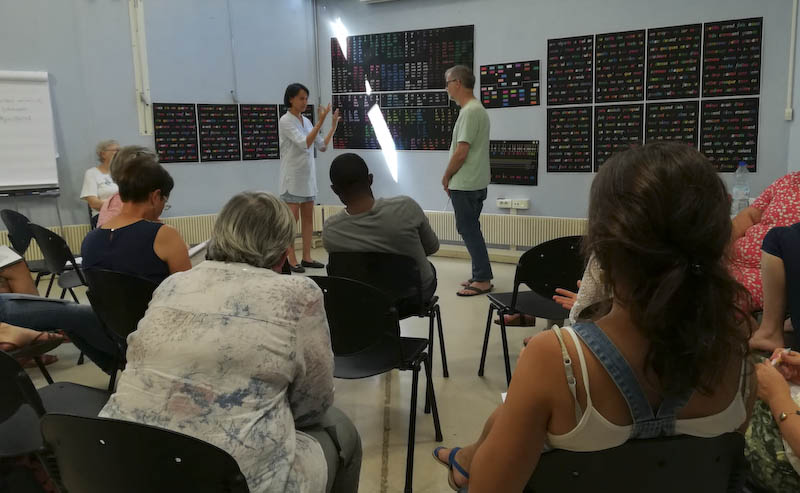
One of the students helping me to improve my French

Finally, the students on the course got a chance to try out what they’d been working on for real with a live non-native speaker of French ie me!  This was a very inspiring end to the course – for me, because I got my French improved and some much better criteria installed for aspects of French – and for the students because they saw and experienced how they could work in this way to improve a non-native speakers french at any level.

In addition … I made a lot of new friends!  Looking forward to returning to Grenoble for more fruitful partnerships in the future!

How I learned to stop worrying and love French spelling

I’d always thought french spelling was impossible, indeed far worse than English … all those weird combinations of letters!

However, when my teacher and I were working on French, pointing spellings on the Fidel (see picture below) and writing sentences on the white board, I started to see what was going on …

An image of a chart relating sounds and French spelling
Pointing on the Fidel shows students how sounds (each colour represents one sound) and spelling relate

For more information about these charts go to the Pronunciation Science website here.

… it was a few days later whilst I was riding my bike (all my best ideas come to the surface when I’m riding) that I realised that if you look at the Fidel almost every spelling occurs only once on the chart. Which means that once you have the ‘key’ you can be pretty certain how a French word sounds from its spelling alone. Especially as French doesn’t have the issue of stress – where certain syllables are emphasised unpredictably – which is such a feature of English.

But how did I learn the ‘key’ … through the simple act of pointing words and phrases on the chart and gradually getting familiar with the patterns – just the same way you get to know where everything is in your local supermarket, or on the high street of your local town.

French is so logical …