
Prioritising reading in a language course biases what students spend their time and energy on towards the time-consuming, energy intensive, fallible and frustrating process of attempting to memorise large numbers of words. And it biases their expectation of what success in learning a language is — towards having to have a large vocabulary.
Given that, according to the Oxford English Dictionary, the English language has some 170,000 words in current use, if we aim for a large vocabulary and aim to tackle that head on — eg through things like making vocabulary lists or using spaced repetition — then we are setting ourselves a pretty daunting task, and one that most people will fail at.
But if we change our point of view slightly and set different priorities then we can avoid this. The trick is to:
- prioritise speaking – which means students only need a much smaller vocabulary and one that contains mostly very common words
- at every stage only give students manageable challenges — usually just one new thing at a time. Trying to work on too many things at once isn’t a good idea, students’ memory very quickly gets overwhelmed and so most of their effort is wasted.
- sequence what students work on carefully. And this is where the statistics help us: the most essential and the most common words and structures are few.
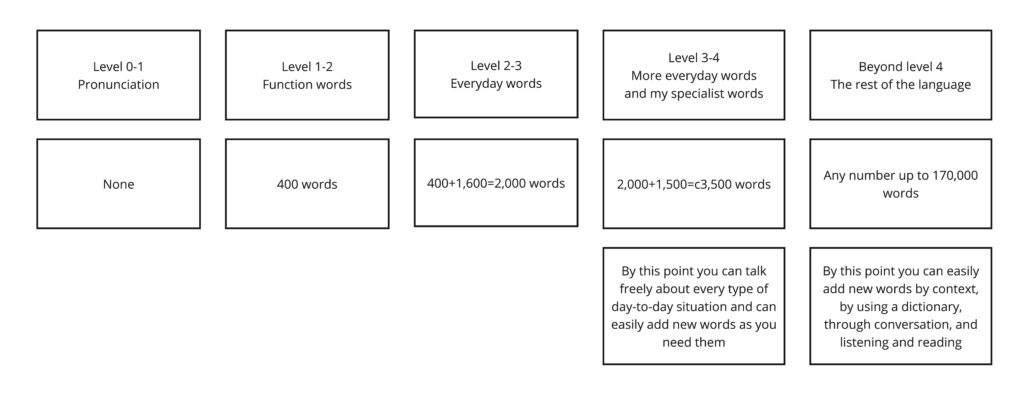
Work systematically in sequence
Step 1: Start by working on the functional vocabulary: In English this is just 450 words (and other languages have similarly small numbers of function words). These words are few, but very common. In English about 55% of the words in every sentence come from this small set of 450 words. This makes these words essential and the first priority for any language learner to work on. But they can’t be learnt from a list or in one go: they are untranslatable and require special work and more time to master because:
They serve quieter, supporting roles – connecting, shaping and organising the content words. […] By themselves, they don’t have much meaning. Whereas a content word such as “table” can trigger an image in everyone’s mind, try to imagine “that” or “really” or “the”.
Pennebaker, J. W. (2011b, September 7). The secret life of pronouns. New Scientist.
Step 2 (which overlaps a bit with Step 1): Start to expand your vocabulary to enable you to talk about the everyday situations that you encounter. Native speakers use about 2,000-3,000 words in their daily life. And most of these words are very common, and repeat and repeat. This means they are easy to learn: repetition and review is built in automatically. Also whilst you’re working at this level you’ll also be deepening your skills with the functional vocabulary.
In fact it is not as difficult as it might sound to master these everyday words if you pick them up through a series of Class Conversations or ‘Tell me’ classes.
Step 3 (which also overlaps a bit with Step 2): start to add the specialist words that reflect your own personal interests, work, or situation. It’s much easier to learn the words that you need to express your own ideas than arbitrary lists prepared for any one else’s syllabus.
Step 4: Once you are able to speak about your day-to-day concerns with facility and ease then adding new vocabulary becomes easier and easier. The more you know the easier it is to learn more words. This is because your brain works associatively and once it has grasped the underlying patterns of the language and has a firm base of every day words, then you will be able to fit new words into your mental lexicon mostly without special effort.
Conclusion
It’s like when we start a new job in a new environment. At first you don’t know ‘how things are done at round here’. Then gradually as you find out more and more about your new work environment, confusion gradually gives way to certainty and confidence.