At the moment in this blog, I’m reporting on the workshop I led at IATEFL 2025 in Edinburgh: ‘Teaching speaking as a skill: innovative ways of correcting.
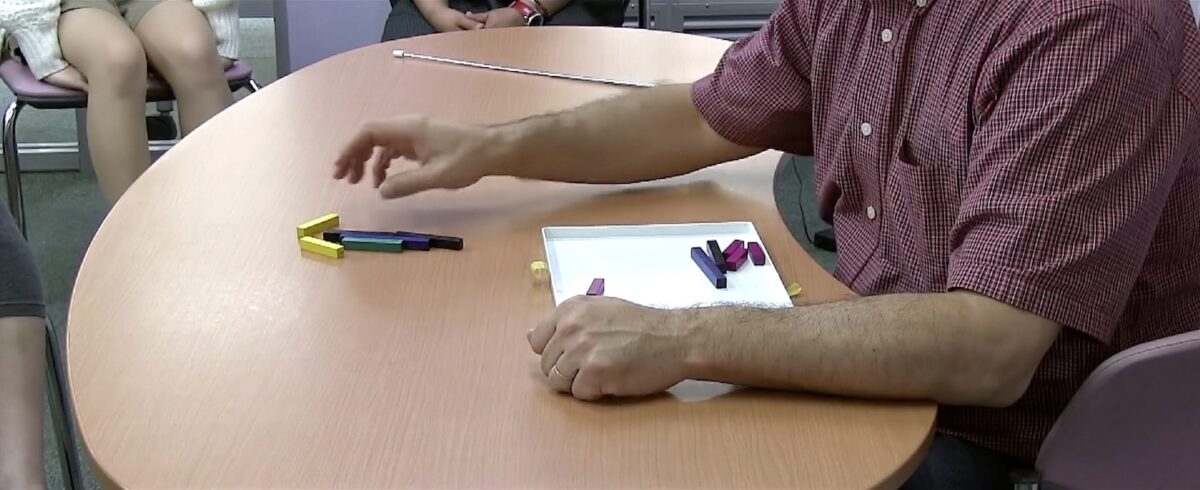
I showed a series of short films from real classes, and the fifty or so participants discussed what we’d watched. Here’s the third film.
In this short piece of work the teacher worked on the distinction between ‘a’and ‘the’. A difficult thing for Japanese speakers because Japanese doesn’t have articles at all.
In the discussion someone made the excellent point: ‘how do we know the student has learnt the distinction?’ And, of course, we don’t actually know from what we see in this clip, though the student’s tone of voice perhaps gives a clue.
And in response to my question back to the group: ‘How would you find out if they’d got it?’ The participant said ‘I’d probably give them a test’. Of course, what we saw on screen was a sort of test and the one thing we do know for certain is that at the start of that test, that particular student wasn’t secure in the ‘a’/’the’ distinction.
Of course, one of the advantages of Cuisenaire rods is you can endlessly and instantly generate as many ‘tests’ of this kind of distinction as you think useful. And such tests aren’t confounded by the addition of a lot of content vocabulary. And the students get instant feedback on their attempts. And there’s no marking to be done afterwards.
An experienced teacher can often intuit or make a good guess as to what’s going through a student’s mind if she observes the students carefully. So long as we keep an open mind about our guesses then this is vital: it guides us to what to do next to keep that student and the class as a whole progressing. And if we guess wrong, we’ll find out soon enough the next time the student or the class needs whatever we have been working on.
So what do you think? How do you know if students have grasped what you’re hoping they have from your teaching?
I believe that there can be a problem if the teacher doesn’t make a clear distinction between “knowledge” and “know-how”, in the sense that they think the student has to learn a piece of information, a rule maybe, or an explanation, as opposed to learning *how to* say the write words in the right context. So, what we want to test is whether the student is able to use the words appropriately, and more specifically to *say* them appropriately.
Which excludes written tests, but also any kind of oral test that would be void of context, like grammar drills usually are. To know if the students “have got it”, the teacher needs to see them using the right word repeatedly, in different setups, until there is no more mistake nor hesitation. Then we know that they’ve learned “how”.