We’re using trial and error, feedback and correction to explore the language. Here’s an example. The character ‘Maria’ had just appeared on the scene, so we didn’t know how to say ‘Give something to Maria’.
So, I guessed, based on what I already knew. Watch the video to see how the teacher gave me feedback and taught us the correct grammar, without explanation or rules.
The first time I said the new grammar (in the middle of the clip), my pronunciation was awful! But notice how I consciously improved it as I practised until I was able to say the sentence quite fluently and quite well. This is what practising is for: getting things we know to be correct to flow out more automatically and with less conscious control.
After the clip we continued practising, giving each other whatever instructions we wanted, and thereby integrating together the new with whatever things we’d done before. And a bit later we extended another step further, by asking each other to give things to Albert: which required another new bit of grammar.
The functional vocabulary
Our focus at this stage in the course is on gaining facility with the functional vocabulary of Catalan and we’re doing that through connecting visible or tangible meanings with example sentences and then practising what we’ve learned. This is the way to get an intuitive sense of the way the language works – how to use its ‘grammar words’ – so that the language just starts to flow out of our mouths in response to the meanings in our minds.
So, we’re continuing to move forward, step-by-step, using the ‘spiralling curriculum’. The diagram below gives a sense of where we’ve got to after seven hours of Catalan lessons: good progress in return for the time we’ve spent!
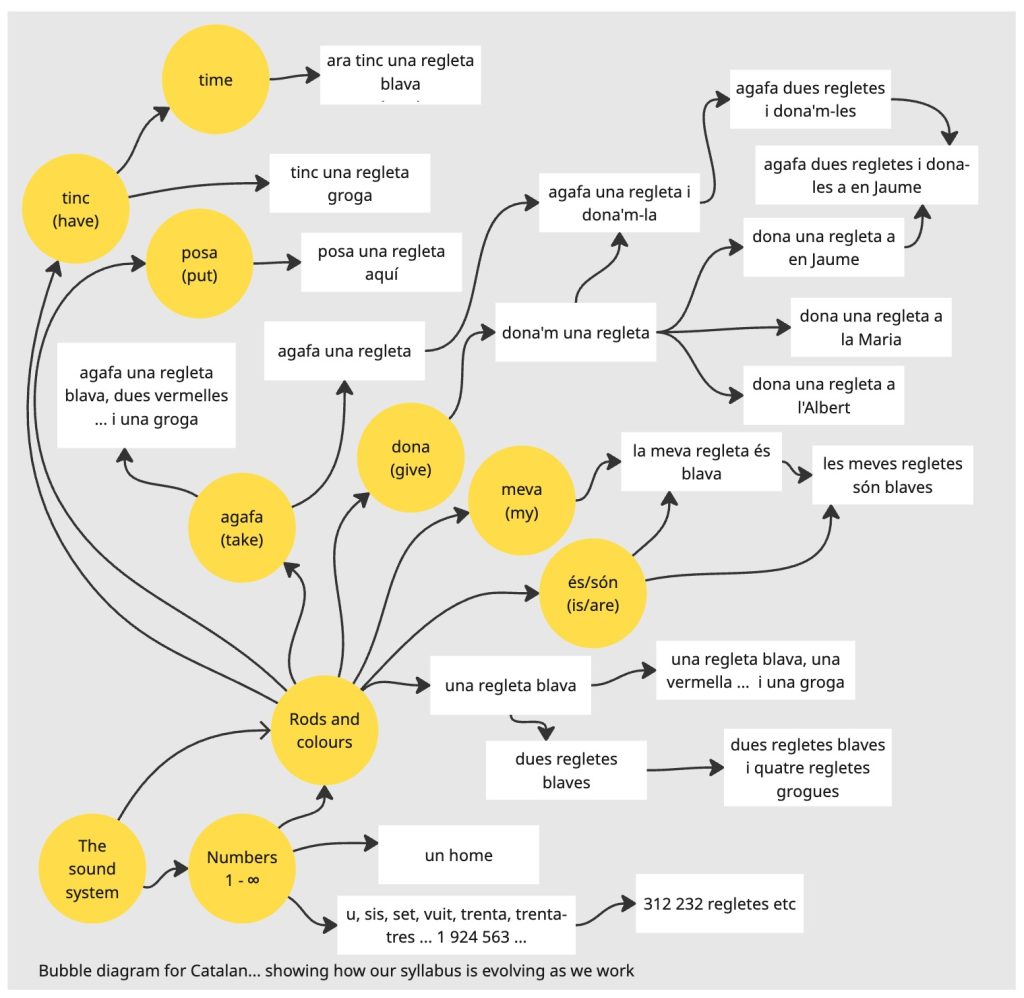
Of course, the examples in the boxes in the diagram are just examples to make the diagram clear. In fact, we, the students, have improvised many, many sentences exploring these parts of the language. And all this work has been done orally with no text book, notes or worksheets. We’re learning to speak the language – reading and writing can come later if either of us decides that’s what we want to do.