I’ve been working with an advanced student whose English is very good. Virtually all of what she say is grammatically correct, with appropriate vocabulary, and it’s perfectly understandable, but … it just doesn’t sound English – it retains the fundamental character of her native language. And she’s living in an English-speaking country and wants to ‘sound English’.
It’s a pity, because, had her teaching at school worked on the fundamental mechanisms of English speech, then most of these problems would have been dealt with long ago:
- rhythm and melody
- individual sounds
- the relationship between English sounds and English spellings
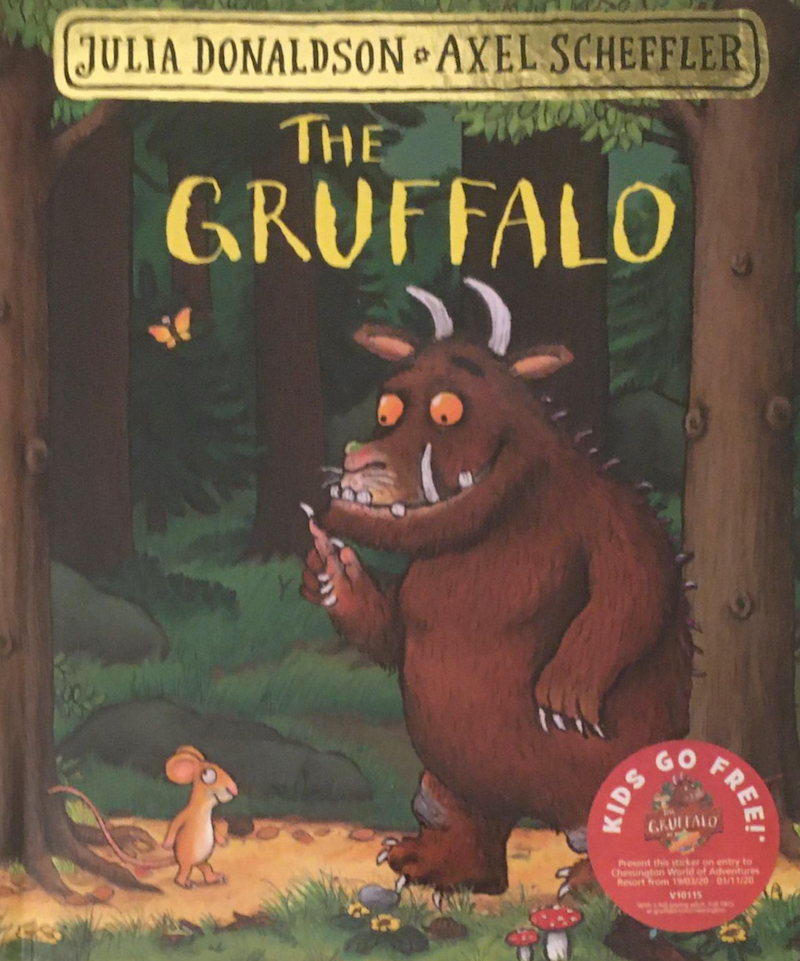
Fortunately we’ve found a perfect text that gives us just what we need to work on these areas: The Gruffalo by Julia Donaldson and Axel Scheffler.
Why is this such a perfect text for this advanced students?
- the story is of no consequence and neither vocabulary or idiom are a problem
- the text has a slightly heightened, but very characteristic, English rhythm
- it contains sentences – questions, answers, statements, exclamations, reported speech – all of which need their own particular melody
- there are plenty of words where the correspondence between spelling and sounds isn’t obvious
- she is more than happy to read the story many, many times – indeed she is going to, because it is a bedtime story for her young kids
So, paradoxically, the very inconsequentiality of the story frees this advanced student to work exclusively on rhythm, melody and sound.
We’ve been working through the text, sentence by sentence, focussing on how she is using her body to:
- make a breath-push on stressed syllables
- say unstressed syllables on ‘the remnants of the breath’
- activate an appropriate melody for each phrase
- change the shapes she’s making with her lips, jaw, and tongue to improve the individual sounds she’s making
- strengthen her criteria for sounds <=> spellings where this is misleading her
This is patient but fascinating work: we have to get these fundamentals right; and then practised with full attention; and then left for the mind to do its job of integrating what we’ve worked on. And, of course, these fundamentals apply to any English sentence, so working in a detailed way on this text is retraining her for anything else she wants to say.
The beauty of working on a text like this is that the fundamentals are met anew on every page; giving lots of varied practise, which gradually cumulates. And, step by step, this work is starting to influence the student’s spontaneous speech. There are some deeply ingrained habits here, which won’t be rectified overnight, but with sustained work, we see (or rather hear) progress.
The very simplicity of a text like this lets us focus on the most fundamental language skill of all – the use of the body.