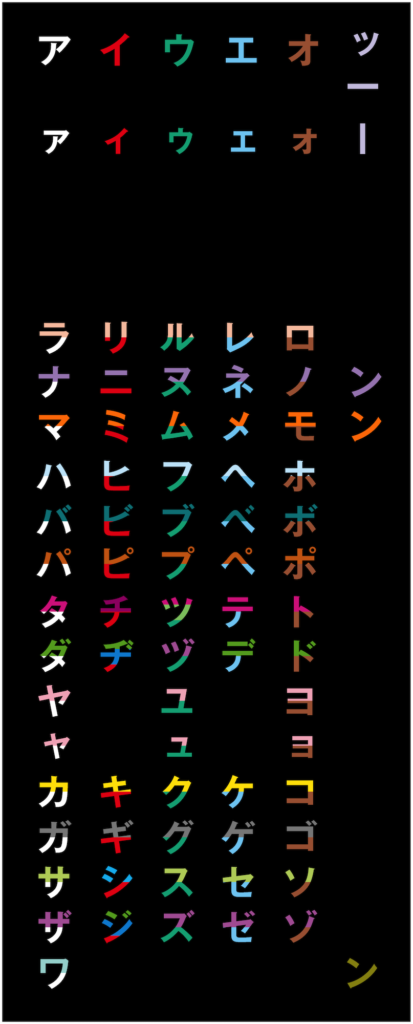
I’m learning Japanese at the moment, online, with Silent Way Tokyo [https://silentway-tokyo.jimdofree.com/japanese-course-with-the-silent-way/].
We started our lessons with working on the simplest of things—humming patterns of lower and higher pitched sounds. It turns out that one of the key things that makes Japanese sound Japanese is the pattern of high and low pitches used for the syllables of words and phrases.
These pitch changes are irrelevant to English, so I am well-trained to ignore them; so much so, that I could hardly hear that this feature of Japanese even existed when I first listened to Japanese speech. And even now that I know that ‘pitch accent’ is as essential for Japanese as stress and reduction is for English, I still find it hard to catch the pattern that Japanese speakers are actually saying. I’m getting better at this with practise but it’s still elusive.
In fact, this experience of having to become sensitive to strange new things, irrelevant to my English sensibility, but vital to the Japanese sensibility that I’m trying to develop, is a key theme of my experience so far with learning this language.
For example, I’ve started to become aware that:
- as well pitch differences, Japanese speakers are very sensitive to the number of, and regular timing of, syllables—quite different from English
- Japanese speakers are very sensitive to the social situation and the words and grammar they use changes depending on who they are speaking with—a feature, little present, in contemporary English
- Japanese people are sensitive to tiny differences in the shapes of characters. At first, I’m almost blind to these differences even though they are vital for correctly interpreting these marks on a page. For example look at: ソ and ン which look very similar but represent completely different—sounds /so/ and /n/ in katakana
So one of the first things we should do, when we start out learning a new language, should be retraining our sensitivity to these types of things: the underlying things that are important to speakers of that language, but which, because they are irrelevant to our native speech, we would normally be oblivious to.
Otherwise, we’ll never even realise that these things exist and are important; we’ll miss all kinds of things that natives unconsciously rely on to express what they want to; and we’ll probably make all kinds of errors without ever realising.
On the other hand, if we train ourselves in these new sensitivities then, because we will come to know what’s important to listen for and look out for, and how to listen and look out for them; we will get more learning out of every encounter we subsequently have with the language.
A question for language teachers, that should be kept in mind at least during the first phase of a course: “What features are important in this language and yet could easily be overlooked by ‘foreigners’?”, leading to: “How can I make it easier for my students to become aware that this exists and how can I help them giving it the right level of attention?”.