This video logs my progress in Japanese. The footage comes from a ‘tell me’ lesson I had last week (August 2025).
The idea of these lessons is that:
- I talk about whatever springs to mind at the moment
- My teacher gives me immediate feedback sentence by sentence and we work on that sentence until I can express my thought well.
- And then we move on to the next idea that occurs to me
This video edits together these final sentences to show the story that I told in the lesson.
Often, the work on each sentence is improving pronunciation, especially my ‘pitch accent’, or melody and flow.
Or, especially with more complex ideas, I go through a series of attempts to formulate and reformulate my sentence, until we are both satisfied that it expresses my idea well. And then I practise it by saying it again a couple of times: speaking a language is as much a physical as a mental act, and this kind of practice helps secure the ‘mental trace’ of the work we’ve done.
My teacher guides me in my experimentation, gives feedback on my attempts and provides missing vocabulary. This lesson was typical in that there was hardly any new vocabulary – I think there were probably only two words I needed that I didn’t already know (ie ‘orientation’, and ‘to plant a cutting’).
The functional vocabulary
Because we’ve done so much work on the functional vocabulary the grammatical work was either correcting slips, or, mostly, finding the best grammatical form for the nuance of what I want to say.
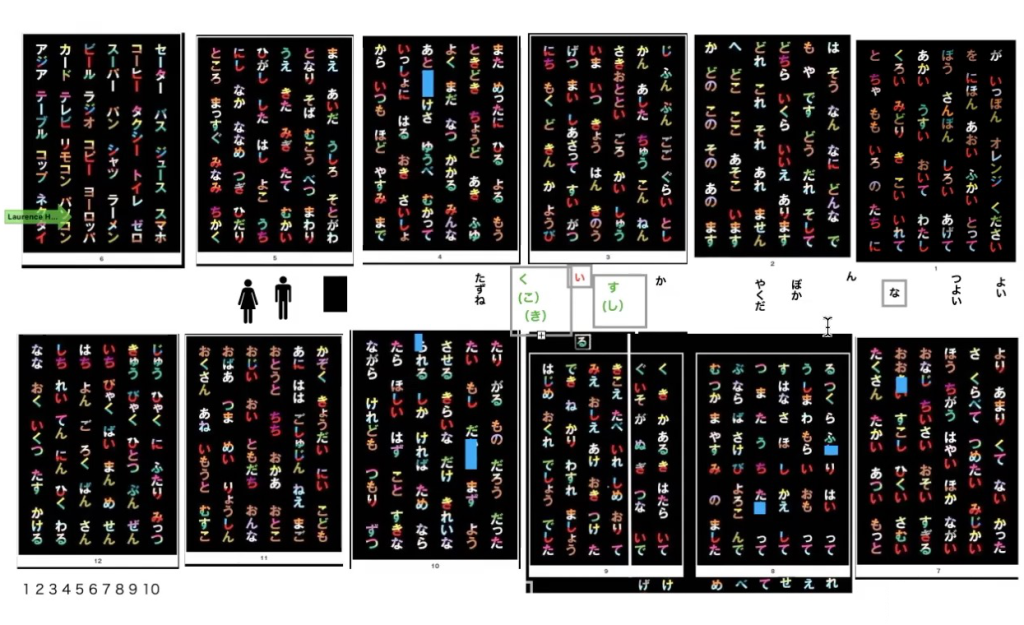
The functional vocabulary is special – it’s the little words and endings that express every type of relationship. These form the majority of words in any sentence (whatever the language) and mastering their use is the key to making coherent, correct, accurate sentences. They are best learnt through use – translation, rules and explanations don’t help and probably hinder. But there aren’t many of these words, and they are so common that working on them first when we learn a language gives us a head start over content-vocabulary-heavy approaches.
Here’s the chart with the functional vocabulary of Japanese (plus some common adjectives, verbs and English loan words) that we’ve been using in our lessons since I started learning a few years back: as you can see there aren’t many of them.
The skills to express yourself accumulate
It’s in the work I do on each sentence so that it expresses my ideas well that the learning takes place. Each sentence worked on gives my mind new material to integrate with what I already know; and everything accumulates so that week by week I can venture a bit further.
Thanks a lot to Silent Way Tokyo for teaching me!