In our 22ⁿᵈ lesson, we met the week in Catalan. Since the lesson took place on a Thursday, we tied our work to reality by first working on: « Avui és dejous » (‘Today is Thursday’). We already knew « avui » and « és », so this was not difficult.
But the minute we started to talk about the other days of the week, we were working on multiple ‘dimensions’:
- the new names for each day
- the past and the future
- temporal relationships like ‘the day before’, or ‘tomorrow’ or ‘the day after tomorrow’
- pronunciation and flow
So our teachers took it slowly, step by step. Every new thing introduced was worked on and practised before another thing was introduced. And after we’d met two or three new things, we practised everything again in any order, integrating together all the work so far, and only then moving on. This how to implement the ‘spiraling curriculum’ in a lesson.
Observing students is the key
Our teachers were observing us carefully as we worked so they could match the pace of the class to our progress: always making sure we were moving forward but never letting us get overwhelmed.
This is the key to good teaching. And they could observe properly because they weren’t lecturing or explaining. In fact, they were mostly silent, so we were doing the talking and they could always tell how well we were doing at any moment.
What we didn’t do
What we didn’t do, was start with ‘Monday’ and try to memorise all seven of the day names in sequence and then recite them in order. This is dull, ends up being a drill and is certain to overload students’ memory. People can’t hold seven items in short term memory: after about four items the mind will ‘overwrite’ one of them to make room for the fifth. This is why memorising lists of words usually doesn’t work.
In fact we never said the day names in the usual order, throughout the class. Although, in fact, we could easily have done this by the end of the lesson because we’d learnt them by use and familiarity and we’d related them to reality: the actual day the lesson took place and it’s place in a whole week.
Catalan always surprises!
Watch this video extract from the lesson to see us at work, having fun and being delighted by one of the many surprises that the language sprang on us!
This was a very productive lesson. There were the seven new day names to work on; new grammar for the past, the future and for temporal relationships; and continual refinement of our pronunciation. And as you will have seen in the video, a delightful experience of this remarkable language!
Our progress
It’s instructive to look back at how our course has developed since we started a few months ago.
As complete beginners to the language, in our first two lessons we worked on the sounds of the language and numbers. Then we started working on the functional vocabulary and gradually, practising everything thoroughly, we moved forward step-by-step, gradually expanding what we could do, until we reached this point.
The two ‘bubble diagrams’ below illustrate our progress. The rectangles provide examples of the kinds of sentences we worked on for each of the themes. Of course, we generated many more such sentences in each lesson. And we used our teacher’s feedback to correct each one and then we practised saying them several times until we could do so with some facility.
Diagram No 1: After 3 hours of lessons

Diagram 2: After 23 hours of lessons
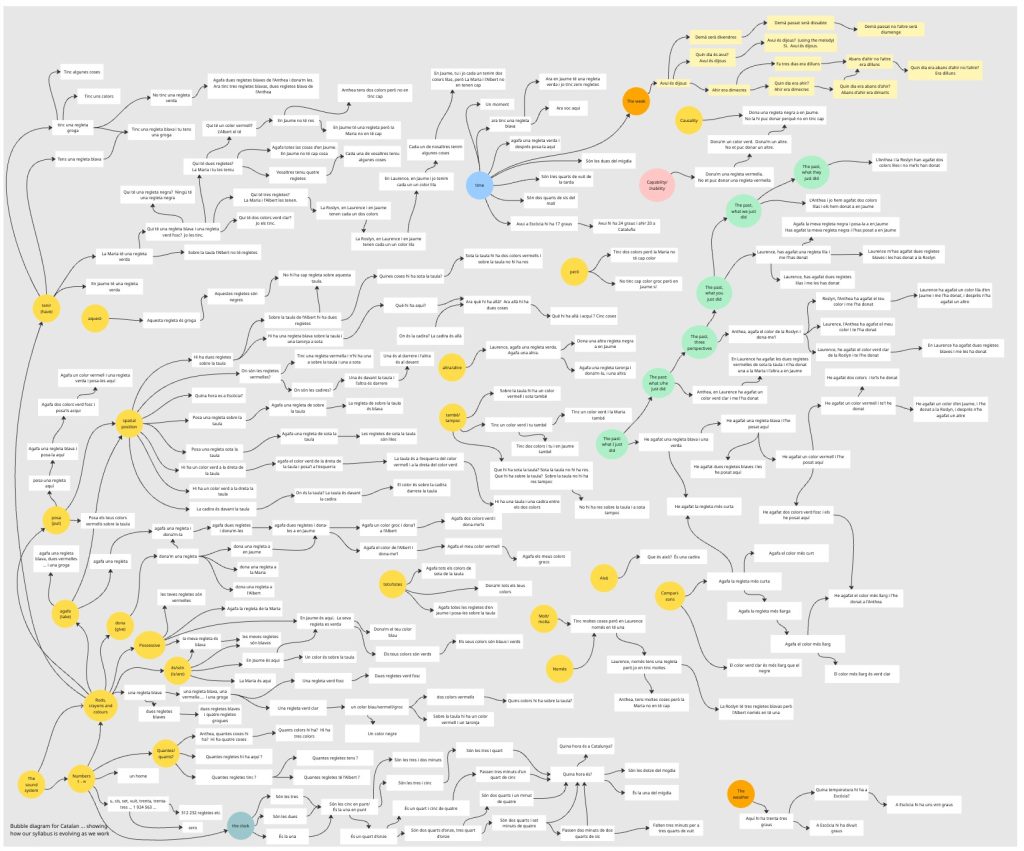
By this stage the diagram is a bit hard to read! So here is a high resolution PDF version.
An excellent return of learning for our time
The diagrams are illustrations of what we had learned at each stage, not what had been covered, because everything in the diagram had been properly practised and integrated together. 23 hours of learning and an excellent return for our time!