The other day I was lucky enough to work with the East Lothian ESOL team giving them a workshop on the Silent Way as part of their CPD.
We’d agreed that it would be an experiential workshop in which the team would take the first steps in learning a language they were completely unfamiliar with. That way the participants would experience for themselves the power of the Silent Way approach … and at the same time re-live how disorientating it must be to be plunged, for the first time, into a language that isn’t your own.
We started the workshop listening to a very short recording of someone speaking some Hindi … which was, of course, at this stage largely meaningless to the students.
We then started to experiment with using our breath, voice and mouths in totally new ways to find the sounds of Hindi – this phase of experimentation; trial and error with feedback from a teacher; and learning to use yourself differently, to suddenly sound different is incredibly useful if you want to develop good pronunciation in a foreign language.

We then started to make sentences about some Cuisenaire rods. These rods are really useful for teaching grammar through situations (see also). Because they are easily manipulable, an infinite variety of situations can be created. And because they are tangible and visible to everyone, there is no doubt about the meaning of the language we create about them, without any need for verbal explanations whatsoever. Everyone’s perception alone is sufficient.
And since meaning comes first … when we speak, the meaning is in our mind first and the language flows from what we perceive or think … we are getting the language game the right way round. Meaning first; language after.
I was really impressed hearing gradually more and more elaborated sentences being said as we gradually expanded the language the students were practising. More than anything I was impressed by how hard everyone was working as they tried to coordinate bizarre and unusual movements of their mouth … to make unfamiliar sounds, strung together on a totally different way of using the breath, to produce coherent descriptions and instructions in this language from a culture half way round the world!
This way of learning makes demands on all the students. They have to stay present to the task, they have to experiment and try out unfamiliar actions that will feel strange but, because it’s all learning by doing, the memorisation burden is almost eliminated and, as the students practise, they progressively establish the ‘knowhow’ to express themselves in the new language.
By the time we’d finished the workshop amongst other words, the words एक, दो, तीन (one, two, three) had been used so when I played the recording again at the end, the team were able to recognise that the speaker was counting in Hindi …
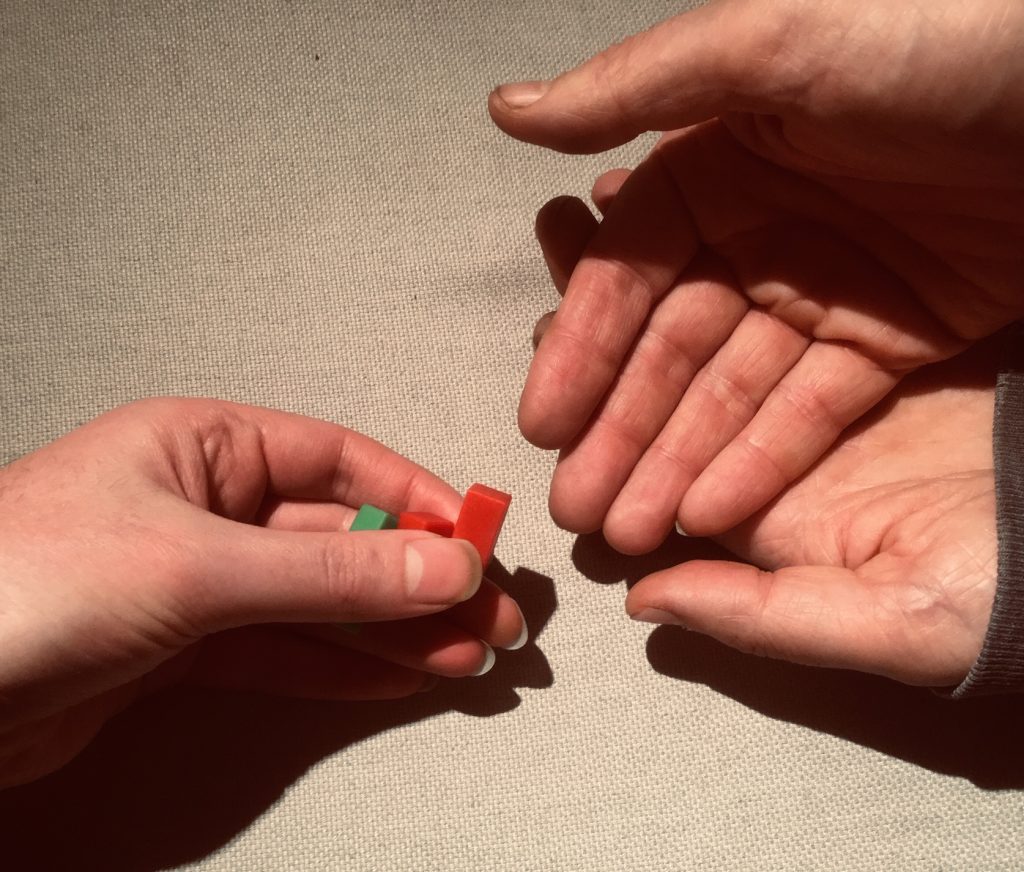
One hour is far too short a time for this amount of work, but congratulations to the students for making it from probably never having heard a word of Hindi to being able (with just a little help) to give instructions such as:
‘[colleague’s name] मुझे दो लाल डंडियाँ और एक हरी दीजिए ।’
and with all of us knowing exactly what was meant by this, without the intervention of any translation whatsoever during the whole hour. A great way of teaching grammar!
Thanks once again to East Lothian Council’s ESOL team for the opportunity to work with them.
PS. It seems superfluous to give the translation of the hindi above, but it is: ‘[colleague’s name] please give me two red rods and a green rod!
I think you should make a video about this on YouTube…
http://www.supremesearch.net
Jamie
Thanks for your comment.
I have thought about this but it’s quite difficult to do, especially given issues of consent from participants. However, we are incredibly lucky because Don Cherry who teaches English in Japan has uploaded a very extensive sequence of videos documenting a series of lessons. There are many occasions in these videos where he uses some of this approach and if you have time, you might want to work through some of them. Meantime, here is just one example of him at work: https://www.youtube.com/watch?v=8UNvMn_k89U
Best wishes
Laurence