I met with my Hindi guru, Harjyot Singh, today. We’ve been working together since December on a) generating Silent Way charts for Hindi and, in parallel, b) me learning Hindi. We’ve met 8 times for exactly one hour each time – one hour is plenty for me to focus and absorb what I need to. Outside of that time I’ve been producing charts which we test when we meet. And I’ve done a bit of practice in between meetings/lessons, mostly on pronunciation.
I took the approach of asking ‘what language do I need to be able to say x, y and z?’ I used the book ‘L’anglais avec l’approche Silent Way’ by Roslyn Young (currently being translated into English), which gives examples of the situations and sentences that are commonly generated from each Silent Way Word Chart, as a guide and then made hypotheses about the language I needed to say these in Hindi using a couple of text books. Each time I met with a Harjyot I tried to generate sentences about a concrete situation and he gave me feedback about grammar, word choice, pronunciation, melody and naturalness. I used this feedback to develop a feel for the language and revise the materials I was creating as necessary. Each time I felt more confidence about a wider range of the language.

For example, chart 1 enables me to describe an infinite variety of simple situations such as these ones below:
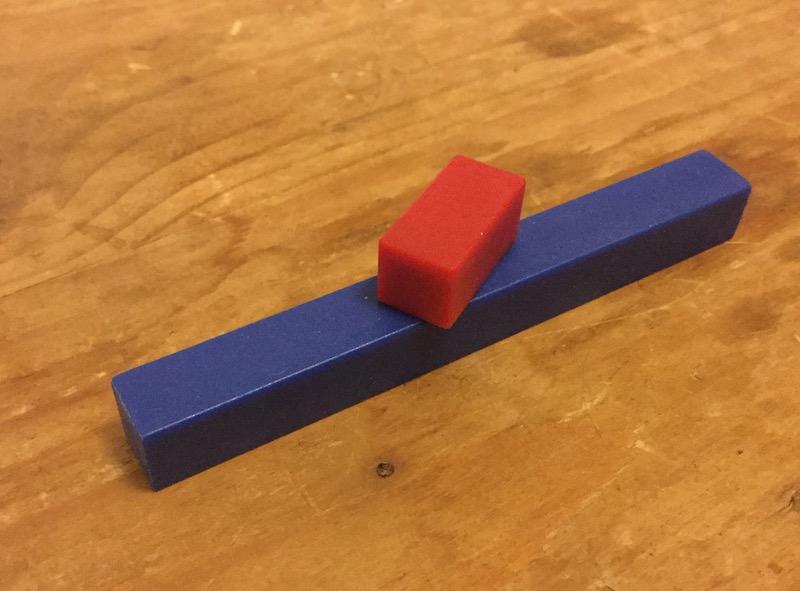
‘This red rod is on this blue one.’
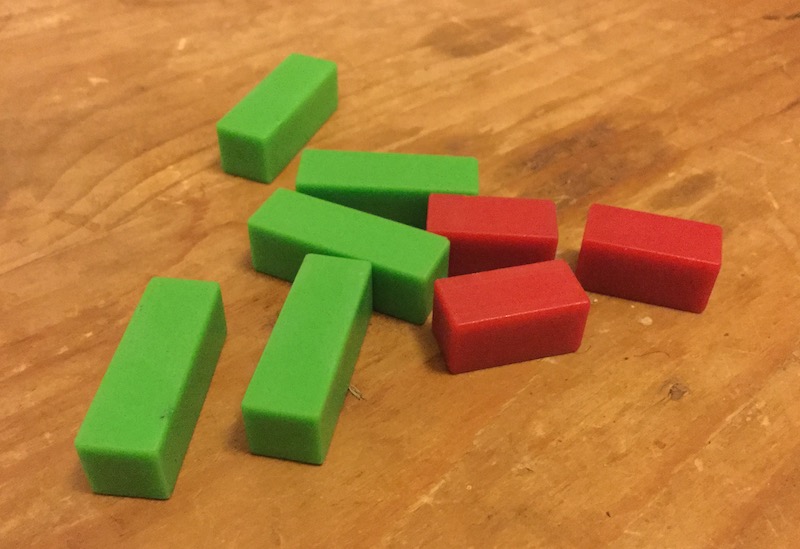
‘There are three red and five green rods on the table.’
Simple sentences, but the beauty is that, having been coached with feedback from my Hindi guru, I can confidently create these sentences for myself using what’s on the charts. A lot of this comes from the fact that when we work together he only gives me the minimum amount of help to perfect the sentence – in terms of grammar, pronunciation, naturalness – that way, because I do most of the work, I develop more quickly accurate criteria for correct Hindi.
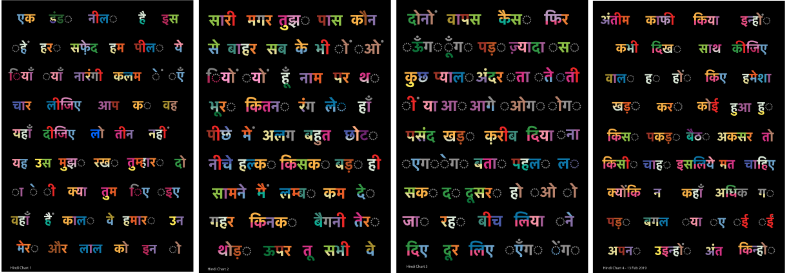
Each chart extends the range of linguistic structures I can master. For example:
- Chart 2 extends what I can say to include things like ‘behind’, ‘in front’, ‘on top’, ‘under’ etc.
- Chart 3 gives me the verbs for ‘to come’ and ‘to go’ and access to the past enabling me to say things like ‘I took a red rod and gave it to him’ and the future so I can create sentences like ‘I will go outside’ etc
- Chart 4 gives me a few more verbs such as ‘to do’ and how to say things like ‘I want’, ‘is needed’ etc
‘Much language with little vocabulary’
Caleb Gattegno
So far on these four charts I have only 190 ‘words’ (including the inflections I need). And since the charts will be displayed on the walls of a classroom, and the pronunciation of each word is evident from the colour coding, there will be minimal memory burden on the students. This means they can put their effort into using this linguistic material to express things they perceive and think, without the weight of memorisation – retention of the words will come as they use them. For more information about Silent Way charts for other languages click here.
What I found interesting was how, somehow, having got to the linguistic coverage of these four charts and having been coached in their use, I suddenly found myself able to talk about real things in my life, extending my linguistic reach from manufactured situations with Cuisenaire rods in the classroom to things like the following, which Harjyot and I worked on today:
मैं पहले मंगलवार को पेरिस से लौट के आया ।
I came back from Paris on Tuesday.
जब मैं पेरिस में था मेरी पत्नी को काम करना था ।
When I was in Paris my wife had to work.
आप को बाद में जिम करना है ।
You have to go to the gym later.
मैं अगले बुधवार को East Lothian Council में एक प्रिज़न्टेशन देने वाला हूं ।
Next Wednesday I will give a presentation at East Lothian Council.
All these things are a) true and b) now we’ve worked on them, correct and c) things I wanted to say. The only ‘words’ not in the 190 on the Charts are ‘Paris’, ‘Tuesday’ and ‘Wednesday’ (I have a separate chart for the calendar), ‘wife’, ‘gym’ which is easy because it’s the same as in English, and ‘presentation’ which is also the same as in English.
Not bad for eight hours of lessons (OK plus lots of work researching in text books and thinking about the language and how to learn it …).
‘Much language with little vocabulary’ indeed.
I have to also say I am so grateful to Harjyot for the gift of Hindi. He’s been amazing and incredibly generous in what must at times have seemed like a bizarre and strange way to approach learning and teaching a foreign language. धन्यवाद!