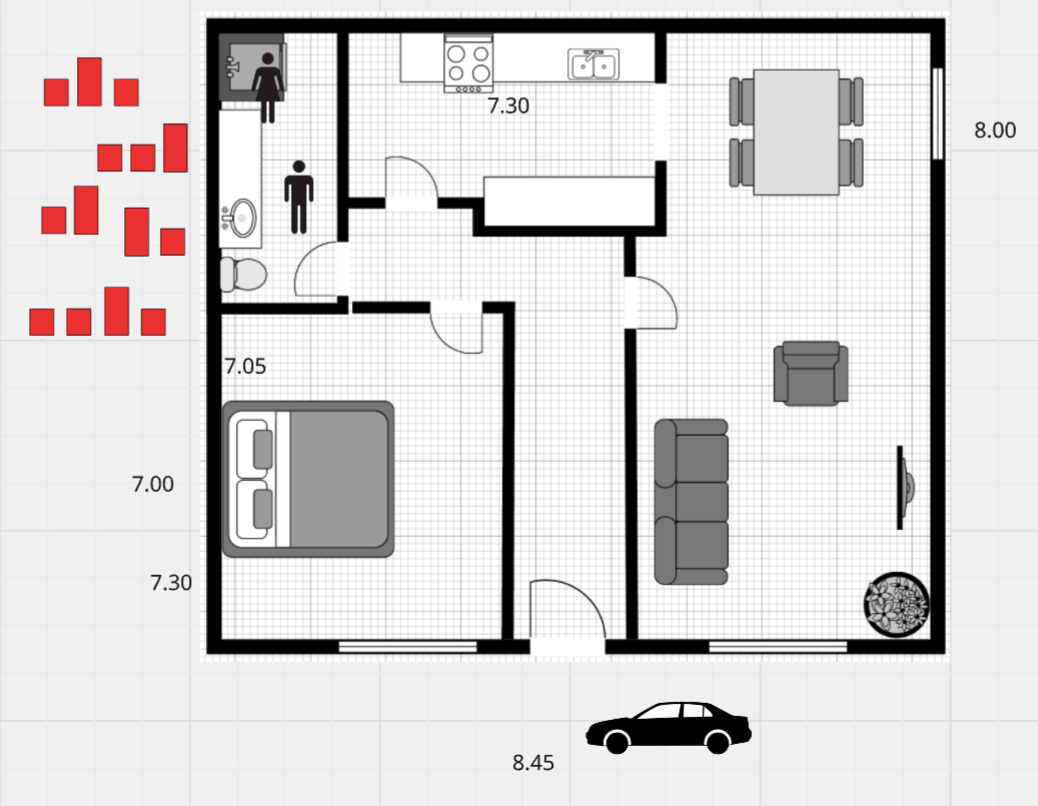
Below there’s a video extract from our most recent Catalan lesson. We’d been talking about Jaume and Maria’s normal morning routine and moving the characters around on this floor plan of their house as the different events unfolded.
The beauty of moving the characters around a simple plan like this is:
- everyone knows what’s happening without explanation or translation
- events can be replayed as often as needed for the students to practise
- the sequence of events can be readily changed or new activities or new language added as students’ skills develop
- unlike text book examples, what happens isn’t pre-set, and students as well as teachers can take over control of the narrative
- during the course of an hour’s lesson a lot of language can be generated, worked on and practised
In fact, as you’ll see in this video extract, as the action played out one of the students ended up with a situation that surprised everyone. And that led to an opportunity for the teachers to introduce some new aspects of the language that we’d not met before.
The teachers used the sound-colour chart and the word charts to provide the new language we students needed to tell the story properly. Pointing on the sound-colour chart is an efficient way of giving students the pronunciation of new words whilst avoiding the ambiguities and confusion that writing and spelling systems often cause. It forces students to pay attention to the sounds of the words and their sequence and to hold them in their minds: this extra effort makes it more likely that they will be retained.
This lesson was also unusual in that we were joined for the first time in a live lesson by Nicoleta Surdu, who has been learning Catalan by following the full videos of our lessons and practising by herself. As you can see, she’s learnt a lot of Catalan this way and was able to fully participate in the class! Congratulations, Nicoleta: an impressive achievement.