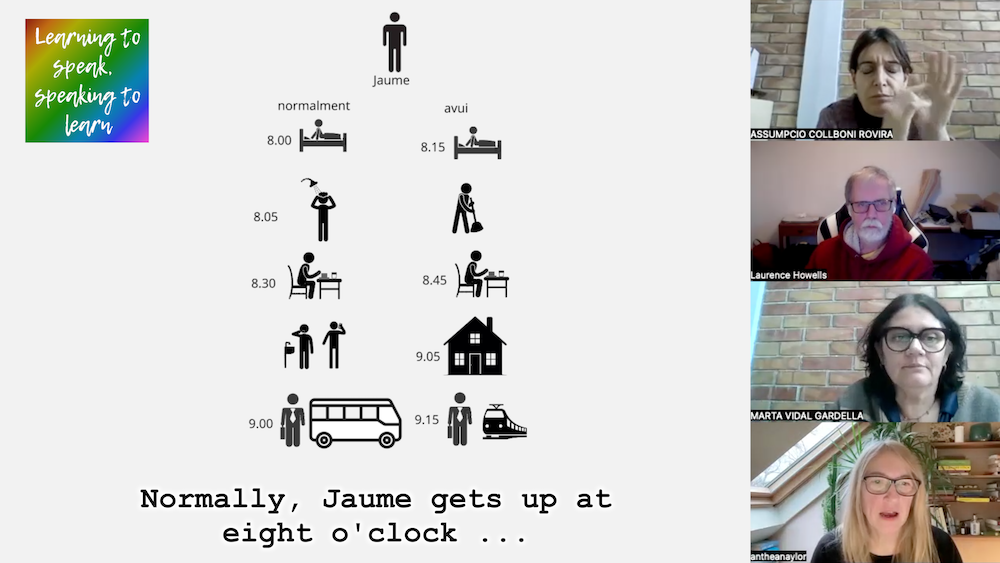
We’re at level 3 in the Silent Way progression framework: we’ve got a grounding in the sounds, rhythms and melodies of Catalan and the functional vocabulary. And now we’re adding everyday vocabulary and working on how the language expresses time.
In our most recent lessons we’ve been exploring talking about a character’s typical day using images like these.

These images are easily manipulated on screen so we can get endless, varied practice very easily. Because we are working with pictures, the sequence of events is always clear. Also the sentences we create never need to be written down. The scenarios can be made as short and simple as we want or as long and elaborate as we can cope with.
It’s a great way to introduce this everyday vocabulary, the various verb forms needed, and you can eliminate distractions. Students can only really be present to one thing at a time and we want them to be the focussed on that. So:
- we used a situation with just a single character so that we only needed the third person – trying to deal with the whole range of conjugations at once would be too much at this stage.
- we kept as much of the situation as possible constant while we explored the contrast between the characters ‘normal’ day and what specifically they had done ‘today’ before our class
Here’s a short video showing some extracts from our lesson:
During the lesson we students generated some thirty or so sentences which described aspects of the situation, all worked on until they were correct and then practised until they started to become easy to say. This is efficient – just two minutes per example sentence – and it gave us lots of experience of both the ‘mechanics’ of how the verbs work – some endings, auxiliaries, word order, associated pronouns, reflexivity etc – and the significance or types of situations these forms are associated with.
So, now our minds have this stock of reliable well-mastered material to work on and to generalise from. And we can rely on sleep to do the next stage of consolidating this and integrating it with the rest of our Catalan. And that will give us a solid base to work from for whatever comes next.
What we didn’t do
We didn’t talk about our own everyday activities, for very good reasons. That would have required us to talk about ‘I’ and ‘us’ and ‘you’ and ‘we’ introducing many conjugations, and would have required all sorts of vocabulary – because everyone’s day is different – and would have been much harder to ‘attach’ to a shared image that gave us all the meaning.
Of course, we’ll expand into this soon, but while we’re taking our first steps in this part of the language it would have set us an impossible task: juggling lots of vocabulary, too many conjugations, too many contrasts and too many meanings that are hard for the whole class to share. Giving students tasks like this that are too far beyond their level is one of the reasons they lose confidence and find language classes frustrating.