Our Catalan project started in July 2025 with two intertwined goals:
- we two students wanted to learn to speak Catalan, and
- our teachers wanted to develop better ways to teach Catalan to the students in their school
These goals were intertwined by design: the teachers would develop their skills using the Silent Way by teaching us; and, in parallel using ‘trial and error’, we would develop the materials needed to teach efficiently.
We students were later joined by two colleagues who also wanted to learn the language. I’ve reported on the first goal in past entries on this blog, but now I’m reporting on the second—applying the approach and what we had developed in school.
Visiting the school
I visited the school in February 2026 to learn more about the students and what they were finding difficult about the language; to offer any advice I could about how to help students with these difficulties; and to discuss face-to-face with the teachers the next steps for our project.
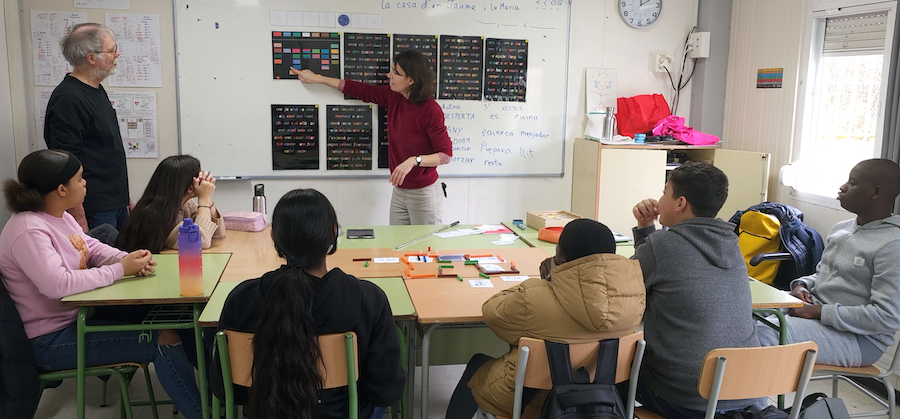
The students come from around the world and have been living in Catalonia for various amounts of time, some shorter, some longer. They need to work on their Catalan so they can participate in normal school and social life. They come to these Catalan language classes for various amounts of time each week depending on each student’s circumstances. The teachers have been using the Silent Way with these students since October 2025.
On the Monday of my visit one of the teachers and I taught the classes together. I provided the structure of the lessons and the teacher provided the Catalan – words, grammar, pronunciation, stress. Some parts of the lessons were filmed and we’ve made this short film documenting the work.
The sound-colour chart
Since October the teachers have been using the sound-colour chart in all their lessons to introduce new words and work on pronunciation. This chart is designed to give a precise way to refer to the sounds of a language in the classroom without using letters. Letters are often ambiguous, unhelpful for students from different linguistic backgrounds and a barrier for non-readers. The chart also gives a quick, precise way to give students feedback on their pronunciation by simply pointing to the coloured rectangles on the chart.
The teachers and I had built the chart through trial and error in our online lessons since July 2025. And since they’d been working with it since October 2025, the students were familiar with it.
Speaking is the priority
The spoken language is our priority, so we don’t use text books or worksheets or reading in our classes. And the students don’t take notes. Our goal is that they develop the skills to speak spontaneously and well. For that they need to store the language in their minds, not on paper.
The students spoke and got immediate feedback for the whole of the lessons illustrated in the film. There was no ‘teacher talk’ or explanations. Any talking that we teachers did, was minimal: just what was needed to direct and guide the activities.
The words on the board
In the film you’ll see various words written on the board. We introduced new words to the students using the sound-colour chart, and then worked on that word’s stress. This meant that the students first met these words by saying them and working on their pronunciation.
Only once the students could say them well, were the written forms shown. Either we, the teachers, or one of the students wrote them on the board. That meant we had something to point to if we needed to refer to them, and it eliminated any pressure on students to try to memorise these words. We wanted them to store this everyday vocabulary in their minds for the long term, by use, familiarity and practice.
Responsive teaching
Because the students were speaking all the time, we, the teachers, always knew what they could do well and where they needed more help or more practice. In other words we had the information to judge, moment-by-moment, whether to move on or whether to consolidate.
And because the lesson wasn’t pre-planned in detail or text book-based, it was easy to spontaneously adjust, vary or replay some of the action. And, if we judged the students were ready, to push them one step forward.
Feedback on students’ attempts
We gave feedback sentence by sentence, either by gesture or by pointing at a word or rectangle on the sound-colour chart. This meant students could immediately correct what they said and practise it. It also meant that everyone else could see and hear each mistake and its correction—so they could also learn from that process.
There are a couple of things in how we gave feedback that we could improve for the future:
- the first is practical. The room was cramped and with two of us working together sometimes we obscured some of the students’ view of the board.
- the second is a bit more subtle. We might have been over-helpful sometimes—perhaps partly because I was working with these students for the first time. As a general rule it’s better to give less help, provided the students stand a chance of fixing the problem themselves: the less we do, the more they do. And the more they do, the more likely that the learning will stick for the long term.
We’ve tested the approach … but there is more to do
As you can see from the entries about Catalan in this blog to date, our specific application of the Silent Way approach to teaching Catalan has been tested with two groups of students in two different contexts: a group of adult beginners in online lessons since July 2025 and groups of immigrant teenagers at school since October 2025.
But there is more to do: our next steps will tackle how best to work with students on the Catalan verb system. This was the main issue we teachers discussed when I visited the school and we came up with some promising ideas which we are developing and testing over the coming weeks and months.
Overall
The film illustrates a series of lessons where students were talking Catalan virtually the whole time, were enjoying themselves, and were learning at the same time. This way of working can be applied to any language.
The film demonstrates an important fact: you can create courses to teach students to speak a foreign language without text books, work sheets, exercises, readings or note taking.
Indeed, I’d make a stronger claim: we were able to get all the students speaking like this because we’d dispensed with all this language class paraphernalia.
Very nice. Thank you for sharing. Inspiring to see students drawn out like this. Drawn out by encouraging their curiosity. Quite refreshingly different from having page after page of a textbook shoved down them.
And ‘hats off’ to the two Catalan teachers we’ve been working with for their great work implementing this approach in their classroom. They’ve really transformed the lives of these kids new to Catalonia, haven’t they!