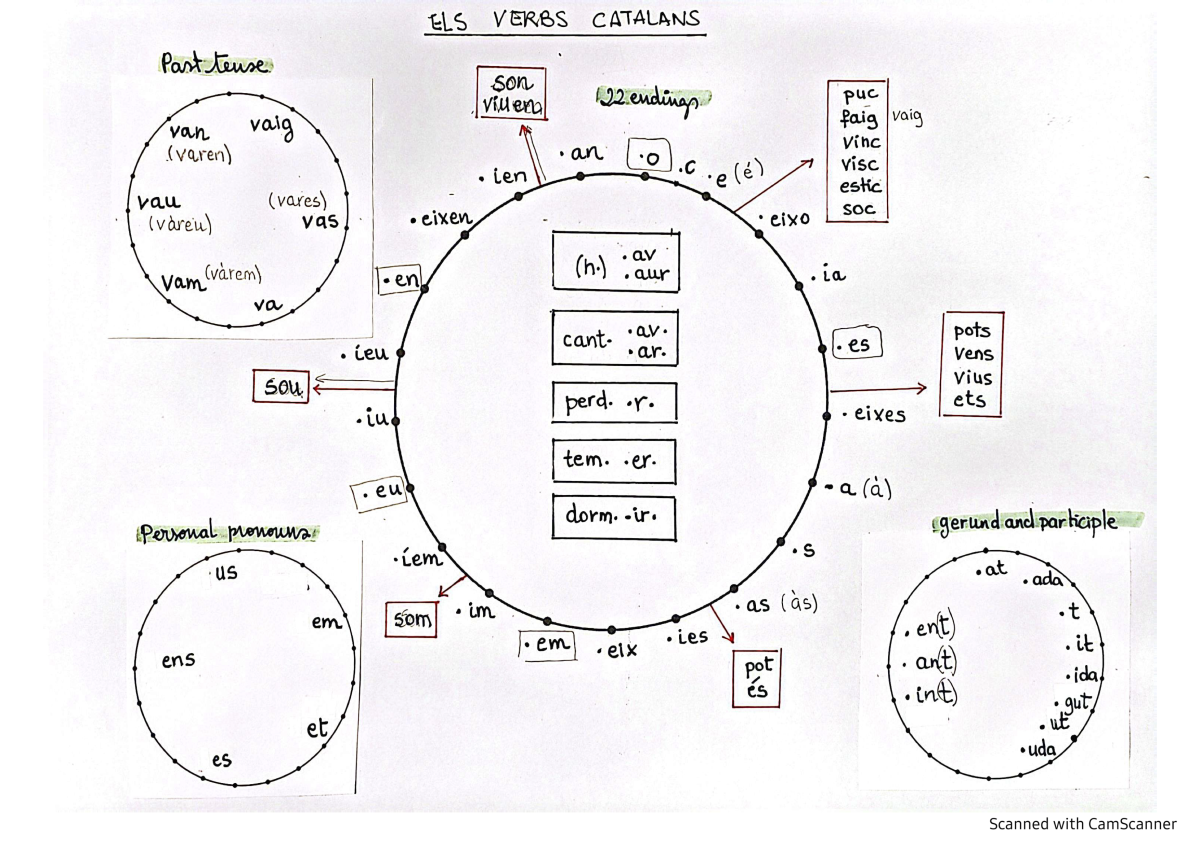
We’d been discussing how to help students master the Catalan verb system, and how we could devise classroom materials to help with this. In the film below, you’ll see us trying out a first draft of a new chart designed by our two Catalan teachers to help teach verb conjugations.
We were looking for something that:
- minimizes the need for memorisation. Memorisation saps students’ energy—something they need an abundance of to learn well. What’s more, even when students work hard at memorising things like verb endings, the results are usually unreliable
- avoids intellectualisation, which all too often leads to ‘knowledge about’ the language rather than the ‘know how’ to speak
- helps students uncover the patterns in the language, and helps them to see that the system isn’t endless—there are always only a limited number of possibilities to choose from
- would be easy to use in the classroom to introduce new verbs and new forms, and to give students immediate feedback
- would support students’ practise in class so that using the verbs would gradually become easier, more fluent and more accurate.
A verb conjugation chart
The teachers built on work done over the years for other languages, and, of course, their knowledge of Catalan. And they continued our use of ‘rapid prototyping’ when developing materials—create something, try it out quickly, consider how it worked and then try again.
The first sketch of the chart our teachers created is above in this blog post and the film below shows extracts from a couple of lessons where we tried it out:
When to introduce this kind of chart?
This kind of work needs to come at the right time in a course. We’d already had a fair amount of experience of the language, and in our previous lessons we’d worked with these verbs, albeit solely in the third person. That gave us a solid stock of experience speaking the language and of using verbs to build on. It wouldn’t be wise to try to use a chart like this with students with much less experience of the language and of this way of learning than we already had.
We took it step by step. In the first lesson illustrated in this film we started with talking in the 1st person about a morning routine. And then in the subsequent lesson we extended that until we were using 1st, 2nd and 3rd persons.
This slow build up is important: students need practice and time to assimilate every new stage properly. The benefit of this step-by-step approach shows in the second lesson in the video: we were noticeably less hesitant and much more fluent with these new verb forms even after just one lesson.
It’s a teaching tool, not a reference work
The charts we’re aiming to build are teaching tools, designed for use in the classroom. We’re not creating reference works, although once students have got used to this kind of chart they often like to take copies home to jog their minds when they practise.
There’s more work to be done, but its a good start.