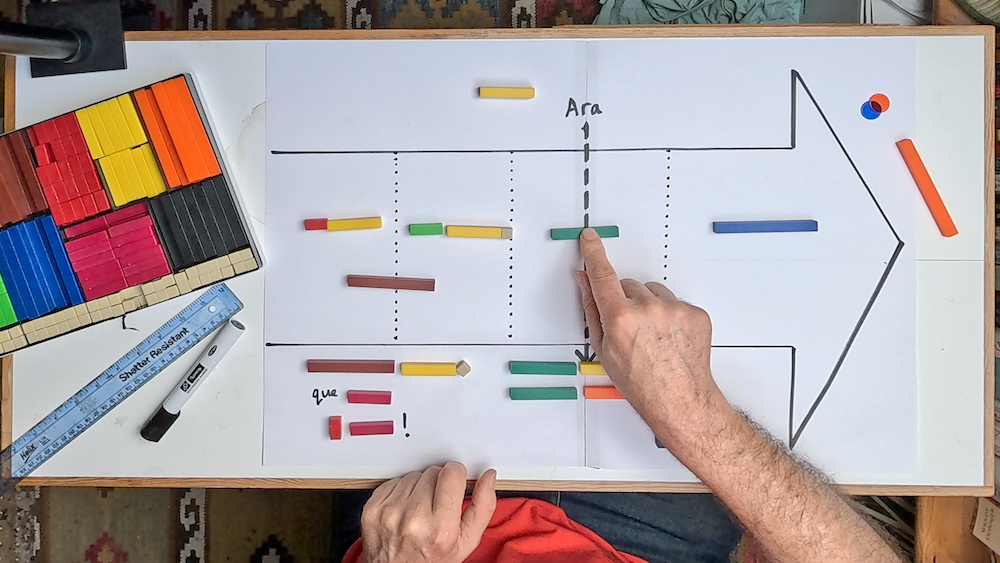
Recently we’ve been developing tools to help teach the verb system of Catalan. We want students to develop an intuitive sense for:
- how verbs conjugate
- the different tenses
At the moment we’re experimenting with this ‘arrow’ model to work on the tenses (we’ve already developed a verbs ‘wheel‘ to work on conjugation). Each of the rods represents one of the tenses, and their arrangement symbolises something about how they relate to each other and to the passage of time. It’s not a grammarian’s or a linguist’s description of the language. It’s a teaching tool, to help students develop, intuitively, a sense for how the different tenses are used, their relationships and their differences.
The idea is to enable students to tie together the tenses and their usage without grammatical terminology and explanations. Apart from anything else this avoids students intellectualising about the language – which tends to hinder the development of their speaking. Because the model is visual, we and our students can simply point on the model when we want to analyse a sentence a student has said, or when we need to give feedback or when a student needs a hint about where to start.
For example, in this model the green rod in the middle on the dotted ‘ara’ (now) line represents the so-called ‘present’ tense, the blue one on the right the ‘future’ tense and the yellow one at the top, the infinitive.
As with everything else in this Catalan project, we’re developing this tool by trial and error: by using it, seeing what works well and what doesn’t, and adapting as we go.
In this video you’ll see us using this model in a recent lesson.
For anyone who’s interested, similar models have been developed for English, French and for Spanish. Of course, each of these models are rather different, reflecting each language’s unique character.