At the beginning of April, Roslyn Young and Piers Messum of Pronunciation Science Ltd and I started work on the possibility of creating virtual classrooms using gaming technology, to teach online using the Silent Way. None of us had any experience of the online gaming world, but it clearly had possibilities.
We now have virtual classrooms for British English, American English and French, designed to be used alongside video conferencing such as Skype or Zoom. These classrooms accommodate up to eight people and are completely interactive – everyone can move or manipulate the objects in the classroom together: they really are shared, virtual spaces. These classrooms can be used to work on every aspect of the language:
- pronunciation
- every aspect of the functional vocabulary (ie grammar)
- spatial relationships, temporal relationships, family relationships etc
- the calendar, the clock, comparisons, numbers, doubt, guessing etc
- free conversation led by the students
- spelling
They have been thoroughly tested for use with a student 1:1 and we’ve started testing them with groups of students with promising results. My report on this process and the lessons learnt, Teaching with the Silent Way in Virtual Classrooms/Enseigner en silence dans des sales de classe virtuelles, June 2020 is available, please click here.
Just one example
Below is a screenshot from the British English classroom in use. In this case we were working on a student’s sentence, which after the process described below became something like: ‘Last weekend we visited my parents in Marseille and swam in the Mediterranean’. (NB. This has been adapted from the student’s actual sentence to preserve anonymity.)
All the elements you see in the classroom, except for the green background, can be dragged in or out of the view as required, and in response to whatever need becomes evident for the class. These are just a few of the tools available, but they are some of the most useful. In fact the pointer is the most used tool – it is used all the time to draw attention to an object or sound or word, point to where there might be errors, for looping gestures inviting the students to change the rhythm of what they are saying, or for gestures inviting the student to slow down and work on every single syllable one by one etc etc.
We started with the student’s original version, represented it as ‘word lines’ on the brown tray, used pointing on the relevant word lines and on the word charts to enable the student to correct any grammatical mistakes, used the sound colour chart (which was already familiar by this stage in the course) plus actual gestures (using the Zoom video) to work on any sounds that needed improvement and to solve most of the problems with stress and reduction. One word ‘Mediterranean’ needed more detailed work, so we used the syllable symbols to work on how many syllables it had, where the main stress was, where the reduced sounds were and where the full but unstressed vowel was.
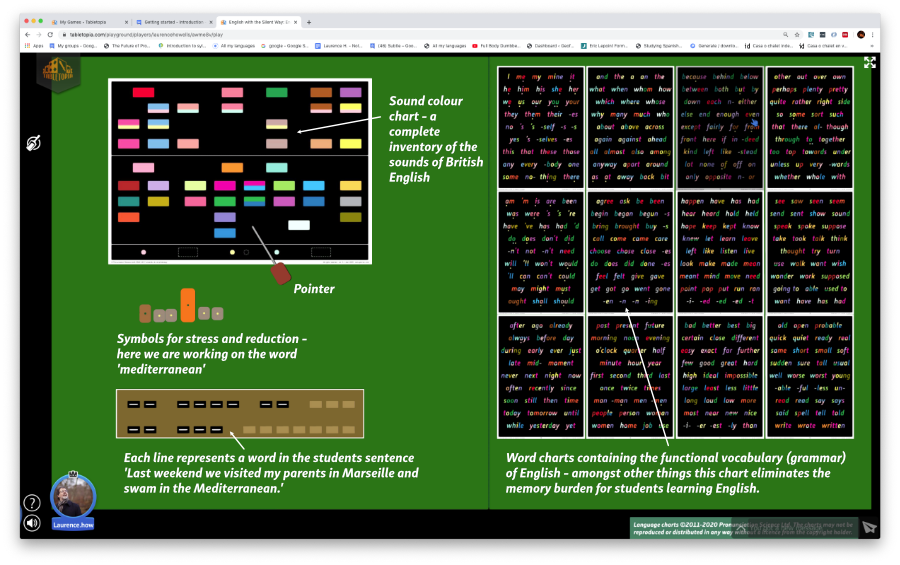
Once these details were established, the student practiced saying the complete sentence, trying to keep all these elements sounding native-like. Holding the whole sentence in the mind and using their vocal apparatus to say the complete sentence required a lot of presence. But practising in this way charges the mind with correct grammar and good pronunciation and, cumulatively, as the students work on more and more sentences, grows their intuitive know-how of how to express themselves in English.
A shared virtual space
The key thing that these classrooms create is a shared, but virtual, space, where teachers and students can see, manipulate and point to objects and charts, wherever the participants actually are in the world. Why is this important? Because:
- we can avoid writing or aural imitation to teach pronunciation: by pointing to the charts in the classroom and gestures, we can train students to use their muscles in the way natives do to make the sounds and energy patterns of that language. This makes it much easier for them to escape the grip of their own native speech and spelling patterns.
- meaning comes first: students’ perception of what they see in the classroom means that meaning can be established unambiguously before the language is introduced – a far faster, easier and more reliable way of establishing the association between meaning and language for beginning students than alternatives such as translation or explanation. In the case of the lesson described above, where the student was sufficiently advanced to launch his own sentence, meaning came first from their memory of the events of last weekend and we used the tools in the classroom to shape language to express their thought accurately and correctly.
- memorisation is minimised: instead students acquire the language through familiarity. That’s why the word charts are so useful – students can get used to the entire functional vocabulary of English without any need to memorise – by pointing on the charts and saying their sentences out loud they gradually become familiar with all these words and their use.
- trial and error, feedback and self-correction builds students’ mental models of the language: by pointing, the teacher can visually guide the student to where a correction is needed and where to seek for the solution. And once it is corrected the student can practice the correct version until they have charged their mind with accurate and correct language. Not only that, everyone else can see and contribute and learn from the same process. And, of course, students can point too and this is invaluable in showing their thinking and in reinforcing how the language works.
- everyone is working all the time: because nothing is written down, everyone has to hold the sentence that is being worked on in their mind, and that leaves a much stronger trace in their minds.
Each virtual classroom contains a lot of different tools designed to make it easier to teach different aspects of the language, but it is the interactive space, virtual, but shared amongst the participants, rather than the plethora of tools, which makes it so effective.
There is potential here both short term – to mitigate the current constraints of the pandemic on people sharing real spaces together – and longer term – to make it possible to teach remotely using the techniques and resources developed by Silent Way teachers over the last half century.
Please contact me if you would like to find out more, or if you would like to learn English or French remotely using the Silent Way. My email is laurence@allmylanguages.com.