Tangible grammar

The first stage of learning something is being aware that there is something to learn. This is often a quite small sign that something is not quite right, or that something could be better. Noticing small things like this is the start of the learning process. Until these small awarenesses are triggered then the rest of the learning process (research and trial and error, practice, and integration) can’t be triggered. Equally, these awarenesses can be clues as to what you need to do to make the improvement required.

For teachers therefore, there is a very important question – how do we best provoke these awarenesses in our students so the learning process starts? ‘Tangible grammar’ is one very useful way of doing this (see also here).

For example, I was working with a class on a series of sentences they had generated about what they did in the week.  Once we’d worked on it, one person’s sentence was:

‘On Tuesdays I sometimes work and then in the evening I come to this school’

I laid out 14 red rods and one green one like this with each rod representing a word (the green one represents ’and’ and helps to orientate the class). As I put the green one down, I waved it and pointed to ‘and’ on my wall chart to make sure people knew what it represented.

Some Cuisinaire rods illustrating 'tangible grammar'
‘On Tuesdays I sometimes work and then in the evening I come to this school’

The person was right at the right hand end of the row of seats, so it was easy to point to the rest of the class and indicate they should change the sentence to refer to the originator of the sentence. To make this really clear I pointed to the person we were to refer to and to the words at the start of the sentence ‘On Tuesdays she …’ on the wall charts. And then I waited to see what the class would come up with. After a few attempts someone came up with:

‘On Tuesdays she sometimes work and then in the evening she come to this school’

I marked the words where something needed to change in this sentence by adding a beige rod on the end of two red rods like this:
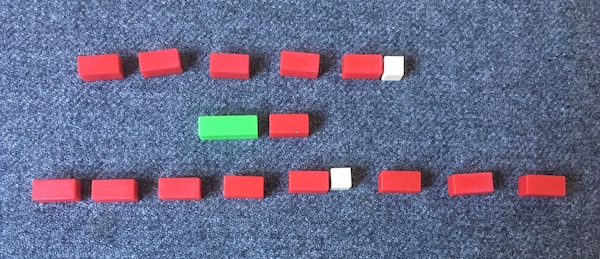
Some Cuisinaire rods illustrating 'tangible grammar'
‘On Tuesdays she sometimes works and then in the evening she comes to this school’

Given this was an elementary class, I helped them by pointing to the ‘s’ sound on my wall charts and to the first beige rod and then to the ‘z’ sound on my wall charts and pointing to the second beige rod. And then I worked with the class until they could say this correctly, distinguishing the two different sounds the letter ’s’ takes.  At which point we had:

‘On Tuesdays she sometimes works and then in the evening she comes to this school’

With this established it was easy to remove the beige rods and indicate to the person whose sentence it was and get her to say the ‘I’ version of the sentence; and then add the beige rods back and get the rest of the class to say the ‘she’ version. It’s important that the students stay in their groups when they do this type of work – we’re trying to establish an accurate intuitive relationship between meaning and linguistic form, so we don’t want a student in the rest of the group saying the ‘I’ version even if they say it correctly – they have to say the ‘she’ version because that’s the only one that’s true to their situation.

Alternating who is speaking a few times, supported by the sight of beige rods being added and taken away, provokes the awareness in the students of what has to change in this sentence depending on who is saying it. This tangible grammar lesson can be strengthened by getting one of the students to add or take away the beige rods – this can provoke a new level of awareness – they have to be precise about which two rods (words) need a beige rod adding.

We then repeated this lesson with someone else’s sentence turning:

‘On Mondays I work hard and later I relax’

Some Cuisinaire rods illustrating 'tangible grammar'
‘On Mondays I work hard and later I relax’

into:

‘On Mondays he works hard and later he relaxes’

Some Cuisinaire rods illustrating 'tangible grammar'
‘On Mondays he works hard and later he relaxes’

If someone missed a word out or mispronounced a word when they were practising, I simply pointed to the rod (word) where the problem was and thus helped them to be aware of where they need to make a correction. This is very precise and can be done casually without making anyone feel awkward or at fault.

By this time, the class had had lots of practice and were starting to get new English knowhow installed. Including, for example, that:

  • something changes in an English sentence depending on who is speaking
  • sometimes an ‘s’ sound and sometimes a ‘z’ sound and sometimes an extra syllable with ‘ez’ gets added
  • that they need to know precisely which word to add these sounds to
  • that English spelling doesn’t distinguish the ‘s’ and the ‘z’ sounds

The real situation plus the visual metaphor of adding a beige rod to a word is a great way of getting this grammatical knowhow installed without any need to talk about verbs, or endings, or the third person, or the first person or any of this ‘teacher talk’. And it’s a great way to get the class to help each other and to identify exactly where the problem lies. We can call this ‘tangible grammar’.

The key thing is keeping the work as grounded in reality and as tangible as possible so that we can rely on students’ perception to become aware of what they need to do; and then make sure they get plenty of practise.
Putting it all together

We need to work on so many different levels when we are learning to speak a foreign language. The unfamiliar words need to be there, sequenced in what might also be an uncomfortable order for us, and with modifications or inflections that might seem surprising to us if these are different from our native tongue. And then … we have to make a series of strange movements of our mouths, voice box and lungs to actually say whatever we’re working on.

Babies have hours and hours of practising each of these elements and how to co-ordinate all of this so that by the time they are toddlers they can chatter flawlessly in their native language. It’s not surprising, therefore, that when we learn a foreign language as an adult we need lots of practise on each of the elements and on putting it all together. This is exactly the issue identified by K Anders Ericsson which he refers to as ‘Deliberate Practice’ see here.

I was struck by exactly this issue the other day when coaching a student who was working on saying the question ‘How many brothers and sisters do you have?’ His difficulty was the /z/ sounds that we need to hear at the end of the words ‘brothers’ and ‘sisters’. He could manage to coordinate nearly everything , but the two plurals was just too much for him, so he would alternate:

‘How many brothers and sister do you have?’

with

‘How many brother and sisters do you have?’

I should say that his native language doesn’t inflect in this way, so even the idea of signalling a plural by modifying the end of a word must have been a big leap out of the comfort zone of his oh-so-familiar first language.

I felt he needed something to slow down his movement from one word to the next so that he would have the time and mental resources to add the grammatically and phonologically unfamiliar /z/ sound. And that once he’d taken the time to do that, and practiced it a few times, he would then be able to gradually build up his linguistic ‘stamina’ in this strange English language.

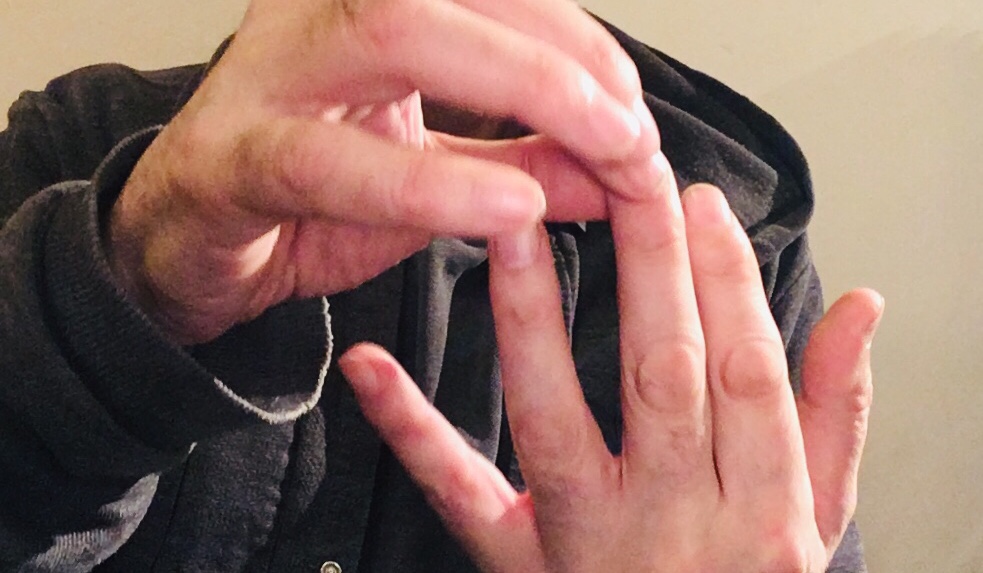
Using the fingers to help a student correct his sentence

I slowed him down by metaphorically putting each word ‘on’ one of my fingers and then pointing to them one by one as he said the sentence and wiggling the fingers representing ‘brothers’ and ‘sisters’ as we got to them to remind him they needed special treatment. This did seem to help and I was really impressed by the effort he had to make to deviate from so many incredibly-strongly established mental and physical habits from his native speech.

I have been exactly there on so many occasions in my language learning, and I can recall so strongly that feeling of having to put to one side what comes so naturally to me in English and be mentally and physically different.

This is difficult work, but with practice and coaching we can add a new way of functioning in a new language. And just like any other human activity it’s careful deliberate practice that enables us to put it all together into something that suddenly flows and feels and sounds ‘right’.

Talking about jobs

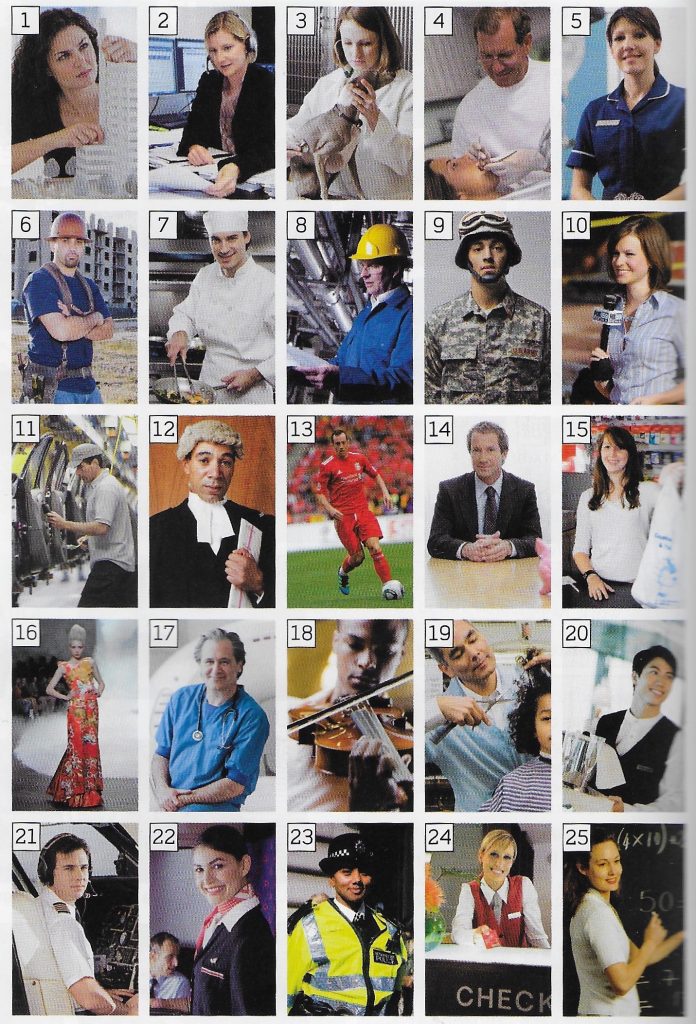
My brief for today’s class was to help the students learn how to talk about different jobs in English. The text book has a set of jobs and pictures for each job – nurse, a soldier, a model, a footballer, a doctor etc.

An image of jobs from a text book, but how do we free students from the text book?

I was a bit nervous about working with this, mostly because all the jobs in the pictures seemed so far from any likely experience of the students. I decided to enlarge the pictures from the book, stick it up on the whiteboard and use one of the jobs as a starting point … and then see what happened.

So I pointed the sentence ‘What does he do?’ on my word charts, and worked with the class until their pronunciation of this sentence was good. And then I pointed (at random) at the footballer … and we created and practiced ‘He plays football’.

We went on to the soldier and with some work generated ‘He’s a soldier and he shoots a gun and runs and drinks’ … their idea not mine …

One of the students pointed to the teacher, so I pointed the sentence ‘What does she do?’ … and got her reply which we then worked on until it was correct and well-pronounced. What was amazing, and so exciting for me was that her reply was absolutely not ‘She’s a teacher’ or similar. It was ‘She writes on the blackboard’.

For me this was a very important moment – what happens when we free students from the text book and let them express their own perspectives?

It was clearly time to open this game up, so I pointed to the sentence ‘What do you do?’ And then opened my arms and invited someone to speak. And after some work we got some pretty adventurous language including:

‘I plant trees in the nursery’
‘I plant trees too’
‘I’m a picker in the mushroom farm’
‘I run my business selling shoes on the internet’

How much richer is the whole experience when the students can talk about their own lives! And my job as a teacher is to enable them to find the language to express what they have to say and get them to practice it so it becomes fluent.

I knew this in theory but it was so inspiring seeing and hearing it happening practice.

The stress and reduction system of English

One of the most difficult things for native speakers of other languages about English is the pattern of stressed and reduced syllables in English words.  In most languages the vowel in every syllable is clearly heard. So speakers of Spanish, French, Italian are very puzzled when they hear English speakers saying things like:

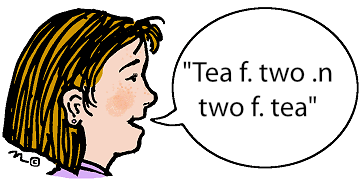
‘Tea for two and two for tea’

Which in normal speech comes out more like: ‘Tea f. two .n two f. tea’

Or

‘A quarter to two’

Which in normal speech comes out more like: ‘.quart. t. two’

where the dots represent almost non-existent, very low energy sounds.

It turns out that about 50% of speech sounds in normal English have this character, being weak, very low energy and often almost non-existent.  So one of the jobs of a teacher trying to give our students good pronunciation is to teach how to make these sounds and this curious rhythmic pattern.

One of the best ways of teaching stress and reduction in English is to get the students to stutter.  For example, if they practice saying ‘ttttttttt two’ and then reduce the number of stutters down to three they will get ‘t.t.two’ which is exactly what they need for the end of ‘A quarter to two’.

What’s particularly important about this, is that once students have experienced the existence of these reduced sounds and produced them themselves, they are equipped to hear them and thereby understand better what these English natives are saying and doing when they ‘swallow their words’.

I was really pleased when I tried this with the students in the East Lothian elementary English class. We were working on the sentence ‘We all yelled for bananas and cream’ which should be ‘Wi all yell.d f. b.nan.s .n cream’. Getting them to practice stuttering from ‘f’ to ‘b.’ ie ‘fffffffb.’ did exactly what was needed to make this very tiny sound.

This technique for teaching stress and reduction and the examples, I learnt from the online course Teaching Pronunciation Differently (Electronic Village Online Jan-Feb 2019) which I highly recommend.

What happens when a language teacher remains silent?

Although … ‘silent’ doesn’t mean mute. It means that the language teacher avoids giving an aural model for the sounds of the language. But through mime, gesture and any other means we can think of, we get the students to experiment and then through feedback from the teacher (‘that’s it!’, ‘tongue a little further back’, ‘that’s too long’, points to voice box, thumbs up sign, etc) discover for themselves what they need to do to make the sounds of the language.

I tried this for the first time as teacher with the elementary english class I’m volunteering with the other week.

  • At first, the class were absolutely mystified as to what they were supposed to be doing
  • Then they started guessing intelligently and using my feedback to home in on the sound we were working on
  • As they got used to the idea I noticed more and more experimentation going on and also expanding certainty on how to make a number of sounds
  • They were focusing on what they were doing with their mouths and their breath and not being distracted away to their ears and hearing
  • They were doing and practicing, not thinking or intellectualising
  • Above all, they were doing the work, not simply hearing the answer from the teacher and almost passively copying it

All of this, seems to me to be as it should be. Speaking English is a physical act of the breath, the voice box, the mouth, the lips etc. If students are going to pronounce well they need to do something different with their bodies from what they are so well used to in their native language.

Training in mouth and breath gymnastics of a whole set of new moves. 

And for the language teacher, I realised even more strongly how silence is a great tool for making sure responsibility for learning is with the students – they have to make the sounds not me.