The first stage of learning something is being aware that there is something to learn. This is often a quite small sign that something is not quite right, or that something could be better. Noticing small things like this is the start of the learning process. Until these small awarenesses are triggered then the rest of the learning process (research and trial and error, practice, and integration) can’t be triggered. Equally, these awarenesses can be clues as to what you need to do to make the improvement required.
For teachers therefore, there is a very important question – how do we best provoke these awarenesses in our students so the learning process starts? ‘Tangible grammar’ is one very useful way of doing this (see also here).
For example, I was working with a class on a series of sentences they had generated about what they did in the week. Once we’d worked on it, one person’s sentence was:
‘On Tuesdays I sometimes work and then in the evening I come to this school’
I laid out 14 red rods and one green one like this with each rod representing a word (the green one represents ’and’ and helps to orientate the class). As I put the green one down, I waved it and pointed to ‘and’ on my wall chart to make sure people knew what it represented.

The person was right at the right hand end of the row of seats, so it was easy to point to the rest of the class and indicate they should change the sentence to refer to the originator of the sentence. To make this really clear I pointed to the person we were to refer to and to the words at the start of the sentence ‘On Tuesdays she …’ on the wall charts. And then I waited to see what the class would come up with. After a few attempts someone came up with:
‘On Tuesdays she sometimes work and then in the evening she come to this school’
I marked the words where something needed to change in this sentence by adding a beige rod on the end of two red rods like this:
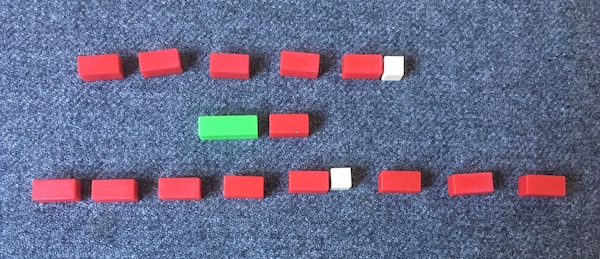
Given this was an elementary class, I helped them by pointing to the ‘s’ sound on my wall charts and to the first beige rod and then to the ‘z’ sound on my wall charts and pointing to the second beige rod. And then I worked with the class until they could say this correctly, distinguishing the two different sounds the letter ’s’ takes. At which point we had:
‘On Tuesdays she sometimes works and then in the evening she comes to this school’
With this established it was easy to remove the beige rods and indicate to the person whose sentence it was and get her to say the ‘I’ version of the sentence; and then add the beige rods back and get the rest of the class to say the ‘she’ version. It’s important that the students stay in their groups when they do this type of work – we’re trying to establish an accurate intuitive relationship between meaning and linguistic form, so we don’t want a student in the rest of the group saying the ‘I’ version even if they say it correctly – they have to say the ‘she’ version because that’s the only one that’s true to their situation.
Alternating who is speaking a few times, supported by the sight of beige rods being added and taken away, provokes the awareness in the students of what has to change in this sentence depending on who is saying it. This tangible grammar lesson can be strengthened by getting one of the students to add or take away the beige rods – this can provoke a new level of awareness – they have to be precise about which two rods (words) need a beige rod adding.
We then repeated this lesson with someone else’s sentence turning:
‘On Mondays I work hard and later I relax’

into:
‘On Mondays he works hard and later he relaxes’

If someone missed a word out or mispronounced a word when they were practising, I simply pointed to the rod (word) where the problem was and thus helped them to be aware of where they need to make a correction. This is very precise and can be done casually without making anyone feel awkward or at fault.
By this time, the class had had lots of practice and were starting to get new English knowhow installed. Including, for example, that:
- something changes in an English sentence depending on who is speaking
- sometimes an ‘s’ sound and sometimes a ‘z’ sound and sometimes an extra syllable with ‘ez’ gets added
- that they need to know precisely which word to add these sounds to
- that English spelling doesn’t distinguish the ‘s’ and the ‘z’ sounds
The real situation plus the visual metaphor of adding a beige rod to a word is a great way of getting this grammatical knowhow installed without any need to talk about verbs, or endings, or the third person, or the first person or any of this ‘teacher talk’. And it’s a great way to get the class to help each other and to identify exactly where the problem lies. We can call this ‘tangible grammar’.
The key thing is keeping the work as grounded in reality and as tangible as possible so that we can rely on students’ perception to become aware of what they need to do; and then make sure they get plenty of practise.