
A lot of people discuss the ‘forgetting curve’ in the context of using spaced repetition systems to memorise foreign language words. The argument is that newly encountered words tend to be quickly forgotten, and periodically reviewing them slows down the rate that they are forgotten. Eventually, effectively, these words become part of a student’s long term memory. These reviews are what a spaced repetition system organises for you.
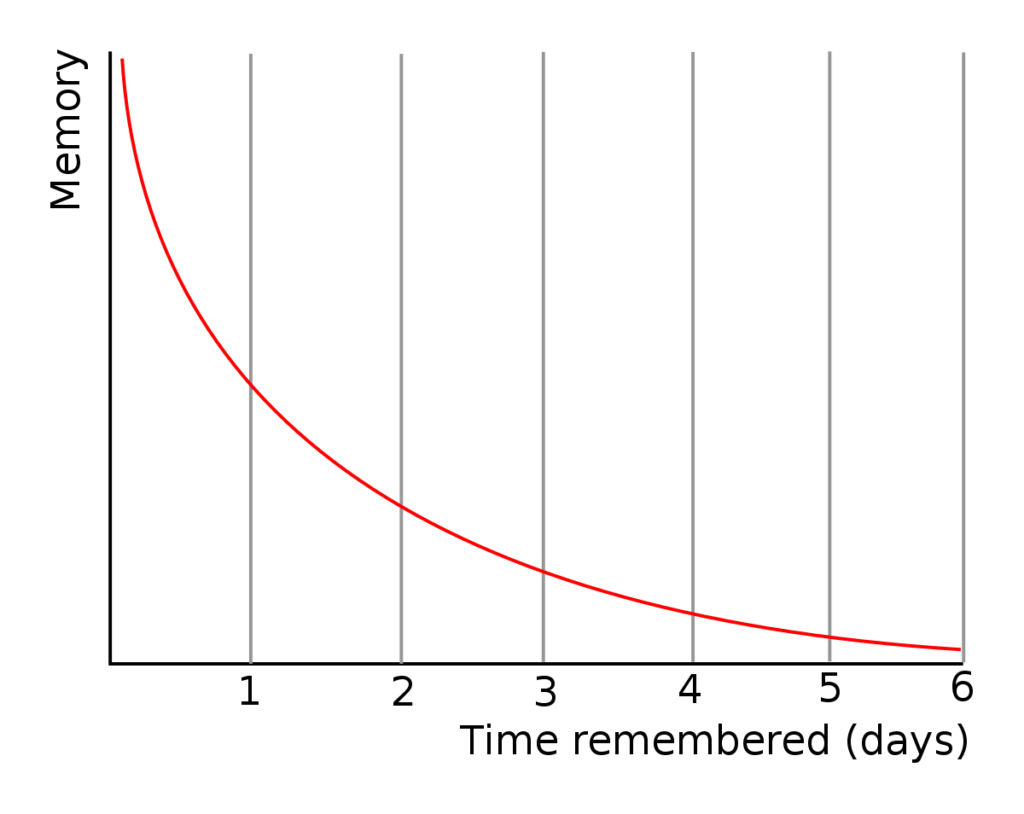
This all seems very scientific, and probably resonates with most people’s experience of trying to memorise vocabulary lists or spelling lists or history dates at school.
But it doesn’t fit with my recent experience of learning both Japanese and French. Neither ‘forgetting’ nor ‘memorising’ seem to have really played any part in those two experiences.
Does the ‘forgetting curve’ really apply to language learning?
For one thing, the original scientific studies on which the ‘forgetting curve‘ was based, researched memorisation of nonsense syllables. Surely, memorising nonsense syllables is far, far, far from what we are trying to do when learning a foreign language?
The new foreign words we are learning carry meanings, they fit into the overall phonetic and syllabic patterns of the language, they often also fit into word families, and they are inextricably imbued with the music of their sounds and rhythms. Not to mention, the contexts in which we come across them and the emotional effect they carry. So all our new words come with all kinds of connections to the real world, to our feelings and to other words.
If the ‘forgetting curve’ describes the ‘down’ escalator, is there an ‘up’ escalator?
Suppose we meet some new vocabulary in a lesson. Say, the rooms in an apartment and some of the verbs used to say what people do in their homes. And we get to say these words: we experience what they feel like ‘in our mouths’. And we get to use them in sentences: what’s in the different rooms? what’s their layout? what’s someone doing in a particular room? how do you get from one room to another?
After a lesson like this, what consistently happens to me is that, immediately after the lesson, I think ‘I don’t remember most of those words.’ This doesn’t bother me, because I know what’s likely to happen next.
The next day, after a night’s sleep, most if not all the words will have ‘magically’ become available to me. And when I turn up at the next week’s lesson, all but a very few will be pretty secure. And if there are one or two I’ve forgotten or have muddled up, my teacher or someone else in the class will help me out. And by that point these new words will seem to be no longer ‘new’. They’ve become, more-or-less, as permanent as English words, though they usually take a bit more work to actually get into my mouth, when I need them.
You can see real examples from exactly this type of lesson and the facility a few night’s sleep seems to provide in this video.
So, after lessons like these, recall seems to strengthen over time without me doing very much …
Why should these memories strengthen?
It’s well known that sleep consolidates and enhances learning. Put simply, skills we’ve practiced (especially motor skills, like speaking) improve during sleep, without any further practice. I think this is what we’re exploiting in lessons that operate like this: everyone gets an extra benefit, provided they get a few good night’s sleep.
Now, if my experience is anything to go by there are some things that make it more likely we will climb on the ‘up’ escalator and not on the ‘down’ one. We’ll increase the ‘charge’ lodged in our mind by the work done in the lessons, and therefore the benefits of sleep, if, during our lessons:
- we stay present to what’s happening. Daydreaming, writing notes, staring out of the window, not noticing what others are doing – all of these, diminish the experience
- we actually talk. The physical act of saying words out loud is quite different from any amount of silent, mental, or written work
- we practise each sentence until we achieve at least a degree of ease saying it
- we make sentences that refer to things we know are real or true, because this always gives our words a firm context. Making stuff up in a language lesson is far less effective: this is not the place to be creating fiction. Save that for a novel
The ‘remembering curve’

So, I’d like to propose that we start talking about the ‘remembering curve’ which seems to be as much a part of our human nature as the other one. What’s more, it operates ‘for free’: providing we optimise how we approach our lessons.
In our daily lives, we keep learning new words and how to use them. One example that’s often an object of attention is names: people’s names or places’ names, for instance. Some people think they’re bad at remembering new names, other have strategies, some might even use flashcards for those, who knows. I’m pretty sure it’s terribly linked to the attention you give the new word, how familiar it sounds to you, and how committed you are to remembering it. If the name is hard to pronounce for you, you’re likely to have a hard time recalling it precisely later. If the circumstances are really special and you get to use the name several times in meaningful contexts, usually that’s a name you’re not going to forget easily: think of a romantic first encounter, or a horrible client, or a very helpful neighbor maybe. On the other hand, if the person means very little or if you’re distracted by seemingly more important things, you may have a hard time even recognizing the name later on.
I’m adding these examples because I think we sometimes look for weird ways to learn vocabulary for a new language, forgetting that we learn new words all the time, and without the help of SRS. There are some lessons in observing this: as you said, using the new vocabulary in a meaningful way is crucial. Being as comfortable as possible with the pronunciation system, knowing related words, letting sleep do its consolidation work, and so on…