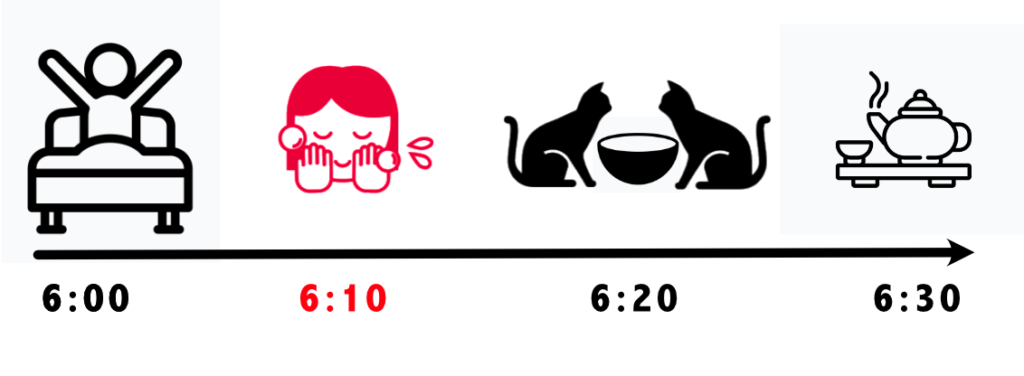
Watch this video (3m 42s) from one of my Japanese lessons (click here). You’ll see me trying to say a sentence, and making various attempts until I arrive at a correct version. You don’t need to know Japanese to see what’s going on.
What you’ll see is a process of trial and error, intelligent guessing and immediate feedback. This is potent, far more potent than a teacher just giving a model and the student copying a correct sentence, or being given the correct answer straight away, or not getting any feedback on the grounds that the first attempt was ‘comprehensible’ anyway.
Intriguingly, research findings show that trying to answer a question powers learning, even when the student provides a wrong answer, and even if they could not possibly know the correct answer. Just trying to answer is sufficient – if, but only if, feedback is provided immediately, and the student gets the chance to correct their attempt. On the other hand, it seems that if feedback is delayed then the student’s error is strengthened (Hays, Kornell, & Bjork, 2012)
As Roediger and Finn stated in Scientific American (2010):
‘Getting the answer wrong is a great way to learn—as long as you receive the correct answer shortly afterward.’
This research helps to explain why one of the cornerstones of teaching languages using the Silent Way – trial and error and immediate feedback – works so well. And why delaying (or not even giving feedback) is a poor idea.
It is sometimes argued that teachers shouldn’t correct students’ attempts, presumably because people think this will stop students’ ‘flow’ and may demotivate them. And Krashen argues that error correction is ineffective for acquisition and should only be used in very limited circumstances (written work and grammar exercises).
‘Acquisition occurs, according to the input hypothesis, when acquirers understand input for its meaning, not when they produce output and focus on form.’
Krashen (1982, p117)
But done the right way it is the most powerful tool in a teacher’s pedagogic tool kit.
Have another look at the video. And ask yourself questions like: What was the teacher doing? What was the student doing? What was the other student doing? How much time was being taken? Was it well spent?
For example, you might see some of the following:
- in the space of about 3 minutes, I launched my sentence and over the course of eight attempts eventually arrived at a correct version
- As well as body language and tone of voice, my teacher used her fingers to pinpoint where the problems were, showed me where to look on the wall charts to find a word I needed, and hummed the rhythm and melody of a phrase
- The process of arriving at the correct sentence was one of discovery, with me sometimes introducing new incorrect possibilities as we proceeded
- Nothing was written down and my teacher didn’t give me a model to copy
What you don’t see in this short extract is what happened afterwards. As a result of this few minutes work, both my fellow student and I were confident saying this kind of thing, and we easily extended the descriptions to encompass all the items of Yoko’s typical morning and our own.
What’s more, my fellow student then felt emboldened to try experimenting with ‘before drinking Japanese tea …’. Which meant that we discovered this doesn’t work in quite the same way. But it didn’t take long, through exactly the same kind of process, for us to grasp how to say things like ‘before drinking Japanese tea/before feeding the cat/before washing her face …’.
All of this is now ‘obvious’ to me – indeed, watching the video again it seems weird to me that a few days ago I should have had such bizarre ideas about how this kind of thing might be said. In other words, the process of exploration, feedback and discovery has added another firm detail to my Japanese mental equipment.
References:
Hays, M. J., Kornell, N., & Bjork, R. A. (2012, May 14). When and Why a Failed Test Potentiates the Effectiveness of Subsequent Study. Journal of Experimental Psychology: Learning, Memory, and Cognition. https://bjorklab.psych.ucla.edu/wp-content/uploads/sites/13/2016/07/Hays_Kornell_RBjork_inpress.pdf (accessed May 29 2023)
Krashen, S.D. (1982). Principles and Practice in Second Language Acquisition. The Modern Language Journal, [online] 67(2). doi:https://doi.org/10.2307/328293.
Roediger H. L. III, Finn B., Scientific American, (March 1, 2010) https://www.scientificamerican.com/article/the-pluses-of-getting-it-wrong/ (accessed May 23 2023)
I agree with your views, and also think that not correcting a student because it might demotivate them, or somehow ‘break their flow’ is a nonesense. As you made clear, feedback is key to learning and students can tell when they’re improving and making steady progress. So, if they’re giving the chance to think about their mistake (as opposed to giving the right answer straight away), they’ll feel really satisfy if they manage to fix it, or if they can feel that it’s beyond their current capacity and get the final correction from a peer or from a teacher. What’s frustrating is feeling that you might be saying tons of things wrong but no one really warns you, or that you’re told what the correct sentence is but with no chance to practice it at all.
Knowing that the teacher will give feedback when something’s wrong is also being sure that as long as the teacher *isn’t* giving feedback, then what we’re saying is correct. This is really empowering, and make us feel confident about what we know and what we still need to work on.