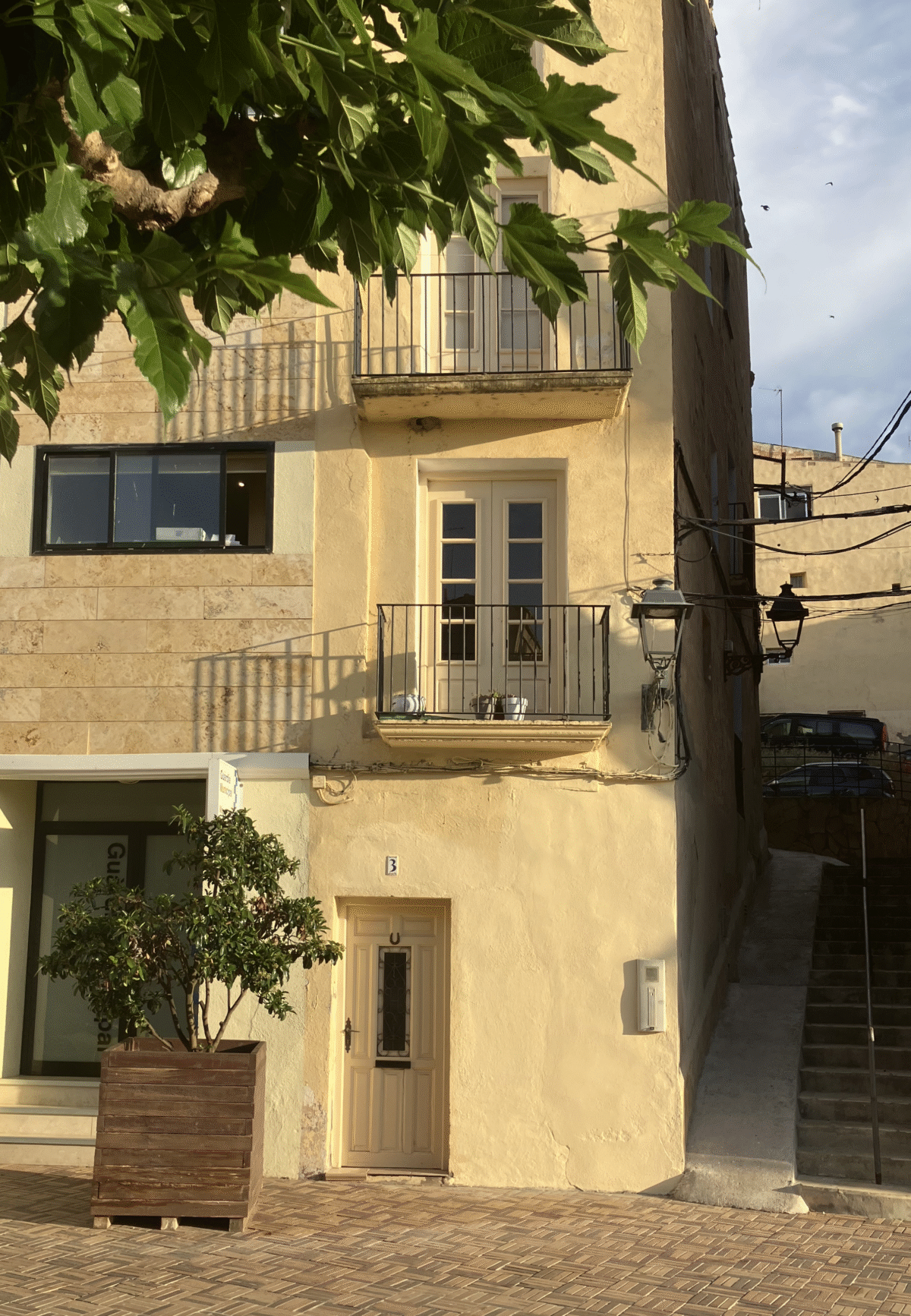
Last weekend I painted (some of) the front of our house in Spain. I’ve done a fair amount of painting in my time but never a south facing, rough cast wall in the mediterranean sun. But just like any other practical skill there are things to be learnt to do it well in this particular context.
Things like: what preparation to do? How to protect the floor from drips? Where best to put the ladder? How much water to add to thin the paint? What’s the most convenient size container to carry that paint up the ladder? How deep to dip the brush? What kind of stroke applies the paint best? What angle is best to hold the brush? How far to reach out safely when at the top of the ladder? etc etc
None of these things can be learnt from a book or watching someone else do it or thinking about it. You just have to do it, notice what happens and try different things out. And a helpful voice from the person on the ground saying ‘You’ve missed that bit out!’ or ‘There’s a massive drip over there!’ or ‘Careful! Don’t lean too far out! Move the ladder instead!’ helps the work to go better.
Speaking a language is also a practical skill, albeit one too often thought of as an intellectual skill: a conception that I think is an error. We’re much better thinking of learning a language as something practical: a function of the body and the muscles.
And this gives a clue to how we should work as teachers. The students are the ones up the ladder, acting: moving their muscles, making sounds, trying to express meanings. We’re the ones on the ground offering feedback, guidance and helpful advice.
This gave me pause.
Of course I’m convinced that speaking a language is a skill, and should be taught as such: through trial and error, and immediate feedback, correcting what didn’t work well and practicing the right way to do it once it has been found, etc. So, in that regard, language teachers should work more in the fashion of a coach, observing, noticing what’s not on point, and helping the students realize what they should be doing different. And so should work people training someone to be a professional painter!
But the distinction between “intellectual skill” and “practical skill” doesn’t resonate as much for me. I feel that with languages, there’s something hybrid going on: a lot is required of our muscles in general, but some of the things we learn to do seems to happen “in the brain” (probably in that Broca’s area) as we get used to formulate and express thoughts in a new fashion that is particular to that new language. Of course as long as I haven’t leaned how to use the muscles properly, I won’t be able to speak properly. But I wonder if that’s isn’t just the end of the chain, with a part of the skill operating at some other level before? In that regard, it would still qualify as a “partly intellectual skill”, that needs its practical, physical, counterpart to be complete and work.
I’m not sure what the implications for teaching are. I’d be curious to understand where your distinction leads you, once you’ve said that speaking a language isn’t an intellectual skill. Yes, we’re the ones on the ground, offering feedback, guidance, and helpful advice (that’s how we teach skills in general), but what should or shouldn’t we do once we see speaking a language as “not an intellectual skill”?
Hi Cédric,
My way of looking at this question is this.
The Self is the learner. The Self has properties, (also called ‘attributes’) like awareness, concentration, patience, etc, and one of these properties is intelligence which Gattegno defined as, ‘the attribute of the self which allows it to seek new ways of relating to challenges which resist being met by preexisting spontaneous approaches already part of one’s experience.’ Intelligence will be needed every time we need to invent new approaches to challenges created because we are learning something.
The Self has also equipped itself with the means of exteriorising things, moving itself, and influencing the environment. We do this by using what we call our ‘body’. Our body allows us to do things: show things, move things etc. It was constructed by the Self for this purpose.
One of the ways the Self has of exteriorising things is by speaking, which requires using our attributes and also our capacity to move those parts of us which are necessary to ‘express’—’press out’—our ideas.
Learning a new language or learning to kick a football—learning anything in fact—is done by our Self, using all of its attributes working together, in various fluid combinations stressing now this attribute, now this other one, now another one, in one harmonious whole, with our Self coordinating everything and using its means of moving things—its body—in order to learn.
Great point! I thought the same thing for a moment when I first wrote this, but then I realised that everything we do is the same: playing football, making a dovetail joint, riding a bike. All are activities of mind and body working together. The point is that when we play football we mostly act instinctively without thinking much about it, and what makes it fun is the physical thrill of running about and kicking the ball etc. Just the same with speaking a language: the centre of gravity is in the doing.
So when you teach elision in French, you can either explain the rules of when to do it, how to do it, when not to do it etc. Or you can simply make a physical flicking gesture between two fingers.
And what makes elision fun for me, the student, is the physicality of saying it; of getting across those couple of words faster and more smoothly. Like taking a perfect jump on on a monutain bike …
In fact I didn’t even know that turning « je etais » into « j’etais » was a thing with a name, until today: it’s just a sort of physical short cut between one set of sounds and another set … The physicality of speech can’t be underestimated, and the physicality of how we learn to speak can’t either.
At least that’s what I think: as Jacques Le Coq said: “The body remembers”.