I’ve been following up this quote from Caleb Gattegno about how to discover the ‘functional vocabulary’ of a language:
… the functional vocabulary ie the items which generate the grammar of the language. These items are the ones we find in any article or passage when we cross out most of the nouns, many of the adjectives and a number of the verbs; what is left refers to one’s self and to others in the numerous relationships of everyday life. We can therefore decide fairly easy what to put on our list.
The Common Sense of Teaching Foreign Languages, C Gattegno 1976 p75
I was particularly interested in this idea because I wanted to discover what the functional vocabulary for Spanish was and how it related to the currently available Silent Way Charts with view to expanding those charts to support students to learn a wider range of the language (see also here).
I also thought it might help improve my Spanish, by showing me the grammar in practice, in actual texts.
So I selected a series of articles from various sources and simply followed the advice given by Gattegno. I interpreted his suggestion as including treating as grammatical entities things like: the endings of verb conjugations, the endings of adjectives and nouns, and various prefixes and suffixes. I also decided to maintain some of the key triggers of grammatical elements eg numbers, days, time triggers etc. Here is the result for the first page of an article from El País
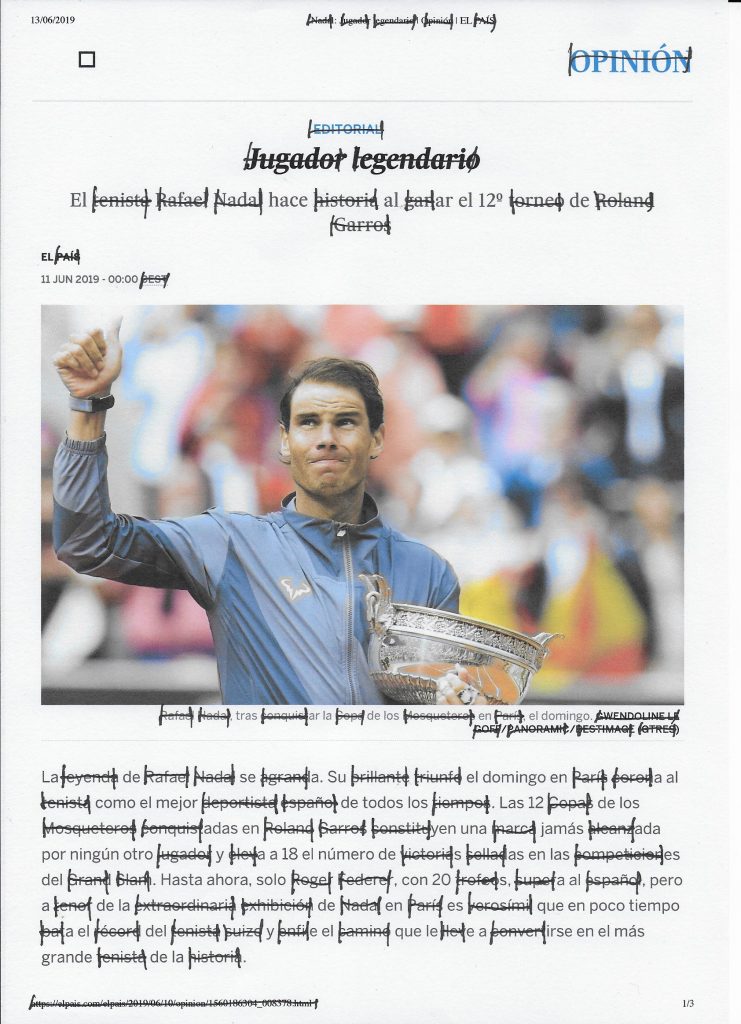
What I found really interesting in doing this was:
- how drawing attention to the grammar in this way did indeed improve, with almost no effort, my confidence and ease with Spanish grammar, helping me to connect together naturally and intuitively things like agreement between nouns and adjectives, causal relationships between parts of a sentence, the ‘internal climate or mood’ associated between different verb forms and time or mood ‘triggers’ elsewhere in the sentence.
- where there were things appearing that I wasn’t sure of what was happening, I used my grammar book to confirm that these were indeed grammatical elements and not vocabulary elements and to lightly note the grammatical category they seemed to belong to. I didn’t particularly try to memorise these items, relying instead on the fact that if I saw something a few times, I would retain it automatically anyway.
- extracting the elements that are left gives a fairly small set of words, prefixes, suffixes and endings, that enable the language to function and that we can use to test what words should be on a word chart
- that the first text I analysed in this way gave me most of the functional vocabulary, the second added a relatively small set of additional elements, and by the time I reached the eighth or ninth texts, whilst there were new items cropping up, they were fairly few and far between.
On its own, this would be a useful exercise for anyone wanting to improve their skills in any foreign language, because it would give them an intuitive sense of the totality of the grammar of that language in real life use. It’s also enjoyable if you pick texts that you’re interested in. For exactly this reason, I’m planning, when I have time, to do exactly the same thing for French and for Hindi.
For me, the main benefit was the list of grammatical elements that I now have which will inform my understanding of what should be on a set of Silent Way charts for Spanish. A huge amount of learning for a very small amount of enjoyable effort!