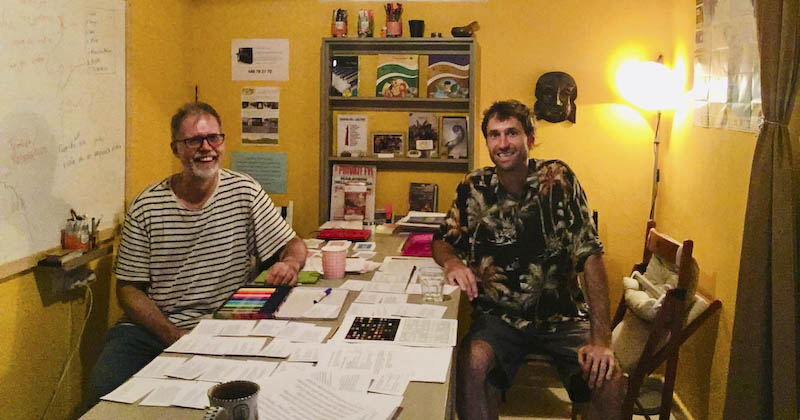
I was privileged to visit Nico Argentato’s language school in Cádiz again at the end of August 2019. The main purpose was to share with Nico some approaches to teaching pronunciation in general, and specifically English. We also took the opportunity to continue our research in how to teach Spanish pronunciation. And, of course, I was privileged to work with some of the students there on their English.
The workshop was based around about roughly 85 ‘Questions without Answers’. By that title I meant that the ‘answers’ have to be found by the participant or participants either because they have to find them for themselves (perhaps with some guidance) within their own mouths or bodies or from their own experience.
Some of the questions were very specifically to do with pronunciation, such as ‘Make an extended ‘ssssssss’ in Spanish and then make the similar sound in English … notice the difference in your mouth, the placement of the tongue, the point of constriction with the palate etc … and notice the difference in the sounds.’
The purpose of exercises like this is to sensitise oneself to how the similar but different sounds are made in the different languages by native speakers. And thereby as a teacher be able to help students change what they do in their mouths – once they change what they do, they start to ‘escape the grip’ of their native pronunciation and step by step can sound more English (or whatever language they are learning).
Some of the questions were more general – how do we acquire skills and knowhow. For example, how did we learn now to walk as babies? or how to ride a bicycle?, or how to play a sport? or a musical instrument? Reflection on our own experience is incredibly valuable even if, as usually happens, we have little memory of the process by which we learnt these things. And, of course, we can’t really say we ‘remember’ how to ride a bicycle or whatever – once we have learnt this knowhow we can simply do it when the situation arises.
What we find for knowhows like this is that they are learnt through doing and feedback from the results of our attempts, they are improved and made habitual through practice, and they are refined through use. We also find that often a coach is needed to help us on our journey towards excellence, with the coach provoking awarenesses that there is something to be learned by the student, and providing guidance on things like: where to focus their work, specific exercises or practice to improve particular aspects of their performance, and how to keep in balance their overall development. Above all the coach isn’t the one creating the learning or the knowhow – that is simply the person themselves.
Since language, and specifically pronunciation, is clearly a knowhow, reflecting on matters like this helps us as teachers rethink our practice. Languages should be taught as practical skills and absolutely not as academic subjects. And teachers should stop ‘teaching’ and start ‘coaching’ instead.
Learning pronunciation and learning how better to teach pronunciation isn’t a linear task. So we ran the workshop in a completely non-linear way – each ‘Question’ was printed on a card, and once we’d finished with working on a particular question we said ‘OK what aspect do we feel we should work on next?’ and then we looked for a card with a question that seemed relevant to that particular aspect. And so we continued ranging freely over the entire subject. A couple of times we reviewed the remaining cards and found we’d covered some of them already in our reflection on other questions. And towards the end of our weekend we repeated this review to identify what still needed to be covered (which was surprisingly little).
An incredibly valuable weekend … hard work but very enjoyable. We’re thinking of perhaps offering the workshop to others in the future. But for now … ¡Gracias a Nico por la oportunidad!