At the end of November 2019 I was fortunate enough to be in Andalucía again and I had the opportunity to try my Spanish in a new situation and at a new level.
I was leading a concert with some Spanish colleagues in the Conservatorio Elemental “Santa Cecilia” de Chiclana de la Frontera: an amazing opportunity to play in the moorish patio of the Conservatorio. Here’s a picture of us on stage at the venue (I’m in the middle with my sitar).
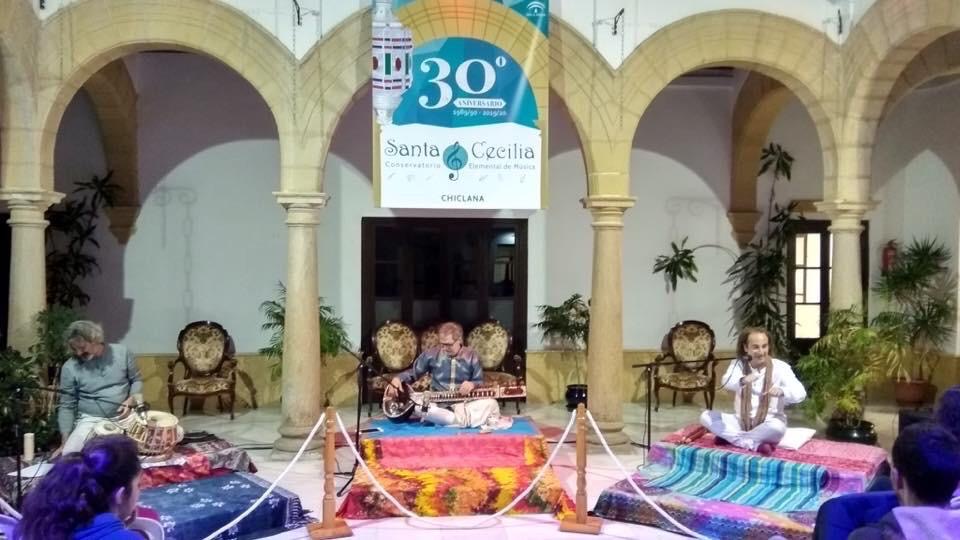
So I had the chance, or perhaps, the duty of introducing the concert to the audience of 200 or so people. It crossed my mind for about 10 seconds to chicken out and do it in English, asking one of my colleagues to translate … but it seemed too good an opportunity to miss.
The concert was on the Wednesday evening, so Tuesday evening I wrote in Spanish what I wanted to say, relying on whatever Spanish came into my head. I’m guessing that because my Spanish had been ‘activated’ by the few days I’d spent in Cádiz I had little difficulty finding words for what I wanted to say.
I left it for a few hours and then came back to it, immediately spotting some ridiculous errors and then read it through to my colleague Nico – who is a teacher of both English and Spanish.
Sentence by sentence, whenever he heard an error or had a suggestion he stopped me and minimally drew my attention to whatever needed fixing. And that one read-through and our work on corrections was sufficient – I felt totally prepared for the speech and when the time came surprised everyone with the quality of my Spanish.
What I wasn’t prepared for though was the effect that this work would have on my general Spanish.
The day after, Nico pointed out a significant and immediate step up in the quality of my spontaneous Spanish. Interestingly, I, myself, was not aware of this improvement – for me it was just ‘how I function in Spanish now’. Though once he had pointed it out to me I had to accept objectively that there was a change, even though my own experience was that I was simply in a ‘new normal’.
I can’t help seeing this whole experience as corroborating evidence for some principles for teaching and learning language. For example:
- language really is learnt from use and feedback. In this case I had almost the perfect feedback combination: sentence by sentence correction and the felt response from a large supportive audience.
- anything actually spoken (as opposed to written or read or heard) by a student has a special power. The act of actually saying these correct, meaningful sentences out loud to someone seems to have a transformative effect. It’s as if the act of speech activates and energises our language assimilating powers.
- its important to work on every sentence until every sentence is correct and as good as it can be in terms of pronunciation. Everything we say leaves a trace in the mind and the process of correcting a sentence gives the mind new material to work on as it constructs a more perfect and more coherent mental model of the language. After all, the purpose of correction is to help students build that better mental model (and not to show how clever the teacher is … or to judge the student …). So its a bit of a waste in class if we don’t work on every sentence to this level of accuracy – what will the mind do with the trace of a sentence that’s only half-correct (or not correct at all)?.
- let the student do the work and choose what they want or need to talk about – it’s them who has the burning need to express themselves and establish relationships with their auditors. That energy is theirs and our job as teachers is merely to help them channel that desire into more perfect language – perfect in terms of words, grammar, pronunciation and melody.
Finally, back to this curious fact that, once we’ve changed how we function in the new language we lose any awareness that there was a time when we didn’t ‘just know’ how to speak like this. A ‘new normal’ is established almost immediately and the human mind seems to be unable to return to or recall the previous state.
This is, of course, what babies do: we none of us have any recollection of a time before we could speak our native language nor of the steps to achieve our mastery of it. It is a rather satisfying and reassuring feeling to be following the course that babies do in learning language, since babies ought to be our role models in language learning : they do seem to be rather successful at it …
Thanks, Laurence, for this account of your big step forward in Spanish. You’re right, once we have had awarenesses, we can’t go back to what we were before they took place. Awarenesses change us fundamentally.
Now that’s a very useful thing to know!!