Aligning meaning and language

I’ve been thinking about one of the small exchanges that happened amongst the students in the elementary English class that I volunteer for. The students had been practising asking each other the question ‘What do you do after work?’.

After we’d worked on a few grammar and pronunciation points, one of the male student’s reply was:

‘After work I go to the gym’.

At which point one of the female students responded. We worked on grammar and pronunciation until her sentence was correct. And then we repeated the exchange, which now was:

Male student: ‘After work I go to the gym’
Female student: ‘After work he goes to the gym but I stay at home and cook.’

I should stress the two students are not related.

What struck me was the way she used word stress and melody (particularly stressing ‘he’ and ‘I’) to express a whole range of feelings about her life, the life of women in her community (and other communities of course) and the balance of work between men and women, in one short sentence.
I’m left with a whole range of thoughts about that female student’s need to express these feelings; that she could get them across in correct English; and that grounding our teaching of languages in what people actually want to say themselves, rather than text book dialogues scripted by others, is incredibly powerful.

A language class is a special environment where we are training people to give precise expression to their perceptions, thoughts, feelings and ideas in a foreign language. We are looking to create an accurate correspondence between meaning and linguistic form. This works so much better if the meaning the students are trying to express is genuinely theirs. If that is the case, at least one of the variables is clear: they always know what they themselves perceive, think or feel. This is why in a Silent Way class, after the very initial stages, we pass the content of the lesson over to the students as far as possible. My job as teacher then becomes to coach them to be able to say what they want to say in correct English and with good pronunciation.

This is why one of my mentors in the Silent Way, often says when initiating a class conversation: ‘Every sentence must be true’. This isn’t a question about truth or lies, it’s that in the special environment of the language class it’s the best way of aligning meaning and language.

Much language with little vocabulary

I met with my Hindi guru, Harjyot Singh, today. We’ve been working together since December on a) generating Silent Way charts for Hindi and, in parallel, b) me learning Hindi. We’ve met 8 times for exactly one hour each time – one hour is plenty for me to focus and absorb what I need to. Outside of that time I’ve been producing charts which we test when we meet. And I’ve done a bit of practice in between meetings/lessons, mostly on pronunciation.

I took the approach of asking ‘what language do I need to be able to say x, y and z?’ I used the book ‘L’anglais avec l’approche Silent Way’ by Roslyn Young (currently being translated into English), which gives examples of the situations and sentences that are commonly generated from each Silent Way Word Chart, as a guide and then made hypotheses about the language I needed to say these in Hindi using a couple of text books. Each time I met with a Harjyot I tried to generate sentences about a concrete situation and he gave me feedback about grammar, word choice, pronunciation, melody and naturalness. I used this feedback to develop a feel for the language and revise the materials I was creating as necessary. Each time I felt more confidence about a wider range of the language.

Hindi Silent Way Chart 1

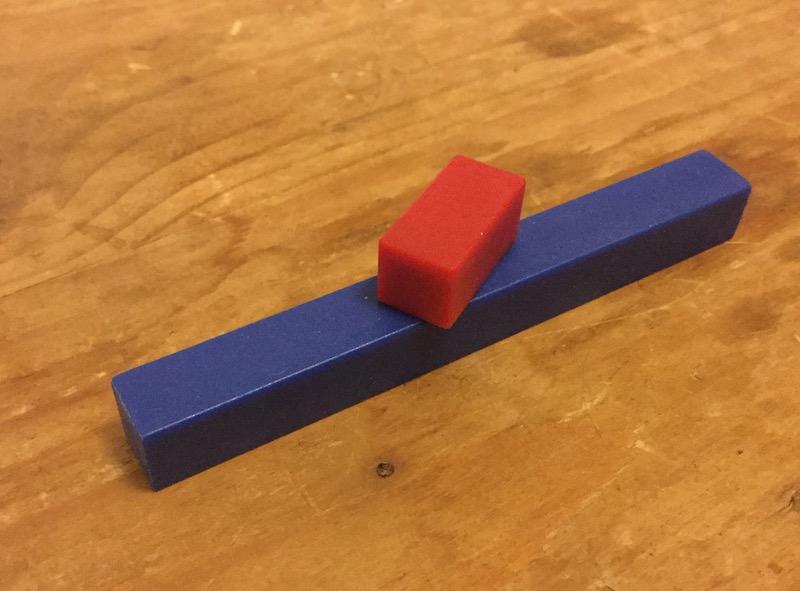
For example, chart 1 enables me to describe an infinite variety of simple situations such as these ones below:

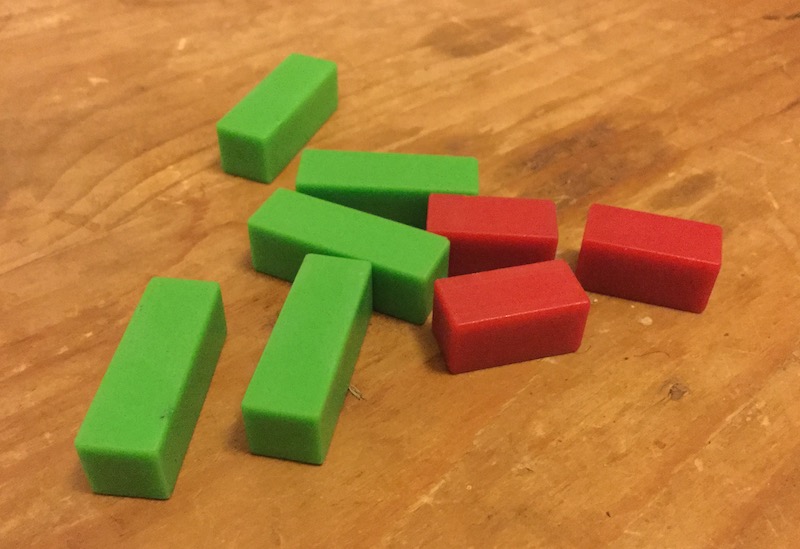
A picture of a red Cusenaire rod on a blue one
‘यह लाल डंडी ईस नीली पर है ।’
‘This red rod is on this blue one.’
A oicture of three red and five green Cuisenaire rods
‘तीन लाल डंडियाँ और पाँच हरी टेबल पर है।’
‘There are three red and five green rods on the table.’

Simple sentences, but the beauty is that, having been coached with feedback from my Hindi guru, I can confidently create these sentences for myself using what’s on the charts. A lot of this comes from the fact that when we work together he only gives me the minimum amount of help to perfect the sentence – in terms of grammar, pronunciation, naturalness – that way, because I do most of the work, I develop more quickly accurate criteria for correct Hindi.

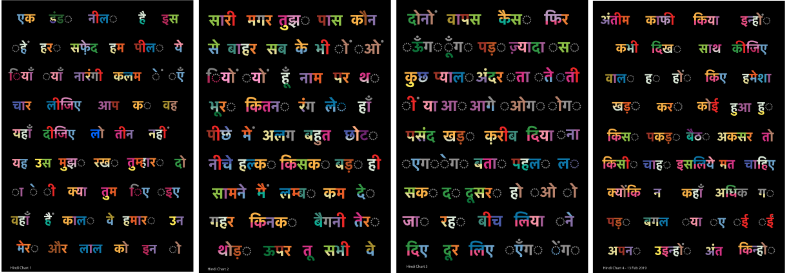
Illustration of four silent way charts for Hindi enabling 'Much language with little vocabulary'
Hindi Charts 1 -4

Each chart extends the range of linguistic structures I can master. For example:

  • Chart 2 extends what I can say to include things like ‘behind’, ‘in front’, ‘on top’, ‘under’ etc. 
  • Chart 3 gives me the verbs for ‘to come’ and ‘to go’ and access to the past enabling me to say things like ‘I took a red rod and gave it to him’ and the future so I can create sentences like ‘I will go outside’ etc
  • Chart 4 gives me a few more verbs such as ‘to do’ and how to say things like ‘I want’, ‘is needed’ etc

‘Much language with little vocabulary’

Caleb Gattegno

So far on these four charts I have only 190 ‘words’ (including the inflections I need). And since the charts will be displayed on the walls of a classroom, and the pronunciation of each word is evident from the colour coding, there will be minimal memory burden on the students. This means they can put their effort into using this linguistic material to express things they perceive and think, without the weight of memorisation – retention of the words will come as they use them. For more information about Silent Way charts for other languages click here.

What I found interesting was how, somehow, having got to the linguistic coverage of these four charts and having been coached in their use, I suddenly found myself able to talk about real things in my life, extending my linguistic reach from manufactured situations with Cuisenaire rods in the classroom to things like the following, which Harjyot and I worked on today:

मैं पहले मंगलवार को पेरिस से लौट के आया ।
I came back from Paris on Tuesday.

जब मैं पेरिस में था मेरी पत्नी को काम करना था ।
When I was in Paris my wife had to work.

आप को बाद में जिम करना है ।
You have to go to the gym later.

मैं अगले बुधवार को East Lothian Council में एक प्रिज़न्टेशन देने वाला हूं ।
Next Wednesday I will give a presentation at East Lothian Council.

All these things are a) true and b) now we’ve worked on them, correct and c) things I wanted to say. The only ‘words’ not in the 190 on the Charts are ‘Paris’, ‘Tuesday’ and ‘Wednesday’ (I have a separate chart for the calendar), ‘wife’, ‘gym’ which is easy because it’s the same as in English, and ‘presentation’ which is also the same as in English.

Not bad for eight hours of lessons (OK plus lots of work researching in text books and thinking about the language and how to learn it …).

‘Much language with little vocabulary’ indeed.

I have to also say I am so grateful to Harjyot for the gift of Hindi. He’s been amazing and incredibly generous in what must at times have seemed like a bizarre and strange way to approach learning and teaching a foreign language. धन्यवाद!

Talking about jobs

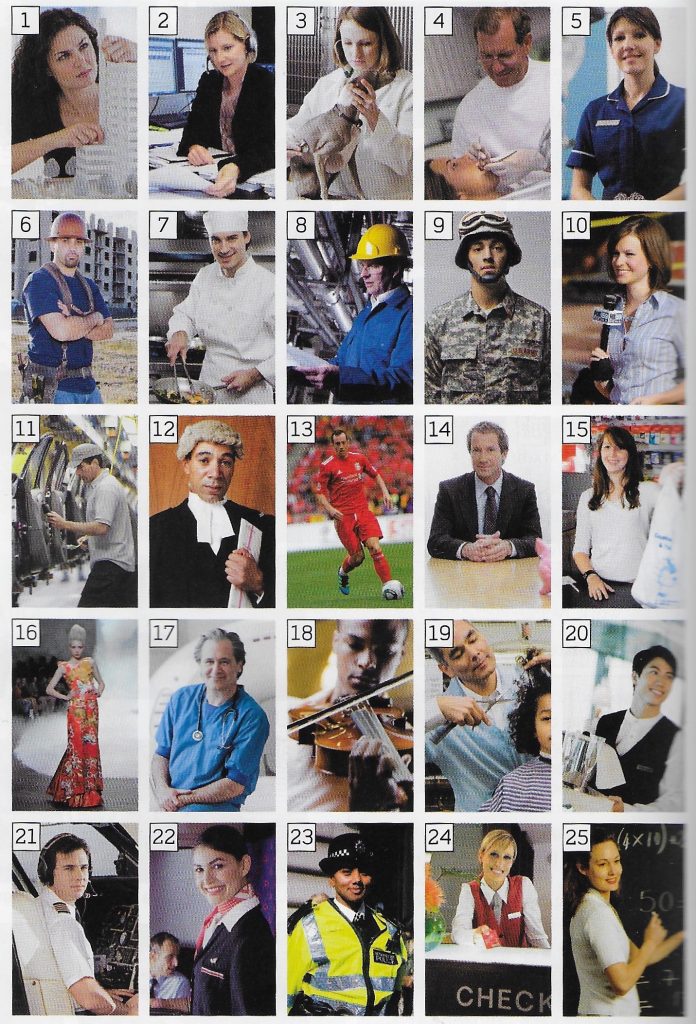
My brief for today’s class was to help the students learn how to talk about different jobs in English. The text book has a set of jobs and pictures for each job – nurse, a soldier, a model, a footballer, a doctor etc.

An image of jobs from a text book, but how do we free students from the text book?

I was a bit nervous about working with this, mostly because all the jobs in the pictures seemed so far from any likely experience of the students. I decided to enlarge the pictures from the book, stick it up on the whiteboard and use one of the jobs as a starting point … and then see what happened.

So I pointed the sentence ‘What does he do?’ on my word charts, and worked with the class until their pronunciation of this sentence was good. And then I pointed (at random) at the footballer … and we created and practiced ‘He plays football’.

We went on to the soldier and with some work generated ‘He’s a soldier and he shoots a gun and runs and drinks’ … their idea not mine …

One of the students pointed to the teacher, so I pointed the sentence ‘What does she do?’ … and got her reply which we then worked on until it was correct and well-pronounced. What was amazing, and so exciting for me was that her reply was absolutely not ‘She’s a teacher’ or similar. It was ‘She writes on the blackboard’.

For me this was a very important moment – what happens when we free students from the text book and let them express their own perspectives?

It was clearly time to open this game up, so I pointed to the sentence ‘What do you do?’ And then opened my arms and invited someone to speak. And after some work we got some pretty adventurous language including:

‘I plant trees in the nursery’
‘I plant trees too’
‘I’m a picker in the mushroom farm’
‘I run my business selling shoes on the internet’

How much richer is the whole experience when the students can talk about their own lives! And my job as a teacher is to enable them to find the language to express what they have to say and get them to practice it so it becomes fluent.

I knew this in theory but it was so inspiring seeing and hearing it happening practice.

How I got interested in the Silent Way

It was through a casual ramble on You tube that I came across a video of a Silent Way class. At that point I was mostly attracted by what this approach to teaching languages might offer/be capable of adaptation to my teaching of sitar – I’m co-director of Edinburgh’s theSitarProject, see our website here. What I thought I saw in the video was a unique way of teaching that properly put learning at the centre.

At that point, whilst, of course, language learning was of interest, I was actually more interested in the pedagogy than the Silent Way itself. I’d tried learning German (at school), Russian (at University), Hindi, Italian, Spanish using a wide variety of approaches. I’d had some success, after a lot of hard work, with Spanish but rather less with all the others.

Having read up more about Gattegno and the Silent Way, I decided that I needed to experience the approach in order to understand it properly and then see what I could adapt for my own music teaching. So I signed up for a 5 day introduction to Japanese course in Paris.

The course was a few months away so I thought I’d better learn some French in order to get as much as possible out of my trip and so started learning French through Skype with Cédric Lefebvre who is a Silent Way teacher.

An image of a Silent Way chart from the Japanese course in Paris
Silent Way word chart for Japanese (hiragana)

Japanese using the Silent Way in Paris was so worth it! And despite having done almost no work on Japanese since last summer, I have retained nearly all of it and know how to make simple everyday sentences about the objects in front of me. I’d love to learn more Japanese some time …

I’ve followed up this experience with more courses, reading Gattegno’s books and conversations with my Silent Way friends – thanks to all of them, but especially Roslyn Young, Piers Messum and Cédric Lefebvre. And, last but not least, I’ve progressed my original goal of becoming a better teacher of the sitar.

I’m so excited to have just started teaching on a volunteer basis a class of elementary students attending classes organised by East Lothian Council. Thanks to the Council for the opportunity.