A perfect lesson

At the end of November 2019 I was fortunate enough to be in Andalucía again and I had the opportunity to try my Spanish in a new situation and at a new level. 

I was leading a concert with some Spanish colleagues in the Conservatorio Elemental “Santa Cecilia” de Chiclana de la Frontera: an amazing opportunity to play in the moorish patio of the Conservatorio.  Here’s a picture of us on stage at the venue (I’m in the middle with my sitar).
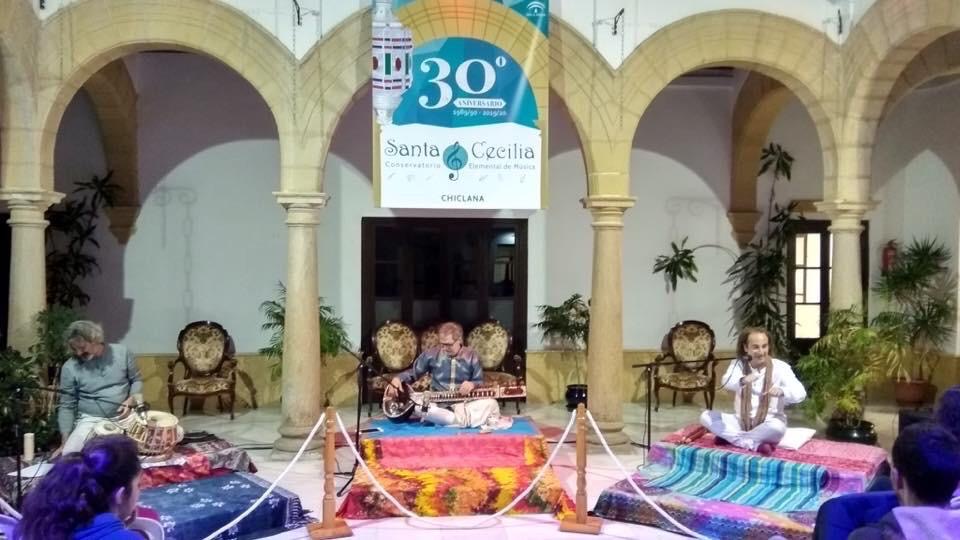
So I had the chance, or perhaps, the duty of introducing the concert to the audience of 200 or so people. It crossed my mind for about 10 seconds to chicken out and do it in English, asking one of my colleagues to translate … but it seemed too good an opportunity to miss.

The concert was on the Wednesday evening, so Tuesday evening I wrote in Spanish what I wanted to say, relying on whatever Spanish came into my head.  I’m guessing that because my Spanish had been ‘activated’ by the few days I’d spent in Cádiz I had little difficulty finding words for what I wanted to say.

I left it for a few hours and then came back to it, immediately spotting some ridiculous errors and then read it through to my colleague Nico – who is a teacher of both English and Spanish. 

Sentence by sentence, whenever he heard an error or had a suggestion he stopped me and minimally drew my attention to whatever needed fixing.  And that one read-through and our work on corrections was sufficient – I felt totally prepared for the speech and when the time came surprised everyone with the quality of my Spanish.  

What I wasn’t prepared for though was the effect that this work would have on my general Spanish.  

The day after, Nico pointed out a significant and immediate step up in the quality of my spontaneous Spanish. Interestingly, I, myself, was not aware of this improvement – for me it was just ‘how I function in Spanish now’. Though once he had pointed it out to me I had to accept objectively that there was a change, even though my own experience was that I was simply in a ‘new normal’.

I can’t help seeing this whole experience as corroborating evidence for some principles for teaching and learning language.  For example:

  • language really is learnt from use and feedback. In this case I had almost the perfect feedback combination: sentence by sentence correction and the felt response from a large supportive audience.
  • anything actually spoken (as opposed to written or read or heard) by a student has a special power. The act of actually saying these correct, meaningful sentences out loud to someone seems to have a transformative effect. It’s as if the act of speech activates and energises our language assimilating powers.
  • its important to work on every sentence until every sentence is correct and as good as it can be in terms of pronunciation. Everything we say leaves a trace in the mind and the process of correcting a sentence gives the mind new material to work on as it constructs a more perfect and more coherent mental model of the language. After all, the purpose of correction is to help students build that better mental model (and not to show how clever the teacher is … or to judge the student …). So its a bit of a waste in class if we don’t work on every sentence to this level of accuracy – what will the mind do with the trace of a sentence that’s only half-correct (or not correct at all)?.
  • let the student do the work and choose what they want or need to talk about – it’s them who has the burning need to express themselves and establish relationships with their auditors. That energy is theirs and our job as teachers is merely to help them channel that desire into more perfect language – perfect in terms of words, grammar, pronunciation and melody.

Finally, back to this curious fact that, once we’ve changed how we function in the new language we lose any awareness that there was a time when we didn’t ‘just know’ how to speak like this.  A ‘new normal’ is established almost immediately and the human mind seems to be unable to return to or recall the previous state.  

This is, of course, what babies do: we none of us have any recollection of a time before we could speak our native language nor of the steps to achieve our mastery of it.  It is a rather satisfying and reassuring feeling to be following the course that babies do in learning language, since babies ought to be our role models in language learning : they do seem to be rather successful at it …
Teaching Hindi in Bulgaria

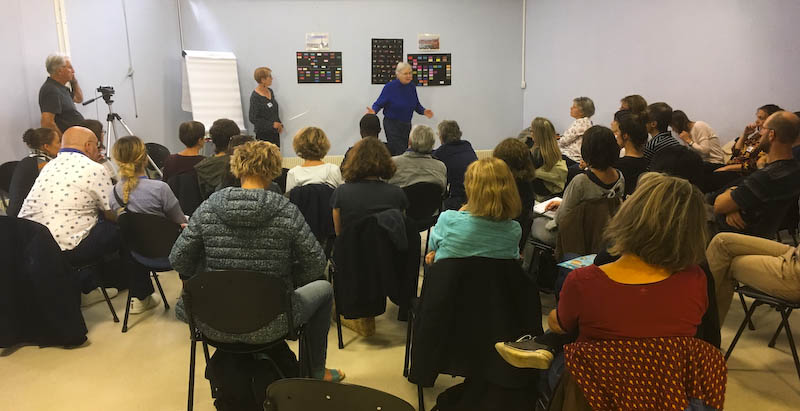
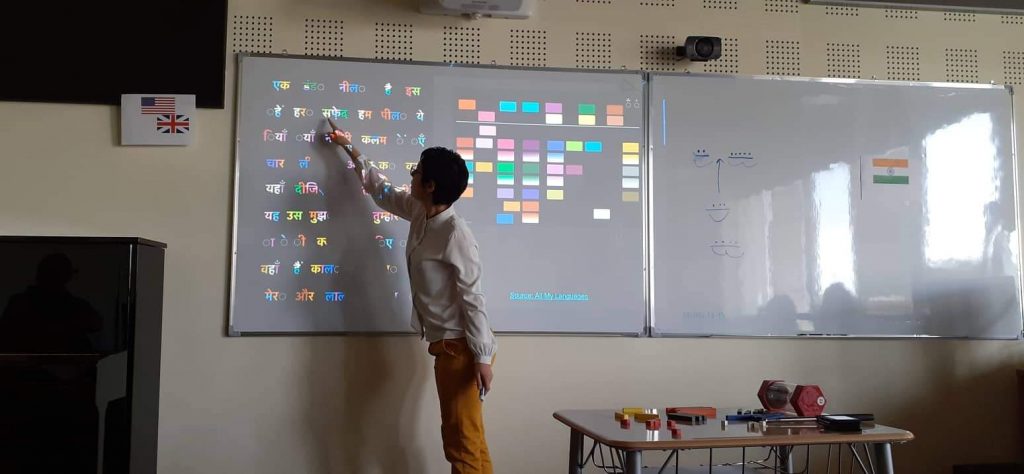
Really pleased that Fanny Passeport used the draft Hindi Silent Way charts I’ve been working on for a session “Less teacher Talk, More Student Voice” at the Central and East European Schools Association Assessment Summit hosted in Bulgaria recently.   The idea was to engage participants in a Hindi lesson using the Silent Way.  This is a great way to enable people to experience the power of this way of working and provoke new ideas about how they could work with their students.  Here’s a photo from the event.

I’m particularly pleased to have made contact with new colleagues to collaborate with on this project.  Creating these kinds of materials is so much easier as a collaborative and shared project – working on your own it’s very difficult to judge whether the choices you are making are good ones or merely idiosyncratic reflections of one’s own strengths and weaknesses.  So with this encouragement I hope to be able to push forward this Hindi project before the end of 2019!

Course for teachers and volunteers working with migrants – Grenoble

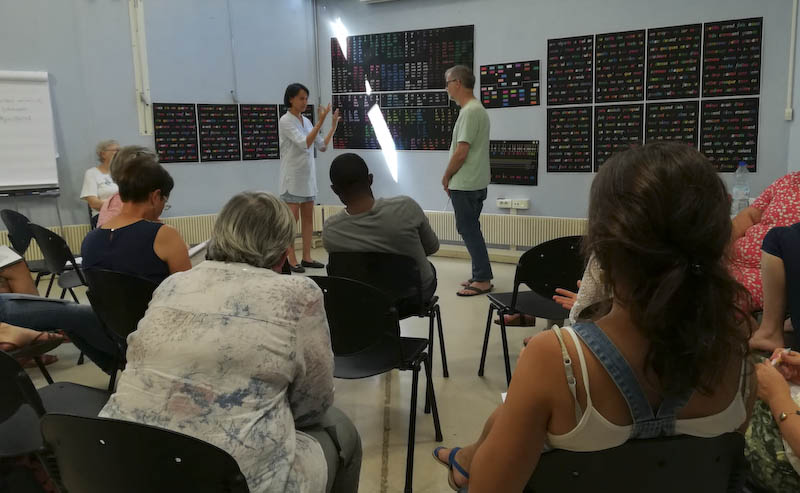
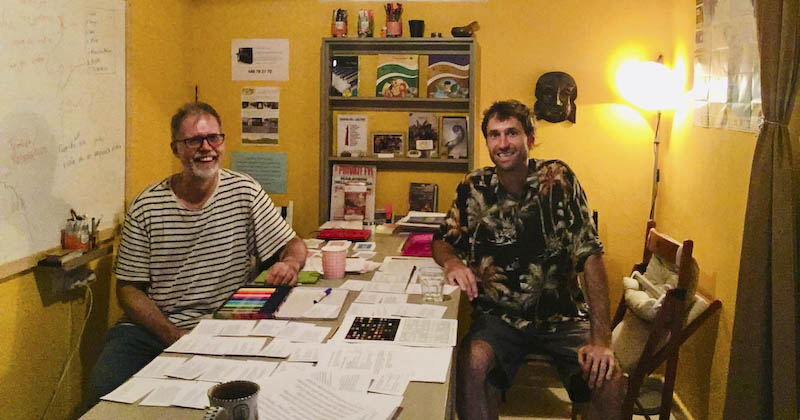
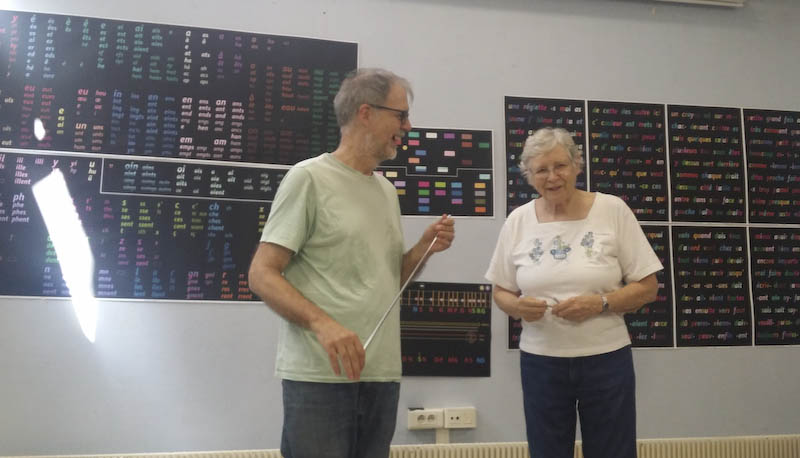
Ros Young and I with Silent Way materials on the course for teachers and volunteers working with migrants

What a privilege to work with Dr Roslyn Young at the 4 day course she gave in Grenoble on the Silent Way for teachers and volunteers working with migrants, especially those who are non-readers and non-writers!

We started with some Hindi taught using the Silent Way to remind us all of the experience of starting from scratch in a language we know nothing about and which uses a completely unfamiliar script. And, of course, to give everyone the experience of the Silent Way and the power of its key foundations: provoking awarenesses rather than distributing knowledge; and retention rather than memorisation.

Ros working with the class helping them to learn how to better teach French to migrants

We then explored the tools available for Silent Way teachers.  For example:

  • ‘silence’ – through the precise use of silence we throw the responsibility back on the student to produce the language and allow the teacher to take up their proper role as coach, guide and guardian of quality. All this means the student is far more likely to build far more quickly accurate criteria for the language. Silence also entirely eliminates a common sin of teachers of any subject – ‘teacher talk’ and explanation.
  • ‘Sleep’ – through teaching language as a knowhow rather than knowledge we ‘charge’ the human mind with experiences which the mind is ready, and supremely able, to integrate and install during our periods of sleep.
  • ‘Mental images’ – all of our charts and how we use them are designed to enable the students to build mental images of whatever they are learning. For example, working with a sound-colour chart will leave the student with a mental image, both visual and kinaesthetic) of the complete inventory of the sounds of French.
  • ‘Meaning not translation’ – by starting with tangible objects in unambiguous situations we ensure that meaning comes before the language, and therefore students and teachers escape from any need for translation – everyone can see that there is a red rod in front of them, or that Clara is taller than Juan, or that the chair is behind the table etc. We need to escape from translation in every language class, but nowhere is this need so obvious as where we have no common language with our students – a situation which is so common when we are working with migrants.
  • ‘Retention not memorisation’ – humans are naturally retentive organisms and our powers of retention are effortless, effectively limitless and normally operate flawlessly. That is why in the Silent Way we avoid memorisation – memorisation is hard work and often faulty. One of the functions of our word charts is to enable our students to become familiar with the functional vocabulary of the language and acquire it through use, thus escaping from the memorisation trap. Since the functional vocabulary is in effect the grammar of the language, working with these charts is incredibly powerful to give the students the capacity to use the language creatively
  • ‘The curiosity of the students’ – as soon as possible we pass over to the students responsibility for the content of the lesson and encourage them to create and test hypotheses to express what they perceive or think or feel. This can be done even at the earliest stages … for example I may perceive that a red rod is on a blue rod, whereas for you the blue rod is under the red rod, whereas for someone else they may perceive simply that there are a red and a blue rod on the table. All these statements are true of the situation. What is important is that we help students express what they themselves think or perceive in correct, true, well-pronounced language.
  • ‘Economical correction’ – we try to do the minimum possible so that the student corrects themselves or discovers the correction themselves. It may be that the student cannot correct themselves without a new word or element of the language being put into circulation – but very often that isn’t the case, and often even just raising an eyebrow is sufficient for the student to find what is needed within themselves. Working in this way rapidly strengthens students’ inner criteria and takes them one step further towards becoming independent of us – just giving them the ‘correct answer’, which is such a temptation for all teachers, has nothing of this power.
One of the students helping me to improve my French

Finally, the students on the course got a chance to try out what they’d been working on for real with a live non-native speaker of French ie me!  This was a very inspiring end to the course – for me, because I got my French improved and some much better criteria installed for aspects of French – and for the students because they saw and experienced how they could work in this way to improve a non-native speakers french at any level.

In addition … I made a lot of new friends!  Looking forward to returning to Grenoble for more fruitful partnerships in the future!

Workshop on teaching English pronunciation, Cádiz, August 2019

Our workshop on pronunciation in progress.

I was privileged to visit Nico Argentato’s language school in Cádiz again at the end of August 2019.  The main purpose was to share with Nico some approaches to teaching pronunciation in general, and specifically English.  We also took the opportunity to continue our research in how to teach Spanish pronunciation.  And, of course, I was privileged to work with some of the students there on their English.

The workshop was based around about roughly 85 ‘Questions without Answers’.  By that title I meant that the ‘answers’ have to be found by the participant or participants either because they have to find them for themselves (perhaps with some guidance) within their own mouths or bodies or from their own experience.

Some of the questions were very specifically to do with pronunciation, such as ‘Make an extended ‘ssssssss’ in Spanish and then make the similar sound in English … notice the difference in your mouth, the placement of the tongue, the point of constriction with the palate etc … and notice the difference in the sounds.’

The purpose of exercises like this is to sensitise oneself to how the similar but different sounds are made in the different languages by native speakers.  And thereby as a teacher be able to help students change what they do in their mouths – once they change what they do, they start to ‘escape the grip’ of their native pronunciation and step by step can sound more English (or whatever language they are learning).

Some of the questions were more general – how do we acquire skills and knowhow.  For example, how did we learn now to walk as babies? or how to ride a bicycle?, or how to play a sport? or a musical instrument?   Reflection on our own experience is incredibly valuable even if, as usually happens, we have little memory of the process by which we learnt these things.  And, of course, we can’t really say we ‘remember’ how to ride a bicycle or whatever – once we have learnt this knowhow we can simply do it when the situation arises.

What we find for knowhows like this is that they are learnt through doing and feedback from the results of our attempts, they are improved and made habitual through practice, and they are refined through use.  We also find that often a coach is needed to help us on our journey towards excellence, with the coach provoking awarenesses that there is something to be learned by the student, and providing guidance on things like: where to focus their work, specific exercises or practice to improve particular aspects of their performance, and how to keep in balance their overall development.  Above all the coach isn’t the one creating the learning or the knowhow – that is simply the person themselves. 

Since language, and specifically pronunciation, is clearly a knowhow, reflecting on matters like this helps us as teachers rethink our practice.  Languages should be taught as practical skills and absolutely not as academic subjects.  And teachers should stop ‘teaching’ and start ‘coaching’ instead.

Learning pronunciation and learning how better to teach pronunciation isn’t a linear task.  So we ran the workshop in a completely non-linear way – each ‘Question’ was printed on a card, and once we’d finished with working on a particular question we said ‘OK what aspect do we feel we should work on next?’ and then we looked for a card with a question that seemed relevant to that particular aspect.  And so we continued ranging freely over the entire subject.  A couple of times we reviewed the remaining cards and found we’d covered some of them already in our reflection on other questions.  And towards the end of our weekend we repeated this review to identify what still needed to be covered (which was surprisingly little).

An incredibly valuable weekend … hard work but very enjoyable.  We’re thinking of perhaps offering the workshop to others in the future.  But for now …  ¡Gracias a Nico por la oportunidad!

Discovering grammar – investigating Spanish texts

I’ve been following up this quote from Caleb Gattegno about how to discover the ‘functional vocabulary’ of a language:

… the functional vocabulary ie the items which generate the grammar of the language.  These items are the ones we find in any article or passage when we cross out most of the nouns, many of the adjectives and a number of the verbs; what is left refers to one’s self and to others in the numerous relationships of everyday life.  We can therefore decide fairly easy what to put on our list.

The Common Sense of Teaching Foreign Languages, C Gattegno 1976 p75

I was particularly interested in this idea because I wanted to discover what the functional vocabulary for Spanish was and how it related to the currently available Silent Way Charts with view to expanding those charts to support students to learn a wider range of the language (see also here).

I also thought it might help improve my Spanish, by showing me the grammar in practice, in actual texts.

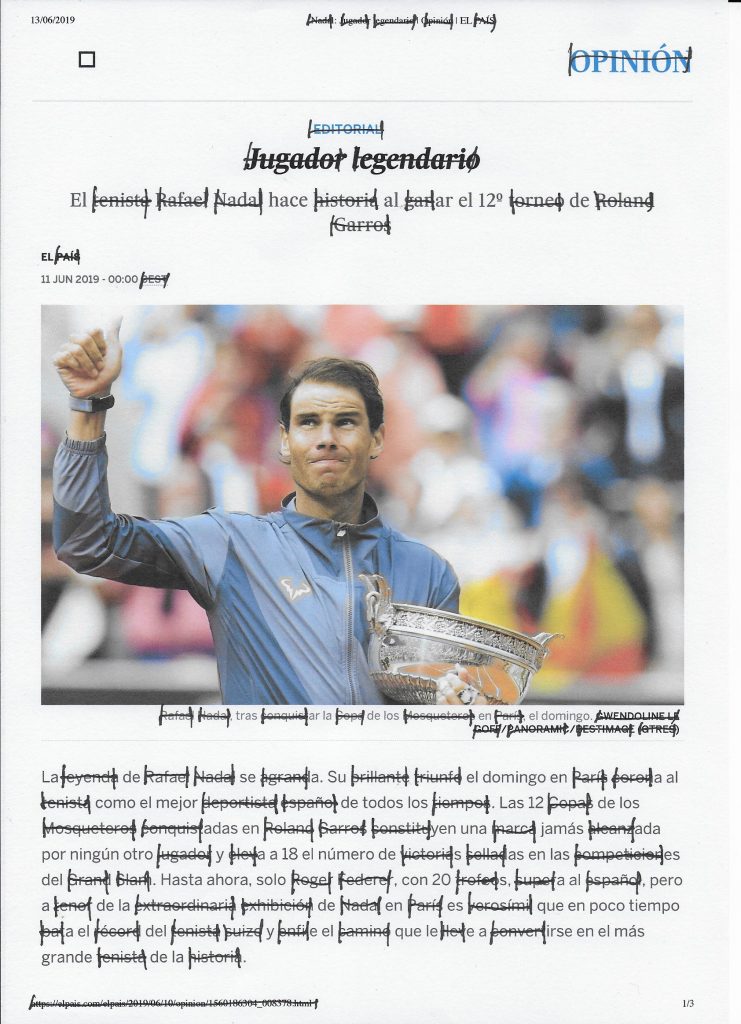
So I selected a series of articles from various sources and simply followed the advice given by Gattegno. I interpreted his suggestion as including treating as grammatical entities things like: the endings of verb conjugations, the endings of adjectives and nouns, and various prefixes and suffixes. I also decided to maintain some of the key triggers of grammatical elements eg numbers, days, time triggers etc. Here is the result for the first page of an article from El País

An article from El Pais analysed to find the functional vocabulary

What I found really interesting in doing this was:

  • how drawing attention to the grammar in this way did indeed improve, with almost no effort, my confidence and ease with Spanish grammar, helping me to connect together naturally and intuitively things like agreement between nouns and adjectives, causal relationships between parts of a sentence, the ‘internal climate or mood’ associated between different verb forms and time or mood ‘triggers’ elsewhere in the sentence.
  • where there were things appearing that I wasn’t sure of what was happening, I used my grammar book to confirm that these were indeed grammatical elements and not vocabulary elements and to lightly note the grammatical category they seemed to belong to. I didn’t particularly try to memorise these items, relying instead on the fact that if I saw something a few times, I would retain it automatically anyway.
  • extracting the elements that are left gives a fairly small set of words, prefixes, suffixes and endings, that enable the language to function and that we can use to test what words should be on a word chart
  • that the first text I analysed in this way gave me most of the functional vocabulary, the second added a relatively small set of additional elements, and by the time I reached the eighth or ninth texts, whilst there were new items cropping up, they were fairly few and far between.

On its own, this would be a useful exercise for anyone wanting to improve their skills in any foreign language, because it would give them an intuitive sense of the totality of the grammar of that language in real life use. It’s also enjoyable if you pick texts that you’re interested in. For exactly this reason, I’m planning, when I have time, to do exactly the same thing for French and for Hindi.

For me, the main benefit was the list of grammatical elements that I now have which will inform my understanding of what should be on a set of Silent Way charts for Spanish. A huge amount of learning for a very small amount of enjoyable effort!

Reduced vowels

I was very struck again the other day with how important it is for people learning English to master its very unusual stress system – something speakers of other languages usually find bizarre and difficult.

The English stress system

In English some syllables are stressed by means of an abdominal push, making those syllables more prominent in a sentence.  The really unusual thing about English is what happens to the other syllables – most of these syllables end up being produced with very unclear, low energy vowel sounds (so-called ‘reduced vowels’), which are hard to hear and often almost non-existent. Often you can describe these sounds as being produced ‘on the remnant of the breath’ used up on the stress syllables.

For example, in normal speech:

‘Tea for two and two for tea’ becomes ‘Tea f. two .n two f. tea’

See my blog entry ‘The stress and reduction system of English’.

The classroom experience

I was working with a Spanish native speaker taking whatever sentences she wanted to say and working on their pronunciation. After we’d worked on a few sentences, she came up with:

‘I’m very grateful to have this opportunity’

… which was in itself a very nice thing to say, and a really good example to work on. I wrote the sentence on the white board and we started off by making some small adjustments to the vowel and the /r/ sound in ‘very’ until that word sounded natural and then we started working on sentence and word stress.

I asked her which was the most important word in the sentence and she said ‘opportunity’. Of course, there is a choice here – if the speaker wanted to particularly stress her gratitude then ‘grateful’ would be the word most stressed. This is an important point – sentence stress is one mechanism used in English to express aspects of our mood or emotion or what we want to emphasise.

I then showed her the syllables in ‘opportunity’ which I analysed as four syllables:

‘o ppor tun i ty’

… and asked her to identify the stressed syllable which she did, correctly identifying the syllable ‘tun’.

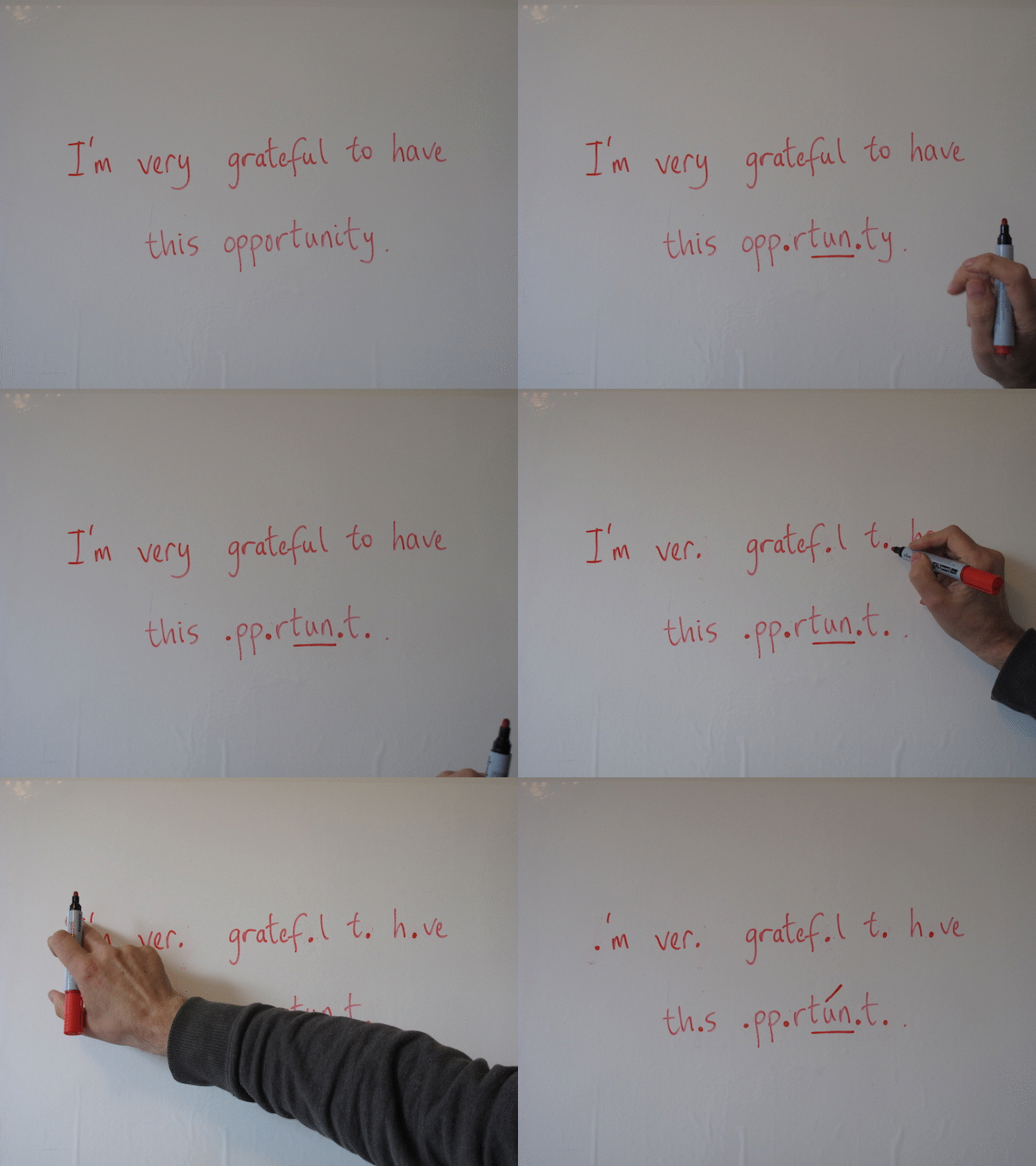
For simplicity I replaced all the unstressed vowels with dots so that we had:

‘.pp.TUN.t.’

From a technical perspective, this might be going a bit too far – strictly speaking, for normal speed speech, the first vowel would probably be better shown as an unstressed full vowel. However, for pedagogical reasons, because this effect of reduction is so strange to Spanish speakers I chose this presentation.

She had some difficulty with saying this! The first thing we worked on was the mechanism of the abdominal push to put the stress on the syllable ‘tun’. Putting her attention on that physical mechanism solved most of the problem. However, articulating the syllable ‘p.t’ remained a bit of a challenge. What I was looking for was the minimum sound between the consonants that maintained a distinct syllable – to make this ‘open transition’ (see Catford, A Practical Introduction to Phonetics 2001, p111). I showed her how to learn how to say this sound by first stuttering ‘ppppppppt’, and then gradually reducing the number of ‘p’s until she could say ‘p.t’.

Once that was mastered it wasn’t too difficult for her to say the whole sentence which I presented as:

‘.’m ver. gratef.l t. h.ve th.s .pp.TUN.t.’

… which, as before, for pedagogical reasons I presented with probably the maximal number of reduced vowels. I supported her saying this sentence by showing the speed and rhythm of the sentence by tapping on the board and then by gestures indicating the flow.

Animation showing the reduced vowels in the sentence

What’s interesting about this experience is that she was able at the end to say the sentence, sounding completely natural in English, without me ever saying any part of the sentence myself. Indeed, because we were focusing throughout on how she used her own vocal apparatus and what it feels like from the inside, me providing an aural model would have been a distraction and a hindrance. She has to do this work herself to establish for herself a new set of habits for how you speak English.

Why is this important?

Finally, is it important that students know how to produce these tiny, unclear, indistinct vowel sounds? … after all it seems such a small thing.  Yes, it absolutely is important!  Because:

  • spoken English is incomprehensible unless people can hear these mumbled sounds. What would you make of hearing this set of sounds: ‘.’m ver. gratef.l t. h.ve th.s .pp.TUN.t.’ if you were a Spanish speaker for whom your lifetime’s experience is of a language where every vowel is clear and distinct, unless you yourself had developed the awareness that this is how english is spoken?
  • the best way to learn to hear the sounds of a language is to first learn how to make them. Once you know how to make them, the ability to hear them accurately seems to be unlocked – until then, you tend to hear them through the ‘filter’ of your own mother tongue (ie you hear them as what seems to you to be the nearest approximation in your mother tongue).
  • if you try to speak English without using reduced vowels you will sound laboured and difficult to understand, and one of the key mechanisms English speakers use to express emotion and emphasis will be denied to you.
  • reduced syllables are one way English speakers use to save energy, enabling you to say ‘.’m ver. gratef.l t. h.ve th.s .pp.TUN.t.’ with only one stressed vowel (in the syllable <TUN>) and only one other full vowel (in the syllable <grate>). If you don’t make the reduced syllables you’ll get more tired than you need to when you speak English!
  • finally, reduced syllables are not some minor part of English – in normal speech they consist of over 50% of the sounds of English.

It’s worth it, and it’s not difficult to teach when you know how!

Tangible grammar

The first stage of learning something is being aware that there is something to learn. This is often a quite small sign that something is not quite right, or that something could be better. Noticing small things like this is the start of the learning process. Until these small awarenesses are triggered then the rest of the learning process (research and trial and error, practice, and integration) can’t be triggered. Equally, these awarenesses can be clues as to what you need to do to make the improvement required.

For teachers therefore, there is a very important question – how do we best provoke these awarenesses in our students so the learning process starts? ‘Tangible grammar’ is one very useful way of doing this (see also here).

For example, I was working with a class on a series of sentences they had generated about what they did in the week.  Once we’d worked on it, one person’s sentence was:

‘On Tuesdays I sometimes work and then in the evening I come to this school’

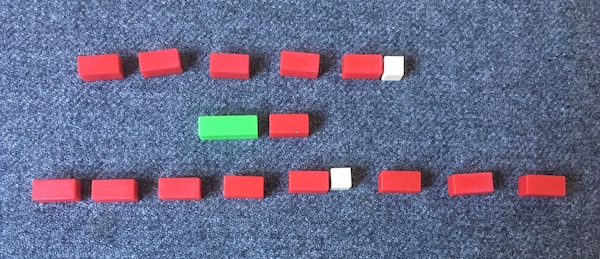
I laid out 14 red rods and one green one like this with each rod representing a word (the green one represents ’and’ and helps to orientate the class). As I put the green one down, I waved it and pointed to ‘and’ on my wall chart to make sure people knew what it represented.

Some Cuisinaire rods illustrating 'tangible grammar'
‘On Tuesdays I sometimes work and then in the evening I come to this school’

The person was right at the right hand end of the row of seats, so it was easy to point to the rest of the class and indicate they should change the sentence to refer to the originator of the sentence. To make this really clear I pointed to the person we were to refer to and to the words at the start of the sentence ‘On Tuesdays she …’ on the wall charts. And then I waited to see what the class would come up with. After a few attempts someone came up with:

‘On Tuesdays she sometimes work and then in the evening she come to this school’

I marked the words where something needed to change in this sentence by adding a beige rod on the end of two red rods like this:

Some Cuisinaire rods illustrating 'tangible grammar'
‘On Tuesdays she sometimes works and then in the evening she comes to this school’

Given this was an elementary class, I helped them by pointing to the ‘s’ sound on my wall charts and to the first beige rod and then to the ‘z’ sound on my wall charts and pointing to the second beige rod. And then I worked with the class until they could say this correctly, distinguishing the two different sounds the letter ’s’ takes.  At which point we had:

‘On Tuesdays she sometimes works and then in the evening she comes to this school’

With this established it was easy to remove the beige rods and indicate to the person whose sentence it was and get her to say the ‘I’ version of the sentence; and then add the beige rods back and get the rest of the class to say the ‘she’ version. It’s important that the students stay in their groups when they do this type of work – we’re trying to establish an accurate intuitive relationship between meaning and linguistic form, so we don’t want a student in the rest of the group saying the ‘I’ version even if they say it correctly – they have to say the ‘she’ version because that’s the only one that’s true to their situation.

Alternating who is speaking a few times, supported by the sight of beige rods being added and taken away, provokes the awareness in the students of what has to change in this sentence depending on who is saying it. This tangible grammar lesson can be strengthened by getting one of the students to add or take away the beige rods – this can provoke a new level of awareness – they have to be precise about which two rods (words) need a beige rod adding.

We then repeated this lesson with someone else’s sentence turning:

‘On Mondays I work hard and later I relax’

Some Cuisinaire rods illustrating 'tangible grammar'
‘On Mondays I work hard and later I relax’

into:

‘On Mondays he works hard and later he relaxes’

Some Cuisinaire rods illustrating 'tangible grammar'
‘On Mondays he works hard and later he relaxes’

If someone missed a word out or mispronounced a word when they were practising, I simply pointed to the rod (word) where the problem was and thus helped them to be aware of where they need to make a correction. This is very precise and can be done casually without making anyone feel awkward or at fault.

By this time, the class had had lots of practice and were starting to get new English knowhow installed. Including, for example, that:

  • something changes in an English sentence depending on who is speaking
  • sometimes an ‘s’ sound and sometimes a ‘z’ sound and sometimes an extra syllable with ‘ez’ gets added
  • that they need to know precisely which word to add these sounds to
  • that English spelling doesn’t distinguish the ‘s’ and the ‘z’ sounds

The real situation plus the visual metaphor of adding a beige rod to a word is a great way of getting this grammatical knowhow installed without any need to talk about verbs, or endings, or the third person, or the first person or any of this ‘teacher talk’. And it’s a great way to get the class to help each other and to identify exactly where the problem lies. We can call this ‘tangible grammar’.

The key thing is keeping the work as grounded in reality and as tangible as possible so that we can rely on students’ perception to become aware of what they need to do; and then make sure they get plenty of practise.

Mouth gymnastics!

I’m delighted to be part of the team for the IATEFL PronSIG event, 1 June 2019 in Cambridge: Teaching English pronunciation as a physical activity: mouth gymnastics

A picture of me playing sitar
Performing at Pranpiya Sangeet Academy, 2018

I’ll be taking along my sitar and teaching demonstration lessons showing the similarities between learning this instrument and learning good pronunciation.

This might not seem obvious at first but … there are lots of similarities: which human cultural phenomena involve the use of arbitrary, ephemeral sounds, strung out in time, that humans use to express meaning and emotion? Music and language!

And learning a musical instrument requires training in very precise, specialist motor skills to a very high standard of accuracy, reliability and ease so that the performer can be freed to focus on their message … just like pronunciation.

The event will tackle the difficult question: ‘How is it that our students speak flawlessly in their native languages but most of them never sound natural in English?’ And it will demonstrate what happens when we treat teaching pronunciation as akin to coaching in any other motor skill. Mouth gymnastics!

Check out the programme here. Look forward to seeing you in Cambridge.

Putting it all together

We need to work on so many different levels when we are learning to speak a foreign language. The unfamiliar words need to be there, sequenced in what might also be an uncomfortable order for us, and with modifications or inflections that might seem surprising to us if these are different from our native tongue. And then … we have to make a series of strange movements of our mouths, voice box and lungs to actually say whatever we’re working on.

Babies have hours and hours of practising each of these elements and how to co-ordinate all of this so that by the time they are toddlers they can chatter flawlessly in their native language. It’s not surprising, therefore, that when we learn a foreign language as an adult we need lots of practise on each of the elements and on putting it all together. This is exactly the issue identified by K Anders Ericsson which he refers to as ‘Deliberate Practice’ see here.

I was struck by exactly this issue the other day when coaching a student who was working on saying the question ‘How many brothers and sisters do you have?’ His difficulty was the /z/ sounds that we need to hear at the end of the words ‘brothers’ and ‘sisters’. He could manage to coordinate nearly everything , but the two plurals was just too much for him, so he would alternate:

‘How many brothers and sister do you have?’

with

‘How many brother and sisters do you have?’

I should say that his native language doesn’t inflect in this way, so even the idea of signalling a plural by modifying the end of a word must have been a big leap out of the comfort zone of his oh-so-familiar first language.

I felt he needed something to slow down his movement from one word to the next so that he would have the time and mental resources to add the grammatically and phonologically unfamiliar /z/ sound. And that once he’d taken the time to do that, and practiced it a few times, he would then be able to gradually build up his linguistic ‘stamina’ in this strange English language.

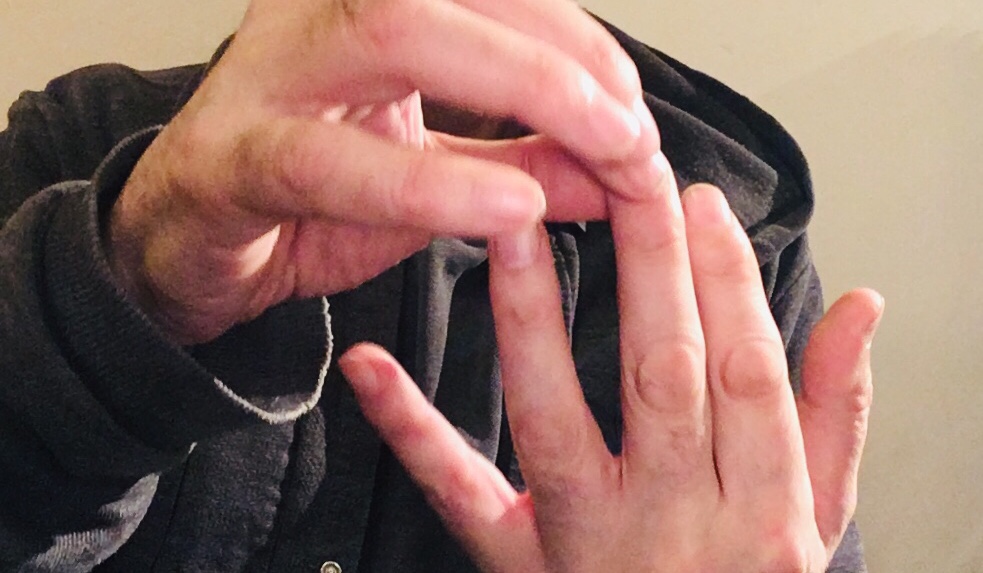
Using the fingers to help a student correct his sentence

I slowed him down by metaphorically putting each word ‘on’ one of my fingers and then pointing to them one by one as he said the sentence and wiggling the fingers representing ‘brothers’ and ‘sisters’ as we got to them to remind him they needed special treatment. This did seem to help and I was really impressed by the effort he had to make to deviate from so many incredibly-strongly established mental and physical habits from his native speech.

I have been exactly there on so many occasions in my language learning, and I can recall so strongly that feeling of having to put to one side what comes so naturally to me in English and be mentally and physically different.

This is difficult work, but with practice and coaching we can add a new way of functioning in a new language. And just like any other human activity it’s careful deliberate practice that enables us to put it all together into something that suddenly flows and feels and sounds ‘right’.

Teaching grammar through situations

The other day I was lucky enough to work with the East Lothian ESOL team giving them a workshop on the Silent Way as part of their CPD.

We’d agreed that it would be an experiential workshop in which the team would take the first steps in learning a language they were completely unfamiliar with. That way the participants would experience for themselves the power of the Silent Way approach … and at the same time re-live how disorientating it must be to be plunged, for the first time, into a language that isn’t your own.

We started the workshop listening to a very short recording of someone speaking some Hindi … which was, of course, at this stage largely meaningless to the students.

We then started to experiment with using our breath, voice and mouths in totally new ways to find the sounds of Hindi – this phase of experimentation; trial and error with feedback from a teacher; and learning to use yourself differently, to suddenly sound different is incredibly useful if you want to develop good pronunciation in a foreign language.

Some Cuisenaire rods in different colours which help teaching grammar
Cuisenaire rods – which have a huge variety of uses in teaching languages

We then started to make sentences about some Cuisenaire rods. These rods are really useful for teaching grammar through situations (see also). Because they are easily manipulable, an infinite variety of situations can be created. And because they are tangible and visible to everyone, there is no doubt about the meaning of the language we create about them, without any need for verbal explanations whatsoever. Everyone’s perception alone is sufficient.

And since meaning comes first … when we speak, the meaning is in our mind first and the language flows from what we perceive or think … we are getting the language game the right way round. Meaning first; language after.

I was really impressed hearing gradually more and more elaborated sentences being said as we gradually expanded the language the students were practising. More than anything I was impressed by how hard everyone was working as they tried to coordinate bizarre and unusual movements of their mouth … to make unfamiliar sounds, strung together on a totally different way of using the breath, to produce coherent descriptions and instructions in this language from a culture half way round the world!

This way of learning makes demands on all the students. They have to stay present to the task, they have to experiment and try out unfamiliar actions that will feel strange but, because it’s all learning by doing, the memorisation burden is almost eliminated and, as the students practise, they progressively establish the ‘knowhow’ to express themselves in the new language.

By the time we’d finished the workshop amongst other words, the words एक, दो, तीन (one, two, three) had been used so when I played the recording again at the end, the team were able to recognise that the speaker was counting in Hindi …

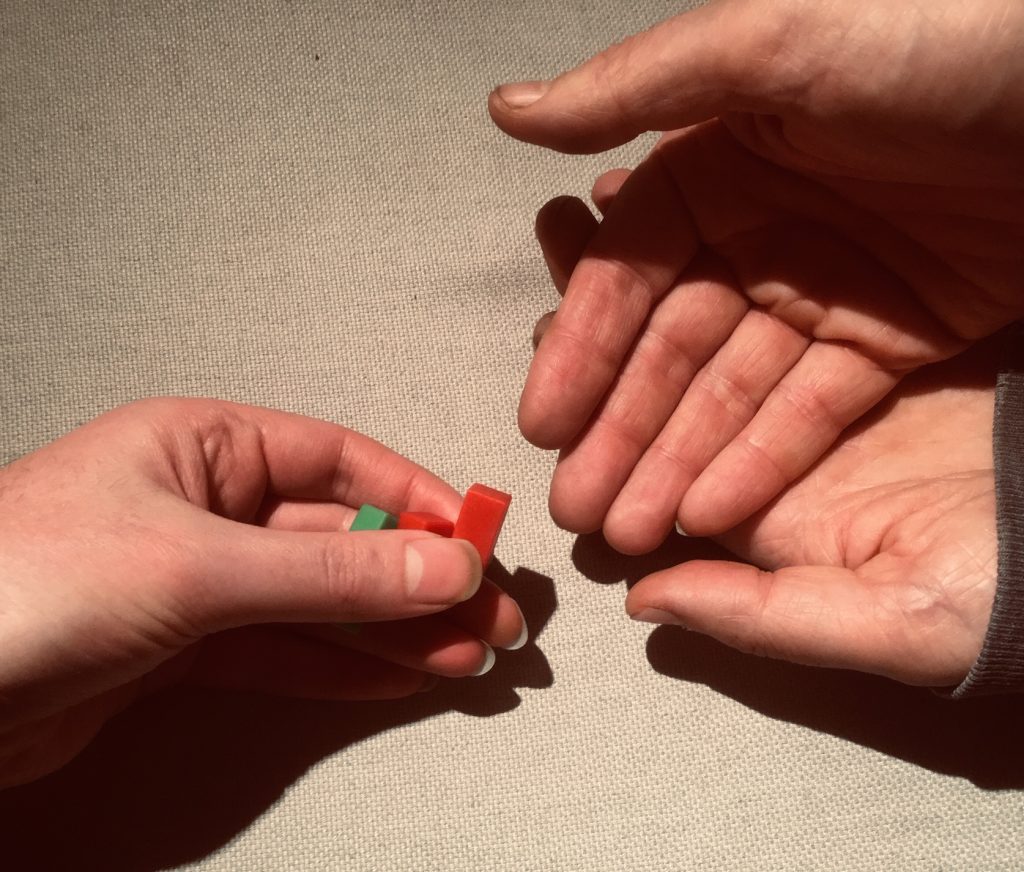
A picture of two people's hands, one of them giving the other two red and one green rods

One hour is far too short a time for this amount of work, but congratulations to the students for making it from probably never having heard a word of Hindi to being able (with just a little help) to give instructions such as:

‘[colleague’s name] मुझे दो लाल डंडियाँ और एक हरी दीजिए ।’

and with all of us knowing exactly what was meant by this, without the intervention of any translation whatsoever during the whole hour. A great way of teaching grammar!

Thanks once again to East Lothian Council’s ESOL team for the opportunity to work with them.

PS. It seems superfluous to give the translation of the hindi above, but it is: ‘[colleague’s name] please give me two red rods and a green rod!