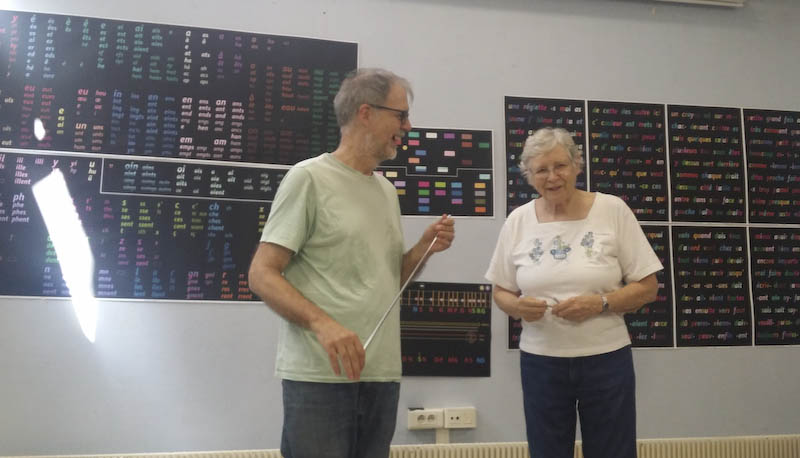
What a privilege to work with Dr Roslyn Young at the 4 day course she gave in Grenoble on the Silent Way for teachers and volunteers working with migrants, especially those who are non-readers and non-writers!
We started with some Hindi taught using the Silent Way to remind us all of the experience of starting from scratch in a language we know nothing about and which uses a completely unfamiliar script. And, of course, to give everyone the experience of the Silent Way and the power of its key foundations: provoking awarenesses rather than distributing knowledge; and retention rather than memorisation.
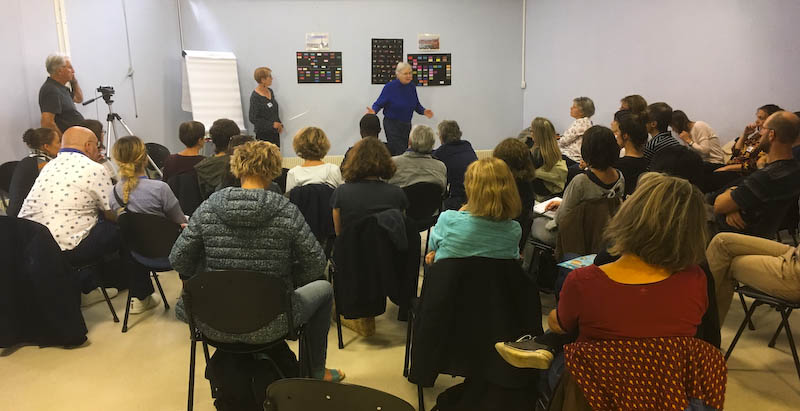
We then explored the tools available for Silent Way teachers. For example:
- ‘silence’ – through the precise use of silence we throw the responsibility back on the student to produce the language and allow the teacher to take up their proper role as coach, guide and guardian of quality. All this means the student is far more likely to build far more quickly accurate criteria for the language. Silence also entirely eliminates a common sin of teachers of any subject – ‘teacher talk’ and explanation.
- ‘Sleep’ – through teaching language as a knowhow rather than knowledge we ‘charge’ the human mind with experiences which the mind is ready, and supremely able, to integrate and install during our periods of sleep.
- ‘Mental images’ – all of our charts and how we use them are designed to enable the students to build mental images of whatever they are learning. For example, working with a sound-colour chart will leave the student with a mental image, both visual and kinaesthetic) of the complete inventory of the sounds of French.
- ‘Meaning not translation’ – by starting with tangible objects in unambiguous situations we ensure that meaning comes before the language, and therefore students and teachers escape from any need for translation – everyone can see that there is a red rod in front of them, or that Clara is taller than Juan, or that the chair is behind the table etc. We need to escape from translation in every language class, but nowhere is this need so obvious as where we have no common language with our students – a situation which is so common when we are working with migrants.
- ‘Retention not memorisation’ – humans are naturally retentive organisms and our powers of retention are effortless, effectively limitless and normally operate flawlessly. That is why in the Silent Way we avoid memorisation – memorisation is hard work and often faulty. One of the functions of our word charts is to enable our students to become familiar with the functional vocabulary of the language and acquire it through use, thus escaping from the memorisation trap. Since the functional vocabulary is in effect the grammar of the language, working with these charts is incredibly powerful to give the students the capacity to use the language creatively
- ‘The curiosity of the students’ – as soon as possible we pass over to the students responsibility for the content of the lesson and encourage them to create and test hypotheses to express what they perceive or think or feel. This can be done even at the earliest stages … for example I may perceive that a red rod is on a blue rod, whereas for you the blue rod is under the red rod, whereas for someone else they may perceive simply that there are a red and a blue rod on the table. All these statements are true of the situation. What is important is that we help students express what they themselves think or perceive in correct, true, well-pronounced language.
- ‘Economical correction’ – we try to do the minimum possible so that the student corrects themselves or discovers the correction themselves. It may be that the student cannot correct themselves without a new word or element of the language being put into circulation – but very often that isn’t the case, and often even just raising an eyebrow is sufficient for the student to find what is needed within themselves. Working in this way rapidly strengthens students’ inner criteria and takes them one step further towards becoming independent of us – just giving them the ‘correct answer’, which is such a temptation for all teachers, has nothing of this power.
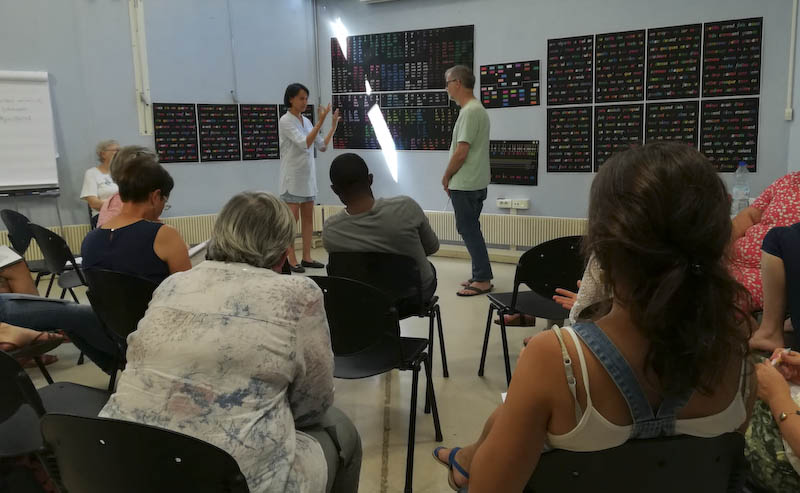
Finally, the students on the course got a chance to try out what they’d been working on for real with a live non-native speaker of French ie me! This was a very inspiring end to the course – for me, because I got my French improved and some much better criteria installed for aspects of French – and for the students because they saw and experienced how they could work in this way to improve a non-native speakers french at any level.
In addition … I made a lot of new friends! Looking forward to returning to Grenoble for more fruitful partnerships in the future!