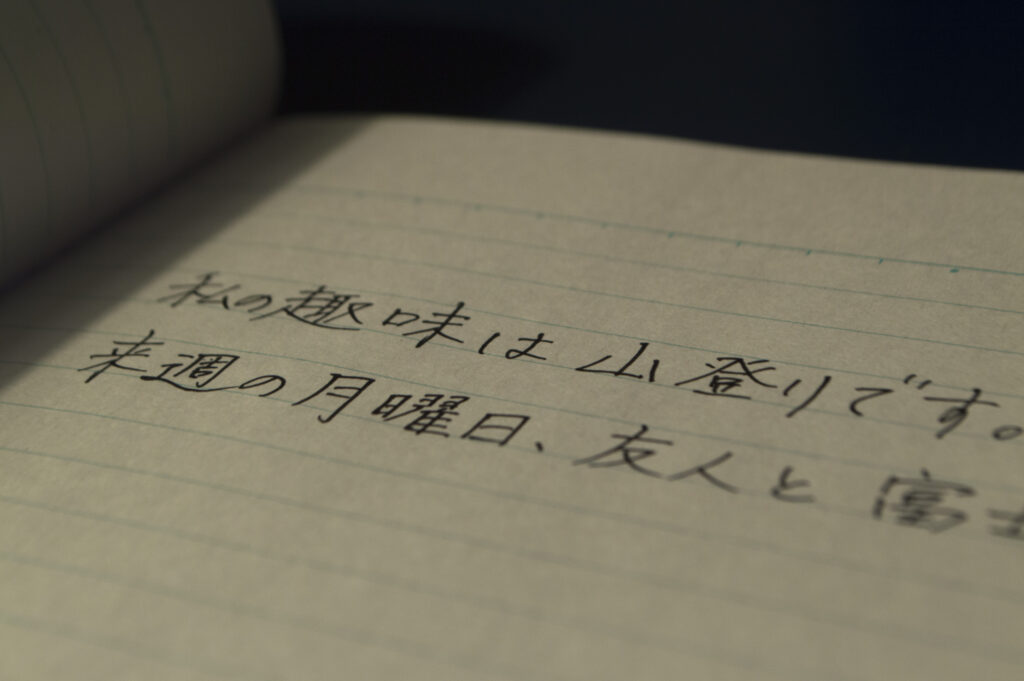
Japanese writing – Takashi Mukoda (see below)
What does it feel like to be illiterate in a language you begin to speak quite well? This must be what young children feel like, when they chat away in their native language before they start reading. And this must be what everyone feels like in a community whose language isn’t written down, or isn’t usually written in normal daily life.
As most of us in literate societies, I’m so used to writing and reading in English, and find it so easy to do without thinking, that it is hard to mentally place myself back in that pre-literate state.
Learning through speaking
But, I’m lucky! Learning Japanese with Silent Way Tokyo means I’ve learnt it almost exclusively through the spoken language. This means I that even though I’m beginning to be able to express myself reasonably well in Japanese, I am almost illiterate in the language.
Which feels surprisingly liberating – childlike even! In my lessons, I get to tell my stories, ask questions of others about things I’m curious about, and describe everyday events. All without the need for note-taking, writing down of phrases or sentences, or reading of texts, dialogues or articles.
And I’m surprised at how most of the words and patterns that I experience in this illiterate state stick in my mind, and how the memory of them seems to strengthen, rather than decay over time. In fact it feels as if, learning this way, I’m experiencing something akin to the much-admired memory capacity of unlettered peoples, albeit on a smaller scale.
All this makes me even more inclined to advise language learners to throw away their notebooks, and immediately become more childlike as a result. You don’t need to write things down to remember them. Indeed as Plato has Socrates argue:
You … have … attributed to [writing] quite the opposite of its real function. Those who acquire it will cease to exercise their memory and become forgetful; they will rely on writing to bring things to their remembrance by external signs instead of their own internal resources.
Plato and Walter Hamilton. 1973. Phaedrus. Harmondsworth: Penguin. 275
Afterword on Japanese
Japanese has one feature that makes it particularly well suited to getting this ‘illiteracy experience’: its writing system is extraordinarily difficult to learn. Difficult even for Japanese kids, and they start with the advantage of already knowing the language.
So for the student of Japanese, offered the opportunity to learn the spoken language by speaking, there’s not much temptation to try reading and writing. At the initial stages of learning the language, why would anyone give themselves the exhausting, frustrating and seemingly endless task of learning thousands of kanji and how they combine to represent vocabulary?
Especially if you are given the alternative of learning how to express yourself freely and spontaneously orally? In other words, the opportunity to behave just like children in that society do: learn to speak and only then learn writing and reading.
Actually, I do intend to learn to write and read in Japanese — indeed I’ve already experimented with how to do it (see here) — and I know it’s going to be easier, less exhausting and more efficient to do once I’ve learnt how to express myself orally at roughly the level of the average six-year-old. At which point, I’ll start to work on it more consistently.
And other languages?
The difficulty of the Japanese writing system creates a big incentive for people to learn with a ‘speaking first’ approach … but, of course, the other benefits — a childlike experience and improved memory — are available to anyone learning any language no matter what it’s writing system is like. And it really is worth the experience …
So, throw away your notebooks and text books and guided readers and start really learning through speaking!
Image by Takashi Mukoda https://www.flickr.com/photos/138667019@N07/25162292173/in/dateposted-public/, CC BY-SA 2.0, https://commons.wikimedia.org/w/index.php?curid=47528402