In a previous blog entry, I wrote about how I was working on writing (and therefore reading) in Japanese.
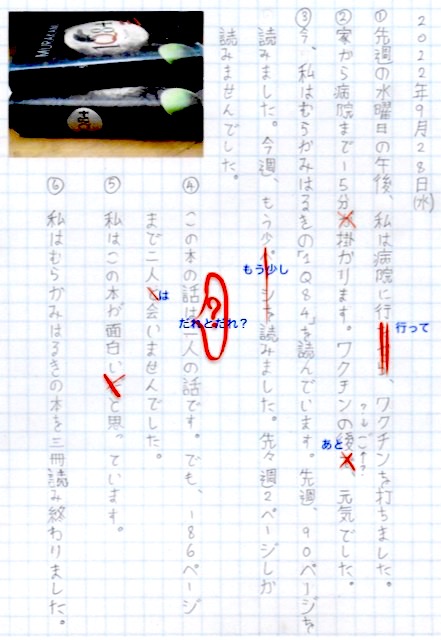
I’ve continued working on this, by writing sentences based on things I’ve talked about in each of my Japanese lessons. I email this work to my teachers, who give me feedback. I usually write something after each lesson. (Incidentally, I never write any notes or anything during lessons. It’s better to give the lesson one’s full attention and that is impossible when you take notes.)
The process
I freely use the online dictionary to remind me of any kanji characters that I’m not certain of, thus reducing any memory burden. (Kanji characters are the ideographic characters originally from Chinese that Japanese uses as part of its writing system.) But:
- because my writing desk is a couple of meters away from my computer I have to hold the characters in my mind for a moment or two after I have looked them up
- to help me ‘encode’ these symbols I pay attention to the ‘radicals’ they contain—’radicals’ are subparts of these characters that are reused in different combinations across many different kanji
- to help this process I also ‘write’ them in the air with my finger. This seems to help me hold the whole shape in my mind whilst I’m getting familiar with them
- because I’m writing by hand I have to look carefully at the shapes and can’t cheat that process
- before I email them to my teacher I read what I’ve written, making any necessary changes that I notice. And I read my work again when I get feedback.

Benefits
This way of working means that:
- because I’m sticking with vocabulary and grammar from my most recent lessons, I’m always reinforcing the oral work in class
- I’m certain that I’m practising characters for familiar words and that any new characters are guaranteed to be limited in number, and relate to words that I already know how to say and know what they mean
- as this work cumulates day-by-day and week-by-week I gradually discover that there are more and more characters I now ‘happen to know’
- the more characters I know the easier it is to learn new ones because I’m already more familiar with more of the ’subparts’ (radicals)
- I’m practising both writing and reading.
In fact I’m avoiding the process of ‘memorisation’—which is hard work, tedious, frustrating and yet unreliable—and instead using the process Gattegno called ‘retention‘. This is the same mental power that we use to remember without any special effort where the things are in our local supermarket, or the shops on the high street of a town we are familiar with, or the layout of our primary school etc etc.
Progress
I’m very happy that I can write anything that I can say, and I can read anything that I can write! This feels in balance. What I would like, though, is to improve my Japanese handwriting … it doesn’t yet ‘flow’ … but I console myself with the thought that when I was 6 or 7 my English handwriting didn’t ‘flow’ either.
You can see more of my progress by watching my video series Learning Japanese using the Silent Way.
Whilst Japanese is an extreme case, with its particularly difficult writing system, in fact, for an English native speaker, similar problems—in principle, if not in degree—crop up when we try to write French, for example, with its unfamiliar spelling system.
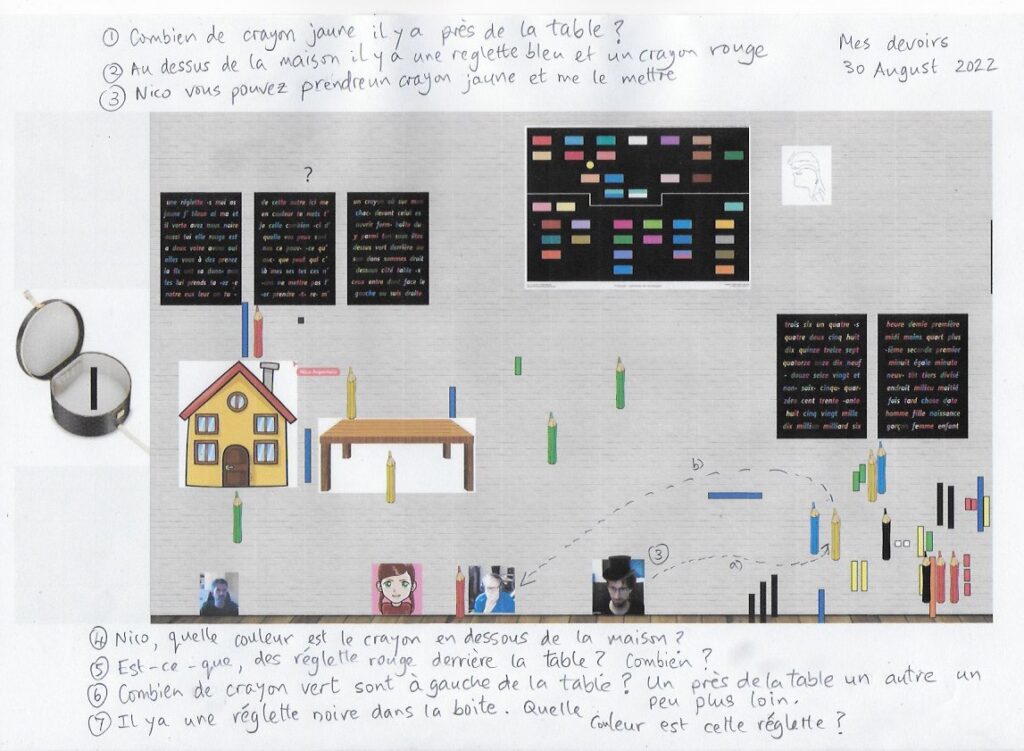
As it happens, I know that the same remedies apply to French as well, because I’ve adopted exactly the same approach to practise my French after each of the French lessons I’ve also been taking. Here’s an example of my practise for French: