
Someone I know recently started learning a new language in a conventional language class. Let’s call them X. They’re enjoying it! And they just had their 5th weekly lesson. One of the activities they did in this lesson was: each student picked a famous person and pretended to be them. Then the others asked them questions: What’s your profession? How old are you? What nationality are you? What languages do you speak?
But X got completely stuck because she couldn’t think of a famous person she wanted to pretend to be, so the teacher said ‘Oh! you just be Marilyn Monroe, because you’ve got blonde hair’. But that didn’t really help because X got Marilyn Monroe and Bridget Bardot mixed up (easy mistake to make) and so, when asked for her nationality, she replied ‘I’m French’.
Firstly, this raises the pedagogical question of why ask students to adopt fake identities? Surely it would make more sense for students to talk about themselves? After all, everyone knows who they are and what nationality they are, and talking about themselves is something that everyone is likely to do at some point. Far more likely than talking about Marilyn Monroe simply because you happen to share the same hair colour.
Secondly, how realistic is it for people to be able to talk about these things in their fifth lesson? Or perhaps more precisely, how realistic is it for people to be able to talk well about these things in their fifth lesson?
After about five lessons in Japanese, I had laid the foundations for the pronunciation, sounds and melody of the language, I was confident in numbers and counting, and I could do, albeit haltingly, sums like 1÷2 = 0.5 or 150,000÷3 = 50,000 in Japanese. Indeed whilst I wasn’t fast at answering these sums, some of that was because I’m not that fast at arithmetic in English either …
But there is no way I could have attempted the questions posed of my friend. Indeed, six months on, I still have no idea how to say ‘film star’ or ‘profession’ in Japanese.
So was I learning Japanese fast or learning slow? It depends on what you think is important in learning a language and what you think should be mastered first. For me, I would far rather:
- start by laying the foundations for great pronunciation: you can’t say anything well in a language unless your pronunciation is good
- take the time to develop facility in whatever tiny bit of the language I’m working on. That way, I will be able to rely on that aspect of the language whenever I need it, and it will be available to me to build other parts of the language on
6 months on, I still don’t know the Japanese for ‘film star’ or ‘profession’ but I’m really not bothered about this. What I can do, for example, is: faced with any situation like the below, I can spontaneously and confidently say anything I want like:
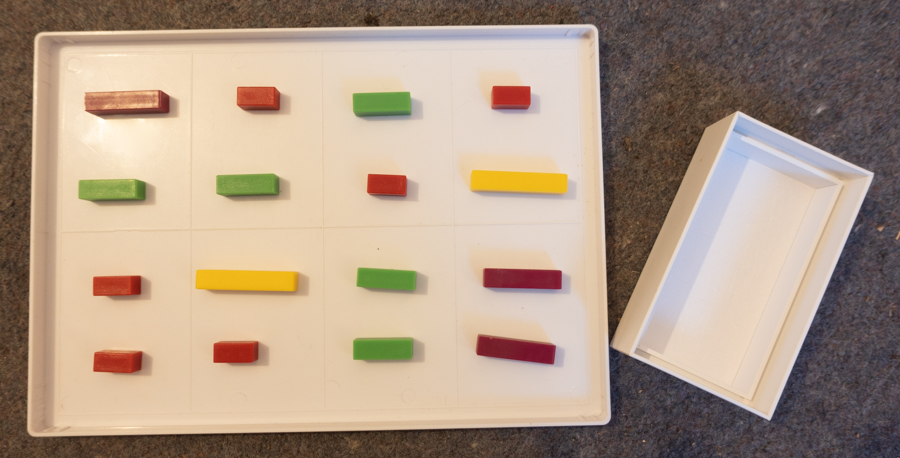
Take the 3rd rod from the left, 2nd from the top and put it in the box. Then take the first rod from the bottom, second from the right and put it in the box. What colour rods are now in the box? Did you put a red rod in the box? There isn’t a blue rod in the box? etc etc (I could go on for hours like this).
You could see this as just a narrow part of the language: who wants to talk about rods after all? But the feeling of being able to do this spontaneously, precisely, and at length and the confidence that, simply by substituting the odd noun and adjective, I now have the ability to express any of these kinds of relationships in any normal circumstance is extraordinarily empowering. For example, if instead of rods I had pictures of film stars then I could choose whichever I wanted, and say who I’d got, and ask you which ones you had etc.
Of course, I don’t know what X will have achieved after six months of her language class. But, if my experience of learning in conventional language classes is anything to go on, I suspect she will have a wider vocabulary in the language she is learning than I do now in Japanese. But I doubt she will have the freedom to use that vocabulary as creatively and spontaneously as I do in Japanese now.
So my answer to the question in the title of this article is: it depends what you value. Would you prefer 1) knowing a lot of vocabulary or 2) a good accent and knowing how to use well any vocabulary that you have.