One of the secrets of our success on our Catalan course is that we haven’t used a notebook, or anything, to write down new words and phrases.
It’s something that’s commonly recommended to language students, but unfortunately, it’s a recipe for forgetting: if you write words and phrases down in a notebook, you can put them out of your mind. Perhaps you imagine you’ll re-read your notes sometime; and perhaps you believe that will help. Perhaps you say to yourself: ‘At least these words and phrases are somewhere permanent; at least I’ve got something to ‘take away’ from my lessons.’ But that’s not really how the mind works.
A more efficient way
Instead, in our Catalan course, we’ve taken a different approach: we’ve cut out the labour and distraction of writing notes and instead used that time and energy to practice properly in our lessons.
We’ve cut out all that busywork and instead done what’s actually needed to put language directly into our minds: practice. We’ve really had to work on the language in our lessons. We haven’t had the option of switching off and hoping that something will sink in. Nor the option to just copy things off the board, or take a photo. And we haven’t been distracted from the lesson by the chance to doodle or by desperately trying to keep up whilst writing notes.
The place where language has to be stored is in students’ minds and the only reliable way to put it there is practice: by students generating example sentences, making sure they’re accurate and correct, saying them to classmates a few times, working to make them more fluid and more automatised, and then moving on to generate and work on the next example or attend to someone else’s.
It doesn’t take many examples, worked on like this, for the students in a class to generalise, make the new language part of their repertoire and build their skills in speaking. And whilst it’s hard work, it’s also fun.
Watch these processes at work
You’ll see these processes at work in the extracts from our twentieth Catalan lesson shown in the video below. We’d just opened up a new aspect of the language – how to speak about the ability or inability to do something, and our teachers had shown us the new language we needed. As always we talked about a real case: I asked my classmate to do something in the classroom that was impossible for her:
| Laurence: « Dona una regleta groga a la Maria » | Laurence: “Give a yellow rod to Maria” |
| Anthea: « No la-hi puc donar perquè no en tinc cap » | Anthea: “I can’t give her one because I don’t have any” |
The language we were working on was more sophisticated than we’d worked on before and rather tricky for us: the way the pronouns are constructed, the word order and the pronunciation details are very unfamiliar, markedly different from anything we’re used to. You can see that in the video: we tried, we got feedback, we started off hesitant and improved as we practised. This is how we advance in a language: trial and error, feedback and practice.
Being able to talk about the ability (or inability) to do something cropped up naturally in our course from situations like the one in the video: it’s the natural response when someone asks you to do something impossible! And it’s an example of how, with simple, tangible objects like Cuisenaire rods, teachers can get students exploring almost every aspect of a language.
What’s more, because the situation was clear and because we weren’t over-burdened and distracted by lots of vocabulary, the really difficult parts of a language stood out: in this case, how to use the pronouns and where to put them.
And with objects like Cuisenaire rods, it’s easy to generate lots of different examples to practise with. The students can just try things out, interact and see what the other person does next. That makes it always interesting. And there isn’t any spoon feeding and students aren’t limited by the teacher or the textbook.
Learning from examples
Our whole approach is based on learning from examples: using examples to get students to correlate the things they want to say with the language to say it accurately and well. The examples provide the raw material students’ minds need to generalise and invent their own implicit ‘rules’ and patterns. The teacher’s job is:
- to keep students’ experimentation within the bounds of what they can manage at any one time
- to give feedback, attempt by attempt
- to make sure students do enough practice, and then
- move the class on to the next step forward in their exploration of the language
This means the lesson is constructed in the moment by students and teachers working together. And as this video shows, the range of things students can say, and the nuances they can express expands lesson-by-lesson.
Here’s the updated version of our ‘bubble diagram’ illustrating the ‘syllabus’ that has emerged over our 20 hours of lessons. Each box contains an example sentence generated in our lessons and the arrows illustrate broadly the sequence of how one aspect of the language has built on another. The yellow boxes show the new things that emerged in our most recent lesson.
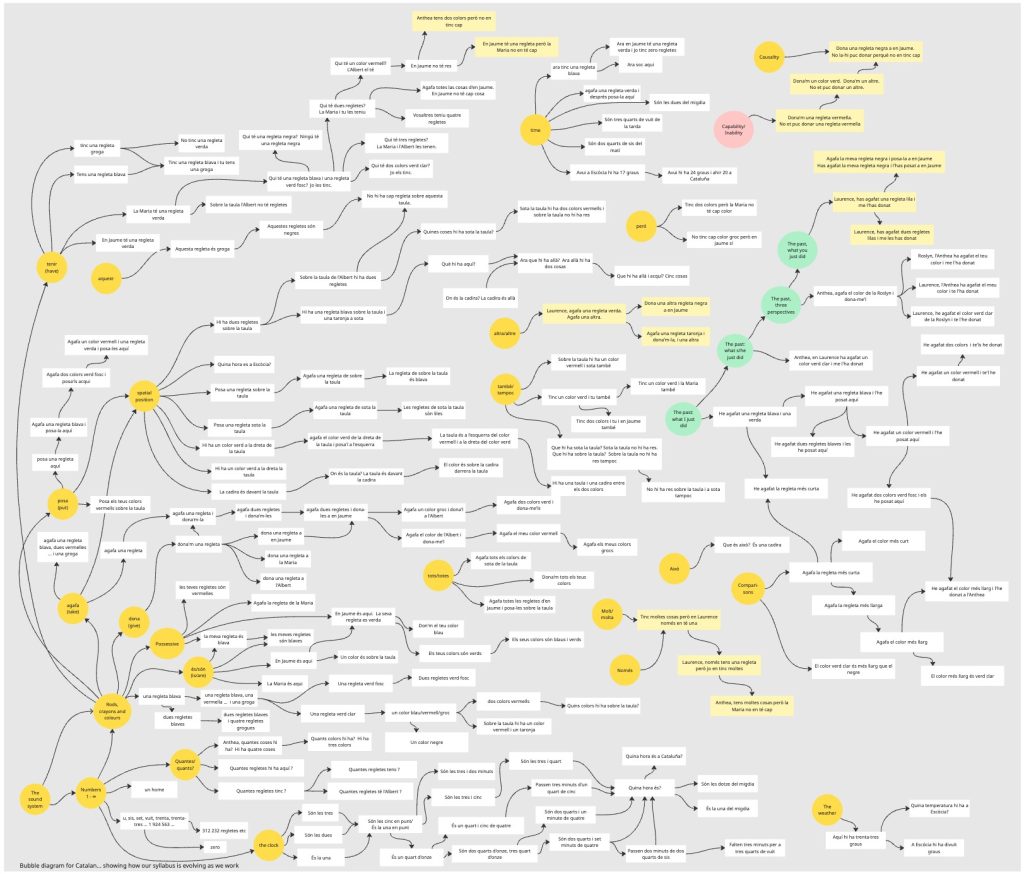
This diagram is getting rather extensive, so here’s a downloadable high-resolution PDF version.
One step at a time!
Working steadily, step-by-step; and consolidating everything by thorough practice means you can make surprising progress in learning a language. And you don’t need to take notes on paper or on your phone: you just need to pay attention, try things out and do enough practice.
I absolutely agree with you in this, but I want to share the example of a limit case, that may be the boundary of it (or maybe not, feel free to object if you disagree).
I have this one student who generally has one lesson per week (but sometimes she needs to skip one because of work), and a bit of time for her French now and then throughout the week. She wanted to take notes during the class, and we’ve effectively tried both approaches (again, usually my students don’t take note, as you recommend hers, and they’re better off that way). When she takes quick notes and use them later for her own practice, she gets to the next class with a much stronger skill for everything that we’ve worked on so far; on the other hand, without the note taking, she didn’t seem to achieve quite as much in between classes.
This may not be relevant for most students. I’d say that it only makes sense here because:
– she’s an experienced language learner;
– she doesn’t have much lesson time, and especially not at a regular, frequent pace;
– she does spend time trying to use her notes to practice (which a lot of other students don’t do).
She’s also at a very beginner level, roughly like you are in the video here.
Well Cédric, You and she have to be right! For her in her situation …
My guess would be it’s the practise that makes the difference, and if the notes are what enables her to practise then I couldn’t argue with that. It’s perhaps harder to rely on noteless free recall of the lesson if you’re short of time? And I suspect people need some training to do it easily – I think I did when I first started to – and that’s also probably not her priority.