Speaking a language is a skill, ‘procedural knowledge’, so like all skills we have to practise it if we want to achieve fluency and ease combined with accuracy and precision. Watch this video to see an example of the process at work.
One of the best ways of expanding your speaking skills is the Class Conversation. It’s a very simple technique. You and your classmates talk about whatever’s on your minds, and your teacher works with you until every sentence is correct, well said and properly practised. Nothing is written down – all the work is entirely oral and aural since improving speaking is the goal. If you want to get extra value out of this, you can add another step. In your next lesson, tell again whatever you recall of last time’s stories.
This isn’t an exercise in ‘memorisation’, nor even ‘recall’ really – though there is an element of recall in it, of course. It’s more re-creation: you already have recent mental images of whatever was talked about, and you have to create sentences that express those images. You can build on, and build from, what was achieved last time and thus consolidate and extend the learning.
Watch this video to see how this worked out in a recent Japanese lesson. In my lesson the week before, I’d found out about my teacher Sumiyo’s recent trip to Paris. And that had led to me talking about the problems that the Musée de Louvre had recently had. And then, as conversations do, I’d digressed to talking about a trip to Paris that I hoped to make in 2026.
The week after, I decided I wanted to practise by re-creating what I’d worked on the previous time. Here’s the video showing extracts from that second lesson:
Work like this cumulates. Practising talking well about one thing means that the next conversation becomes just a little bit better and a little bit easier. And gradually your skills build, leading to better quality speaking and improved fluency. It doesn’t happen overnight, but it doesn’t take for ever.
This video also illustrates another useful technique. At about 2 mins 21s into the video I use the word charts (these show the functional vocabulary of the language) to stabilise a sentence I’m working on by pointing on the charts. This pointing process slows everything down and makes sure that my grammar is accurate and secure: there’s no fudging or slurring over details when you do this. And this means I have an accurate, stable platform from which to build towards fluency, ease and speed ie the ability to say my sentence well, and with less conscious control.
In this update on our Catalan project you’ll see how we are using the Class Conversation technique to grow our skills in talking about the everyday. And our progress really is snowballing as a result.
We’ve just had our 29ᵗʰ Catalan lesson. We happened to talk about what we’d all been doing recently. Watch the video to see the kinds of things we worked on.
The advantages of this kind of Class Conversation lesson with a group of intermediate students like we are are many. For example:
there’s never any shortage of things to talk about and things to find out about each other: every day is always different and everyone’s days are always different.
there’s always scope for practice – retelling the story from other perspectives, combining sentences into more complex ones, adding or omitting details
talking about the everyday automatically means we work on the common words and common structures: exactly our priorities at the moment
the lesson is entirely about our stories, not something the teacher or textbook author imposed. So we’re invested in the work and what our classmates have to say
everything gets worked on until it is correct, sentence-by-sentence, and immediately. That’s how we improve. And because every sentence is practised – ie said several times – the language gets properly lodged in our minds
nothing is written down, so we have to use our minds all the time – to construct each sentence each time; to listen properly to each other; and to construct our replies, or follow up questions; or to change the subject when we feel like it!
Even quite low intermediate level students can handle and enjoy this kind of conversation-based lesson. And don’t underestimate older students – the average age of this group of students is in the early seventies.
Our progress
We moved into this kind of lesson about a month ago after 25 hours of learning Catalan. And, as a quick look at the last few blogs in this series will illustrate, our progress is snowballing fast. This is typical of a Silent Way course: in the early stages we work on the fundamentals thoroughly with Cuisenaire rods and objects in the classroom, and then we move into students exploring their own and each other’s everyday lives through the language. What remains constant is that everything is worked on until it’s correct and has been practised. This is what enables us to speak confidently and accurately and make this kind of progress. And we have a lot of fun learning.
If you’d like to find out more, just message me or comment below.
Watch how the Class Conversation technique really helps students develop their speaking. In the video, we talked about what’s been happening, and what’s going to happen, in our everyday lives. And our teachers helped us to improve our Catalan sentence by sentence
In the Silent Way at the start of a course we focus on good pronunciation and giving students a sense of how the functional vocabulary is used to express clear tangible meanings. And because of how we work, by the next stage, students are already confident trying to say things, getting feedback and working on their sentences.
All this means they have a great basis to start talking about their lives and everyday experiences, and therefore to start expanding the language they can use.
someone starts a thread in the conversation and students take each thread wherever they want
there are automatically opportunities to practise as students retell someone else’s story, ask each other questions and check details
there are no textbooks or worksheets; there’s no reading; and nothing gets written down. It’s all speaking the language because that’s, by far, the most important skill students need to develop
there’s one rule – everything must be true – that way the language remains grounded in, and connected to, students’ own lives and experiences. And that also means that everything students say is spontaneous, different and unique – because everyone’s life is different
this isn’t just a chat. It’s a lesson. So the teacher works with class on each sentence, as it is said, until it is correct and well said. This is crucial: it’s where the learning happens. Without the work to improve every sentence there would be little learning taking place. We want students to be improving their skills every time they speak or listen to a classmate speaking, sentence by sentence
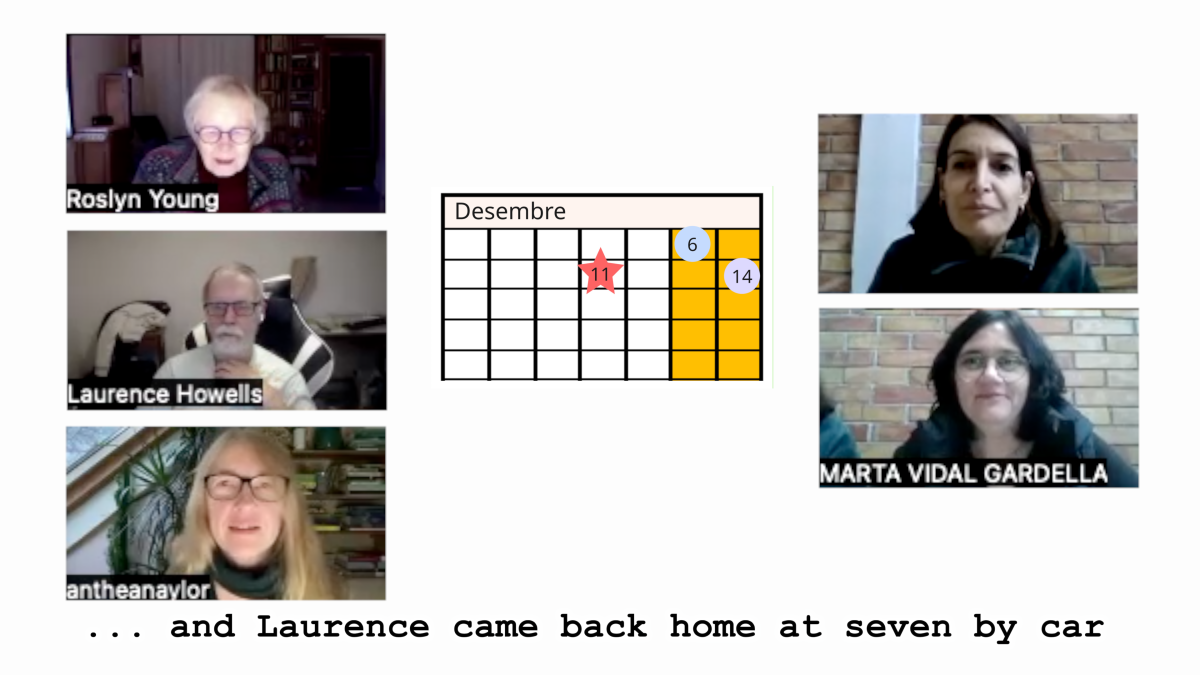
This is the stage we’re at in our Catalan course after 28 hours of lessons. Watch this short video to see a few extracts from our last lesson of 11th December 2025. We started the lesson with a picture of the calendar on screen and began talking about events in our lives: since it happened to be earlyish in December that’s where the conversation went, but it could have easily gone elsewhere.
This lesson came from our collaborative project to a) develop Silent Way materials for Catalan and the skills to use them, and b) at the same time for us students to learn to speak this wonderful language.
We started just five months ago with us students knowing no Catalan and as you can see we’ve made a lot of progress.
Now we’ve got a good grounding in the functional vocabulary, we’re ready to start talking about real events from our lives: a significant milestone in learning any language
We’ve reached intermediate level on the Silent Way progression framework. In other words we’ve started moving from talking about tangible objects in the online classroom to talking about things from our lives. We haven’t wasted time on rules or grammar exercises or textbook dialogues etc. And we haven’t used our energy to memorise lots of vocabulary. We’ve focused on talking about real tangible objects and situations to get a feel for how the language works – things like how the language expresses spatial, temporal, and personal relationships and the sounds, rhythm and flow of the language. There’s more to do on all that, but we’ve got the foundations to build on.
This lesson naturally followed on from what we did in the last one – talking about where we were going to be on which dates – a very fruitful way of allowing new learning to build on and consolidate previous work.
This video shows a sequence of clips from the lesson. Features that you will see illustrated in the video are:
we talked about the situation from multiple different perspectives
this meant there was a lot of practice and consolidation of the new language
but this wasn’t just repetition – we had to change and adjust the sentence every time the perspective or who we were talking to changed
as we practised, things got easier and we sounded more fluent
we added details as we went and gradually built up to quite an extensive narrative
everything we said was true and based on real plans, so everything either conjured up, or flowed from, real and relevant mental pictures
we weren’t thinking in English and translating into Catalan, there wasn’t time or need for that. We were just describing the situation as we knew it directly in the language
our sentences weren’t written down – so we had to recreate them from within every time. And this means the language is likely to ‘stick’ where it needs to be: in our minds.
This work is an example of how, using the Silent Way we’ve grown over 26 hours of lessons to be able to narrate a series of real events from our lives and manipulate changes in the language required depending on the context – who we were talking about and to whom we were talking.
A great return for the investment of 26 hours of our time
This is a significant milestone in learning any language: so much of normal conversation in any language is narrating sequences of events and plans of this sort. It’s the bedrock of what most of us talk about most of the time.
So feeling this confident speaking in Catalan about real travel plans like this is most satisfactory, especially after only 26 hours of work!
Watch the video in this blog to see how our skills have developed over the last 25 hours of lessons so that now we can tackle talking about some of the things going on in our lives.
After 25 hours of Catalan lessons using the Silent Way, we’ve started to move our conversations out of the classroom.
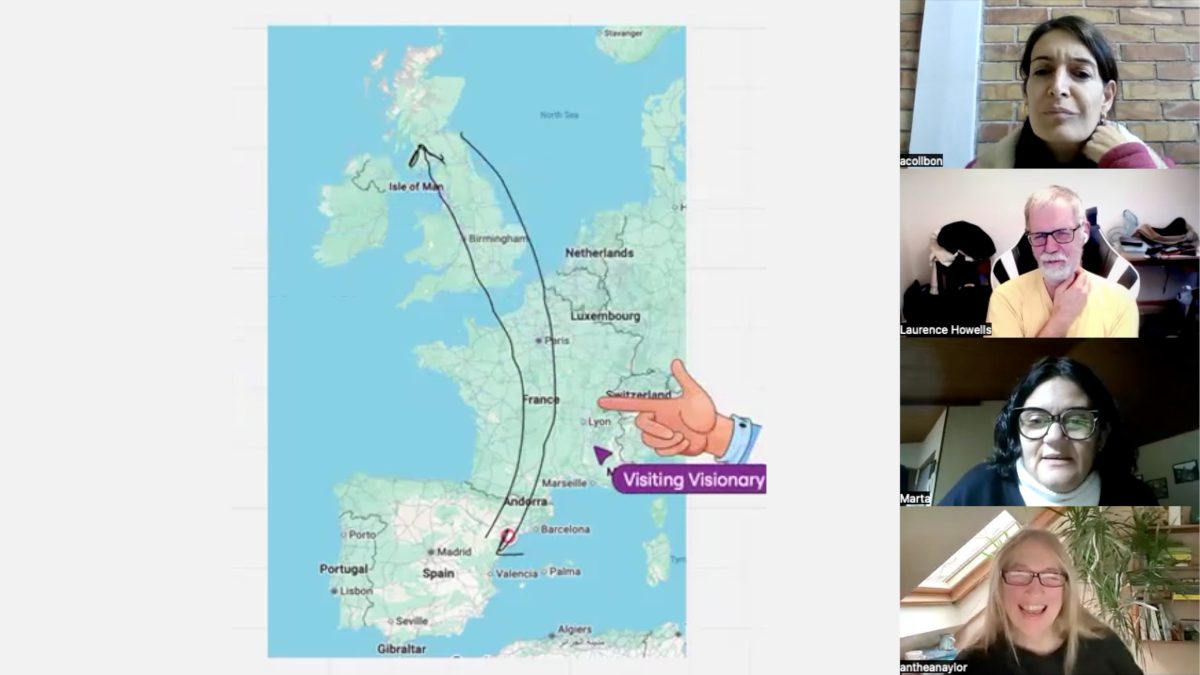
In this lesson, we were able to take control of the conversation and ask and answer questions of each other about what we’d been doing, for a whole hour. We talked about where we were going to be, or had been, and when. About half way through the lesson we needed words like « sud » (south), « est » (east), « oest » (west) and « nord » (north) to say what we wanted. Our teachers let us take the conversation wherever we wanted, giving us any bits of language that we were lacking, and giving us continual feedback.
This kind of student-led, freely-developing conversation, is typical of Silent way classes as students move from beginner towards intermediate level. There was lots of practice, but no drills, and immediate feedback on everything we said: this is how we improve. Everything we talked about was true, and everything was based on our lives.
Here’s a short video giving a sample of how the conversation developed:
Sub-skills accumulate if they are thoroughly worked on
We could talk freely like this for an hour, because we’d worked, step-by-step, towards this stage over the last 25 hours. This is important. you can’t expect beginner students to come out, unscripted, with sentences like the following (which one of us did):
« Des del diumenge catorze al dilluns vint-i-dos de disembre seré a Bouclans a l’est de França » (From Sunday the fourteenth to Monday the twenty-second of December I will be in Bouclans, in the East of France.
You can’t expect students to produce sentences like this unless you’ve enabled them, through your teaching, to develop a myriad of small sub-skills (for example, with numbers, articles, word order, days of the week, months, verbs and pronunciation etc), all of which need to be co-ordinated and put together to produce, spontaneously, sentences like this one.
This is why we work carefully and thoroughly on every tiny step until it is secure, so that everything accumulates and is available to students when they need them.
Once we are certain how to say something, we still need to work on the physical actions needed to get the sounds, syllables and words out of our mouths. And that means practice.
In our twenty-fourth lesson we extended the work we’d done on talking about the week to things like: « la setmana pasada » – last week – « la setmana pasada no l’altre » – the week before last – « la setmana vinent » – next week etc. And then we combined that with the month and date. We ended up with sentences like:
« Quin dia serà dijous de la setmana vinent no l’altre? Vint-i-set de novembre » – What day will Thursday of the week after next be? The 27th of November.
Facility with the calendar and this kind of language is an important underpinning for the ability to tell everyday stories – it gives the means to tie events to dates and times. So this is something we want to be able to do fluently, with ease and facility.
So we need practise. And it’s not just working on the mental tasks required to put together these kinds of sentences, it’s also achieving physical ease in getting the sounds and syllables out of our mouths. It’s easy to underestimate the difficulties of this latter task, until you try it and find yourself stumbling, hesitating and producing the wrong sounds. Not least is the difficulty of saying « novembre » in Catalan, where the similarities with ‘November’ mean we are all too likely adopt familiar English elements and therefore badly mispronounce the word.
Practice is vital to make any part of the language easy and automatic, freeing up our minds for the rest of the task of expressing ourselves. Once we have worked out what we need to say, we need to say our sentences again a few times to get them working smoothly and well.
Watch this video to see that process at work. At first you’ll see me ‘guessing’ how to describe the day that I decided to work on. Once I was certain that my idea for how to say it was correct, I practised it several times. As usual, nothing was written down – I had to construct it each time from my own mental resources.
Find out about our latest project which will showcase efficient and innovative techniques to teach students to speak a foreign language confidently and well. And, of course, I’ll also tell you about the opportunities I’ve had to speak Japanese whilst I’ve been here!
It’s my last day in Hiroshima. I’ve been here for just over three weeks, working on a project filming some of the English classes that Don Cherry gives at Hiroshima International University. The aim is to document how he teaches spoken English in this context: ie to large groups of students who have studied English at school for several years but never really spoken it.
Hiroshima Heiwa Kinen Kouen (Peace Memorial Park, Hiroshima)
You can’t come to Hiroshima without visiting the Peace Park (Hiroshima Heiwa Kinen Kouen) and thinking about what happened here 80 years ago. So here’s a little video from the Park.
Speaking Japanese
Of course, being in Japan means I’ve had more chances to speak Japanese. And its been great. For practical, everyday purposes I seem to be able to say whatever I want, people seem to understand me, and with a slight mental delay I seem to understand them.
I’ve had extended conversations in Japanese with several people on interesting topics like art, learning languages, teaching music, growing trees etc. And in shops and restaurants; or catching trains and street cars; or visiting museums, parks and gardens; the words these situations call for seem to arise quite naturally and easily. Things like:
‘Is there an ATM here?’
‘Is this the South gate, or the North gate?’
‘How do I pay for my ride?’ [on a street car]
‘Either is fine’ [when asked if I want a window or aisle seat on the Shinkansen]
Q: ‘Is it winter in Scotland now?’ My answer: ‘No it’s Autumn, the same as here.’
‘Is everything in this restaurant really gluten free?’ [The answer was ‘Yes, except for the beer’]
‘Is this restaurant open every day?’ ‘Which days are you open?’ [The answers were: ‘No only three days each week’, ‘Saturday, Sunday and Monday’]
‘Which of these houses is this address? (Pointing to the address on my phone) etc
I don’t suppose I could talk about the political thought of Karl Marx or Kantian philosophy in Japanese but then I probably couldn’t do that particularly well in English.
It all feels very natural and familiar
None of this is particularly surprising. It all feels very natural and familiar because for the last couple of years our online Japanese lessons with Silent Way Tokyo have all been about expressing well whatever happened to spring spontaneously to mind: things that had happened either recently or long ago, things that interested me or I’d recently discovered, current problems or challenges, news of friends or relatives etc. Our lessons aren’t led by the teacher or a textbook; the content comes entirely from us, the students. And the teachers help us sentence-by-sentence, until we can say what we intend to say, accurately and well. And then they make sure we practise, so that what we’ve worked on begins to ‘stick’. And we’re always working on speaking: we never read out sentences or dialogues, or memorise little set speeches or routines.
So that’s why I’m ready to spontaneously start talking and responding, in the moment, to whatever crops up.
Here’s a brief video of me speaking impromptu to one of the classes we video’d, thanking them for giving us the opportunity to film them. It’s not the most elegant speech, and there are several things I meant to say that I forgot to: exactly as I would in English if I stood in front of thirty two 18-year old university students to speak without notes, at the end of their last class, on a Friday afternoon.
What’s next for our project
There’s a lot of work now to do on the footage we took. We filmed eleven full, 90 minute lessons each with several cameras to give multiple points of view on the action and we interviewed the teacher six times to find out what he was trying to do in each lesson, why he emphasised certain things, what things he was less happy about, how he managed and organised teaching some 180 students in several classes and, more generally, to understand his whole approach to teaching English.
One of the most interesting things that we did was to film the same class over three consecutive lessons. This means we’ll be able to show how the teacher built the work from lesson to lesson over three weeks, how the students’ speaking progressed over the series, and how these three lessons will fit into the direction of the whole course.
What we’re aiming for
The goal is that other teachers can see Don Cherry’s approach and the techniques he uses, in practice, in real classes. This will give the viewers practical ideas that they can borrow, develop, adapt and apply in their own courses and their own context. Whilst we’ve filmed English classes, this approach and the techniques Don has developed over his 30 years of experience teaching in this context can be adapted, re-invented and applied to teaching any language.
The edited video series will start appearing early in 2026.
Thanks to Don Cherry, colleagues at Hiroshima International University and all the students involved.
Watch this film to see the Catalan language continuing to spring surprises on us: how do you say ‘Three days ago’?
In our 22ⁿᵈ lesson, we met the week in Catalan. Since the lesson took place on a Thursday, we tied our work to reality by first working on: « Avui és dejous » (‘Today is Thursday’). We already knew « avui » and « és », so this was not difficult.
But the minute we started to talk about the other days of the week, we were working on multiple ‘dimensions’:
the new names for each day
the past and the future
temporal relationships like ‘the day before’, or ‘tomorrow’ or ‘the day after tomorrow’
pronunciation and flow
So our teachers took it slowly, step by step. Every new thing introduced was worked on and practised before another thing was introduced. And after we’d met two or three new things, we practised everything again in any order, integrating together all the work so far, and only then moving on. This how to implement the ‘spiraling curriculum’ in a lesson.
Observing students is the key
Our teachers were observing us carefully as we worked so they could match the pace of the class to our progress: always making sure we were moving forward but never letting us get overwhelmed.
This is the key to good teaching. And they could observe properly because they weren’t lecturing or explaining. In fact, they were mostly silent, so we were doing the talking and they could always tell how well we were doing at any moment.
What we didn’t do
What we didn’t do, was start with ‘Monday’ and try to memorise all seven of the day names in sequence and then recite them in order. This is dull, ends up being a drill and is certain to overload students’ memory. People can’t hold seven items in short term memory: after about four items the mind will ‘overwrite’ one of them to make room for the fifth. This is why memorising lists of words usually doesn’t work.
In fact we never said the day names in the usual order, throughout the class. Although, in fact, we could easily have done this by the end of the lesson because we’d learnt them by use and familiarity and we’d related them to reality: the actual day the lesson took place and it’s place in a whole week.
Catalan always surprises!
Watch this video extract from the lesson to see us at work, having fun and being delighted by one of the many surprises that the language sprang on us!
This was a very productive lesson. There were the seven new day names to work on; new grammar for the past, the future and for temporal relationships; and continual refinement of our pronunciation. And as you will have seen in the video, a delightful experience of this remarkable language!
Our progress
It’s instructive to look back at how our course has developed since we started a few months ago.
As complete beginners to the language, in our first two lessons we worked on the sounds of the language and numbers. Then we started working on the functional vocabulary and gradually, practising everything thoroughly, we moved forward step-by-step, gradually expanding what we could do, until we reached this point.
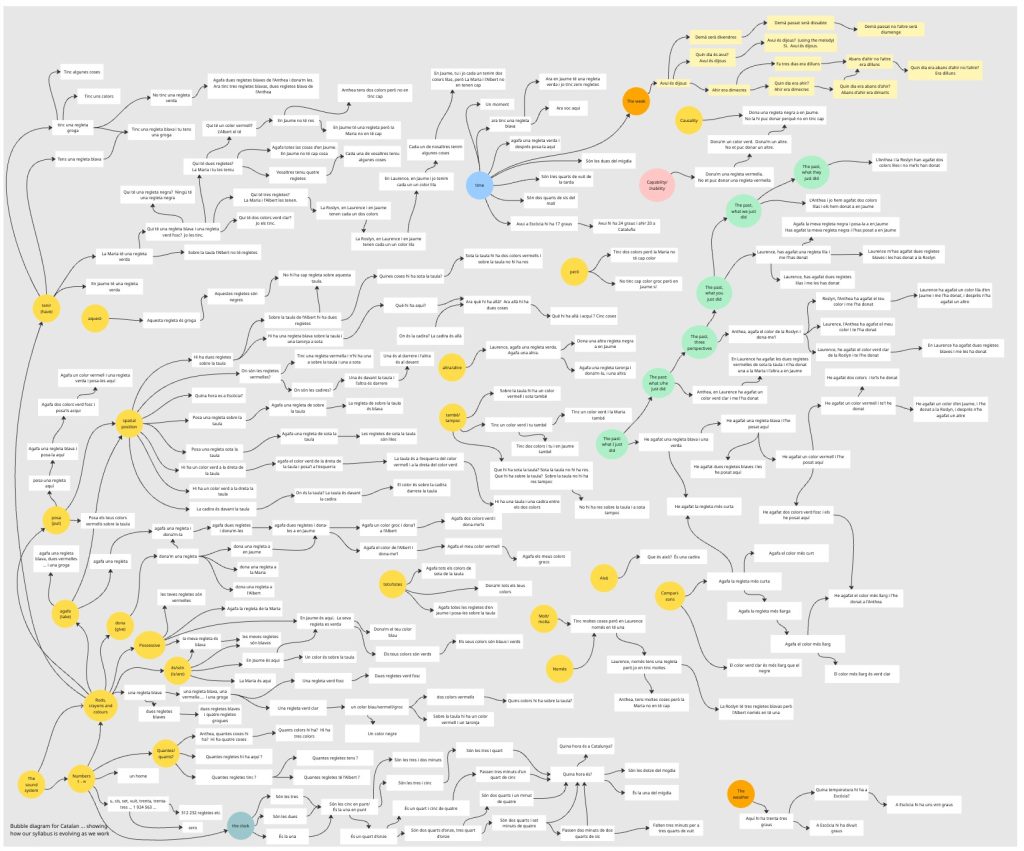
The two ‘bubble diagrams’ below illustrate our progress. The rectangles provide examples of the kinds of sentences we worked on for each of the themes. Of course, we generated many more such sentences in each lesson. And we used our teacher’s feedback to correct each one and then we practised saying them several times until we could do so with some facility.
Diagram No 1: After 3 hours of lessons
Diagram 2: After 23 hours of lessons
By this stage the diagram is a bit hard to read! So here is a high resolution PDF version.
An excellent return of learning for our time
The diagrams are illustrations of what we had learned at each stage, not what had been covered, because everything in the diagram had been properly practised and integrated together. 23 hours of learning and an excellent return for our time!
Teaching by examples, rather than rules and explanations, is extremely effective. But teachers need to take care to juxtapose examples so that students spot the patterns of similarity and difference efficiently
When we teach by examples (rather than rules and explanations) we’re relying on the universal human ability to generalise from experiences. It’s extremely effective.
One of our jobs as teachers is to help students make these generalisations by how we juxtapose the examples they work on. We want them to reliably spot similarities, so we need to group examples from the sub-systems together. But we also want them to see the differences, so, before they get too comfortable and start to ‘over-generalise’, we need to introduce contrasting examples showing the other patterns that they need to get familiar with. Judging how long to stick with similarities and just when to surprise students with a contrast is one of the skills teachers need to hone.
And we must also give students plenty of practice with each subsystem and with integrating the whole system, so that it starts to stick in their minds and becomes something they can do with facility and with confidence.
An example: telling the time in Catalan
Every language has unique and special things that are part of its essential character. Getting to know these things gives students a window into ‘the spirit of the language’. Amongst the many things of this sort that we’ve worked on in our Catalan course, telling the time certainly stands out. As far as I know, the Catalan system is completely unique, it’s certainly surprising, but at the same time it’s completely logical.
Precisely because it is so unusual and foreign, most students will find it difficult to learn. And at the same time, precisely because it is logical and consistent, it’s easy for teachers to fall into the trap of trying to teach it intellectually, imagining that this will enable students to learn to how do it. It won’t: procedural skills have to be learnt by doing and by practising.
Fortunately, teaching what’s needed step-by-step, and by examples avoids these problems and makes it easy and fun to learn. You do need to take the time necessary, but, working this way, it will become as familiar and natural to students as telling the time in their native language.
Watch this film to get an idea of how we and our teachers tackled it.
Students can only make something like this properly a part of themselves through exploring it step-by-step and through plenty of practice. But tackling it this way means it’s never a chore and the surprises always keep it interesting!
If we pitch language lessons right, we can rely on humans’ ability to generalise from a few examples so that students get to build their own inner sense of ‘what sounds right’.
When we speak a language we start with a perception or idea and then produce the words and sounds needed to express that idea. The ideas and the meaning come first; the words come after.
When we are teaching, we have to get students working on this whole chain of language – right from thoughts, all the way to sounds – and we have to do it in such a way that everyone in the class is learning all of the time.
The video below is a perfect example of teaching this way. As you watch it ask yourself questions like:
one student launched each sentence starting from whatever they decided to talk about, somehow always venturing a bit beyond what they could easily do. But not venturing so far that it became impossible. Why do you think the lesson stayed at that ‘sweet spot’, the most fruitful place for learning?
no one was ever in doubt about the meaning someone was trying to get across before any work was done on the sentence. What had the teacher done to make sure this was the case?
the teacher didn’t do any of the things conventionally associated with ‘teaching’. What did she do instead? What did she do to get the students’ sentences correct? How much did she say? What impact did the process of correction have on the students?
how engaged was the whole class? Were they all learning? Were they helping each other?
why aren’t all language classes like this one? What could you do in your classes to evoke this kind of purposeful, but fun atmosphere?
In the Silent Way approach, we rely on students’ ability to generalise from the example sentences they produce and work on. And we do all this work orally. This means we can bypass all the tedious, and largely ineffective work on rules, explanations and exercises. And this approach means that students build their own inner sense of ‘what sounds right’. And they have fun whilst they are doing it.