Blog

Catalan – Speaking to learn project, week 5: small steps cumulate!

We’re working intensively on the functional vocabulary of the language gradually expanding the range of what we can talk about with confidence and certainty. Watch the video to see how far we’ve got.

This blog updates on our project to develop the materials and skills needed to teach spoken Catalan to beginners, using the Silent Way. We’re pooling the team’s skills and knowledge of the language; how languages are learnt and should be taught; and our experience of teaching to both learn the language and to create the materials needed at the same time!

Here’s how far we’ve got with our spiralling, one-small-step-at-a-time curriculum. The important point is that these small, secure steps – just one function word at a time – each properly practised, cumulate over time into the ability to speak freely, spontaneously and accurately.

We’re deliberately working exclusively on the functional vocabulary – the words and endings that carry the grammar of the language. And this means we’re learning intuitively how the language functions.

And you can see the results in the video. After just nine hours of lessons, we’re able to confidently improvise a whole series of correct and accurate sentences about what we see in our shared online classroom. None of this was rehearsed or pre-prepared – we just expressed whatever occurred to us in the moment. And you can see, we could correct ourselves and we were certain about what we said. Sure, we both know we need to up our game on pronunciation, but that takes time.

We’re building a secure ‘core’ of the language from which, once we’ve done a bit more, we’ll be able to expand as far as we want to take our Catalan skills in the future.

Catalan – expanding what we can do one step at a time

Trial and error is central to learning any skill. Watch this video to see how to use it in a language lesson to connect meaning and new grammar without rules of explanations.

We’re using trial and error, feedback and correction to explore the language. Here’s an example. The character ‘Maria’ had just appeared on the scene, so we didn’t know how to say ‘Give something to Maria’.

So, I guessed, based on what I already knew. Watch the video to see how the teacher gave me feedback and taught us the correct grammar, without explanation or rules.

The first time I said the new grammar (in the middle of the clip), my pronunciation was awful! But notice how I consciously improved it as I practised until I was able to say the sentence quite fluently and quite well. This is what practising is for: getting things we know to be correct to flow out more automatically and with less conscious control.

After the clip we continued practising, giving each other whatever instructions we wanted, and thereby integrating together the new with whatever things we’d done before. And a bit later we extended another step further, by asking each other to give things to Albert: which required another new bit of grammar.

The functional vocabulary

Our focus at this stage in the course is on gaining facility with the functional vocabulary of Catalan and we’re doing that through connecting visible or tangible meanings with example sentences and then practising what we’ve learned. This is the way to get an intuitive sense of the way the language works – how to use its ‘grammar words’ – so that the language just starts to flow out of our mouths in response to the meanings in our minds.

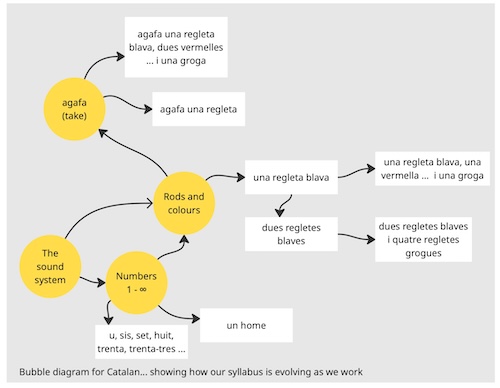
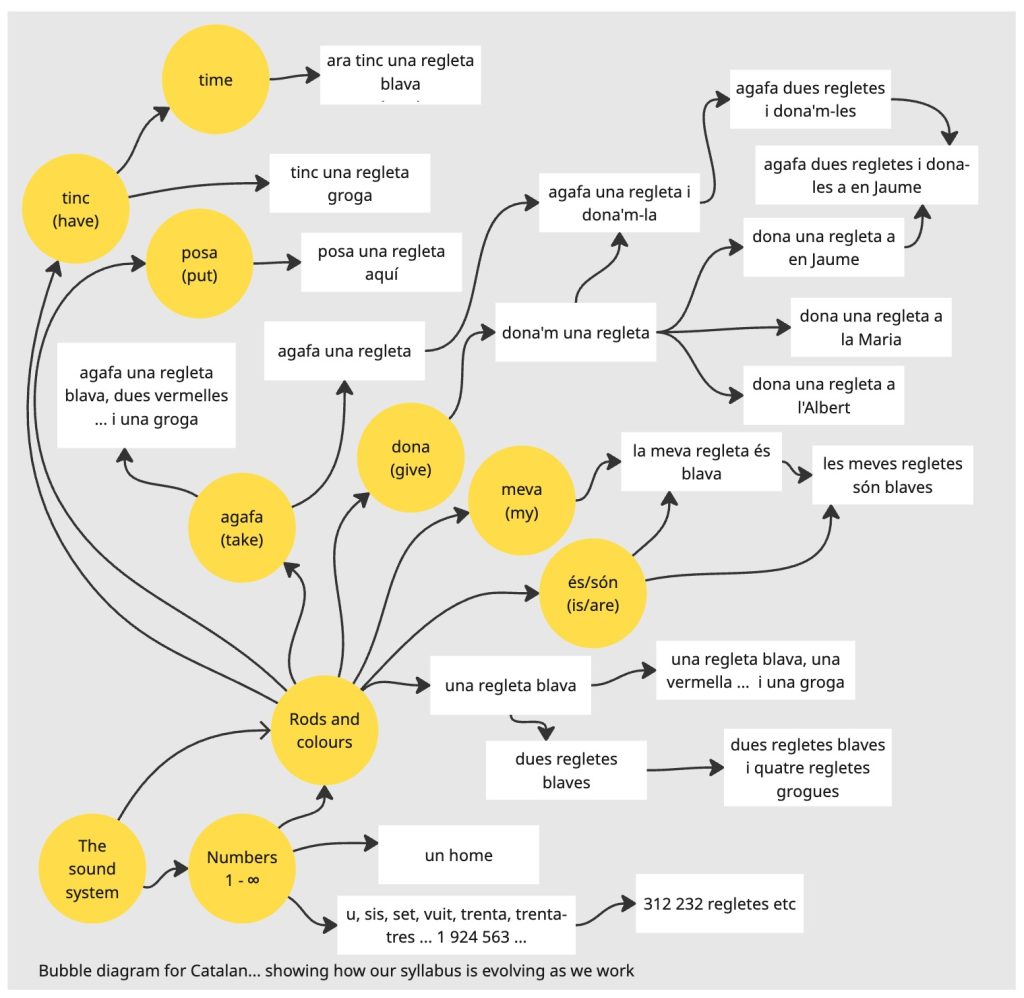
So, we’re continuing to move forward, step-by-step, using the ‘spiralling curriculum’. The diagram below gives a sense of where we’ve got to after seven hours of Catalan lessons: good progress in return for the time we’ve spent!

Of course, the examples in the boxes in the diagram are just examples to make the diagram clear. In fact, we, the students, have improvised many, many sentences exploring these parts of the language. And all this work has been done orally with no text book, notes or worksheets. We’re learning to speak the language – reading and writing can come later if either of us decides that’s what we want to do.

Catalan – week 3 making meanings clear

This extract from a lesson shows how you can make the meaning of a phrase clear to beginner students without translation or explanations.

This extract came from the end of our fifth lesson ie after almost five hours. We’d been using the word « tinc » (I have), but just before this clip our teachers had introduced the word « ara ».

They introduced it by showing us its sounds and where the stress was and getting us to practice it as just pure sound. They didn’t give a translation or an explanation: as you’ll see, we just used the changing situation to make it’s meaning in this context clear. And then we practiced.

Now, we still can’t be certain of this word – it may have many significances and it may be used in different ways from how a word like this is used in other languages we know. But we are pretty certain that if we want to describe the sort of changing situation depicted in the video in Catalan, we can use this word in this way. And this will be confirmed or refined in future lessons.

Tolerating this kind of uncertainty and avoiding translation, whilst the teacher makes sure students gain a sense of the meaning, is key to beginning students forging a direct connection between what they experience or want to say and the words they need to express it in a foreign language.

Catalan – Week 3, using the ‘pronunciometer’

Pronunciation is such an important aspect of learning a language. Find out how to use the ‘pronunciometer’ to improve students’ pronunciation skills.

Here’s the ‘pronunciometer’:

It’s simple: 10/10 means native-like, around 5 means kind of OK, and 1/10 means awful. It gives teachers a way to give students feedback in a precise, non-judgmental way about that all-important aspect of speaking a language: pronunciation.

Here’s how we used it in our Catalan lesson:

The purpose of having some kind of scale against which to judge our pronunciation is to remind us, we’re all aiming to get our students’ pronunciation as good as possible: as close as possible to native-like. And to give us an impetus to change something about how we say a word or phrase.

Put it another way, we, as students, really, really don’t want to end up around 4 or 5 on the scale – comprehensible but still sounding very ‘English’. That’d be awful and embarrassing. So, working word by word to improve from mediocre to better to good is what we want to do.

The scale on its own is of no value. The teacher has to follow it up with guidance on what the student needs to do to improve: where the flaws are in the student’s attempt, what to work on, where the energy balance between the syllables needs to be adjusted etc.

This is best done by directing the student’s attention to whatever changes they need to make to what they are doing with their voice and their muscles. And once the student has made an improvement, getting them to practice: ie say the word again a few times.

We’ll be using this tool in our future lessons to improve how we sound. And to build really good pronunciation skills.

Catalan-speaking to learn project, Week 2 

Week 2 of our Catalan project. Our learning is gradually cumulating. Today, we’ve started giving each other instructions and seeing them carried out.

This is where we’ve got to at the end of Week 2, after 3 hours of lessons: we’re giving each other instructions!

We’ve built up to this, starting with some work on pronunciation, then on numbers, then some colours. Then we put all these together, and finally we added a verb in the imperative « agafa ». 

This ‘bubble diagram’ gives an overview of how these elements built one on another. This isn’t and can’t be a linear curriculum: it’s a spiralling curriculum. We’re not finished with any of these bubbles and everything will get worked on and re-worked on, and then varied and extended every lesson. 

One of the notable features of how a Silent Way course works is that we start with a very concentrated and restricted vocabulary: in this case just one noun « regleta » and a few colour adjectives plus a few function words.

You see the benefit of this concentration in the video: we already could confidently create our own unique, correct sentences. And we knew we’d been understood, because we saw the actions we’d asked for being carried out. We are already independently and autonomously ‘thinking in the language’ and expressing precisely what we intend. This is worth a lot. 

Catalan – speaking to learn project

A new project to develop the materials and the skills to teach spoken Catalan to beginners using the Silent way. It’s a collaboration between two native speakers of the language and the silent way.online team.

Over the next few months I’m going to be blogging about our new Catalan project. This project aims to develop the materials and the skills to use them to teach spoken Catalan to beginners using the Silent way. It’s a collaboration between two native speakers of the language and the silentway.online team.

Our approach is going to be a ‘learning by doing’ one. We’ll develop trial materials and techniques, try them out in a safe environment with two beginners to the language, reflect on the experiences as we go and then adapt everything in a ‘rapid prototyping’ cycle.

The project builds on the knowledge, skills and experience we have of teaching many languages using the Silent Way. It’s founded on a set of principles about the nature of language, how people learn and how they are best taught (see here for more information)

I have two roles in the project. Firstly I bring the skills and experience to build Silent Way materials and guide the process. But, since I don’t know Catalan, I’m also one of the students. This is an unusual, but not unheard of, and fascinating arrangement.

Before our first lesson, I used the IPA Catalan chapter, a dictionary with IPA plus the web site Forvo to make a first attempt at a sound-colour chart and to make a first attempt at a numbers chart. These charts will become pedagogical tools that allow teachers to work efficiently on pronunciation and to teach students how to use the numbers. As expected in our lesson we confirmed many things but also discovered things to improve in the first draft charts. For next time, we’ll have second drafts to try out.

By focusing on pronunciation and this small but very important aspect of the language, we, as students, were immediately taken into a new Catalan ‘world’ and enabled to leave English behind for a little while. This is the first step to gaining that all important feel for ‘the spirit of the language’.

Here’s a tiny video clip from our first lesson showing how we’re working.

Speaking a language is a practical skill

There isn’t any other way to learn practical skills than by doing, and there isn’t any other useful way to teach them either: what you have to do is make sure the students are safe, let them try, give them feedback as soon as possible after they’ve tried and steer them in what you think will be helpful directions.

Last weekend I painted (some of) the front of our house in Spain. I’ve done a fair amount of painting in my time but never a south facing, rough cast wall in the mediterranean sun. But just like any other practical skill there are things to be learnt to do it well in this particular context.

Things like: what preparation to do? How to protect the floor from drips? Where best to put the ladder? How much water to add to thin the paint? What’s the most convenient size container to carry that paint up the ladder? How deep to dip the brush? What kind of stroke applies the paint best? What angle is best to hold the brush? How far to reach out safely when at the top of the ladder? etc etc

None of these things can be learnt from a book or watching someone else do it or thinking about it. You just have to do it, notice what happens and try different things out. And a helpful voice from the person on the ground saying ‘You’ve missed that bit out!’ or ‘There’s a massive drip over there!’ or ‘Careful! Don’t lean too far out! Move the ladder instead!’ helps the work to go better.

Speaking a language is also a practical skill, albeit one too often thought of as an intellectual skill: a conception that I think is an error. We’re much better thinking of learning a language as something practical: a function of the body and the muscles.

And this gives a clue to how we should work as teachers. The students are the ones up the ladder, acting: moving their muscles, making sounds, trying to express meanings. We’re the ones on the ground offering feedback, guidance and helpful advice.

What’s taught isn’t what’s learnt

It’s obvious that what we teach isn’t what’s learnt, so we have to change our focus. We aren’t teachers of language, we’re teachers of people. And the people are the ones doing the work on the language.

It’s obvious that what we teach isn’t what’s learnt. Indeed when you think about it the two activities don’t have much to do with each other. ‘Teaching’ is commonly words and explanations coming out a teacher’s mouth and ‘learning’ is some mysterious transformation in students’ minds and bodies.

So when we’re teaching we have to make educated guesses about what’s going on in students’ minds and then act to provoke some kind of change in the right direction and then help them make that change more stable and ideally permanent.

So we aren’t teachers of a language, we’re teachers of people. We can only act in this way if the students are doing nearly all the talking: the only evidence we have of what might be going on in students’ minds when they try to speak a foreign language is what they say.

We have to get good at observing students at work – what they say, the mistakes they make, their confidence or hesitancy – and intuiting how to act to help them improve. But the first step is getting them talking, because then we have something to work on – they’re active and the process of trial & error and feedback can begin. And that’s how we learn.

If you want to remember things, don’t take notes

Outsourcing our memory to pieces of paper is all very well for things we don’t want to remember long-term. But for things like language, I think it’s a mistake.

I read something the other day that advised language learners:

‘Take down notes to remember things’

The trouble with this is we usually write notes of things we don’t want to bother remembering: shopping lists, today’s to-do-list, packing lists etc. And something in our notebook is in completely the wrong place for language: words and phrases need to be in our minds..

Perhaps, noting something gives us the illusion of permanence; but permanence on paper isn’t much use. Perhaps it also makes us think we’ll re-read our notes (we probably won’t) and that that process will make the language lodge in our minds (which it probably won’t).

Personally, I don’t make any kinds of notes when learning a language, and I don’t let my students do so either. I think it’s much better to try to ‘encode’ the words into long term memory directly as soon as we encounter them. And taking notes distracts from that process.

Our time and energy is much better spent practising what we’re working on, trying to retrieve the words from our minds, and saying them out loud. These are the things that strengthen long term recall.

And the more you work like this, the better you’ll get at storing words more-or-less permanently in your mind in a place where you can pull them out when you need them. And if it takes a couple of encounters with something to store it long term, that’s still more efficient than writing it in a list and then putting it out of your mind.

In fact, I’d say notebooks and vocabulary lists are mostly counter-productive and simply encourage forgetting. So my advice is the opposite:

‘If you want to remember things, don’t take notes’

Teaching listening – start with pronunciation

With pronunciation you have something you can work on – how students sound. With listening, you never know what they’ve heard so you’ve no easy way of intervening.

It’s pretty obvious that if students’ pronunciation is poor, they are probably going to find it hard to decode what’s being said to them–their mental image of the language is probably distorted.

We can’t work directly on what people hear or what they make of what they hear: it happens inside their heads. But with pronunciation we have something to work on: how they sound. And we can improve that by training how they use themselves when speaking English. So that gives teachers a place to start helping students with listening.

If we work properly on pronunciation–in English especially reductions, stress, contractions, connected speech and intonation–then as well as training students how to use their mouths and muscles we are also helping them to build better mental representations of how English sounds. And every time they open their mouths and speak well, they will be reinforcing these mental images. Once their pronunciation is good, then they stand a chance of decoding what they hear.

They’ll still need some specific training–every type of skill needs its own particular development and practice, and speaking and listening are distinct skills. And they’ll need to grow their vocabulary. Nevertheless they will have what is the key foundation on which to build.

What’s more, it’s two for the price of one! They improve their pronunciation and at the same time they lay the foundations for listening,

Therefore, before you start working on listening, work on students’ pronunciation.