Watch how the Class Conversation technique really helps students develop their speaking. In the video, we talked about what’s been happening, and what’s going to happen, in our everyday lives. And our teachers helped us to improve our Catalan sentence by sentence
In the Silent Way at the start of a course we focus on good pronunciation and giving students a sense of how the functional vocabulary is used to express clear tangible meanings. And because of how we work, by the next stage, students are already confident trying to say things, getting feedback and working on their sentences.
All this means they have a great basis to start talking about their lives and everyday experiences, and therefore to start expanding the language they can use.
someone starts a thread in the conversation and students take each thread wherever they want
there are automatically opportunities to practise as students retell someone else’s story, ask each other questions and check details
there are no textbooks or worksheets; there’s no reading; and nothing gets written down. It’s all speaking the language because that’s, by far, the most important skill students need to develop
there’s one rule – everything must be true – that way the language remains grounded in, and connected to, students’ own lives and experiences. And that also means that everything students say is spontaneous, different and unique – because everyone’s life is different
this isn’t just a chat. It’s a lesson. So the teacher works with class on each sentence, as it is said, until it is correct and well said. This is crucial: it’s where the learning happens. Without the work to improve every sentence there would be little learning taking place. We want students to be improving their skills every time they speak or listen to a classmate speaking, sentence by sentence
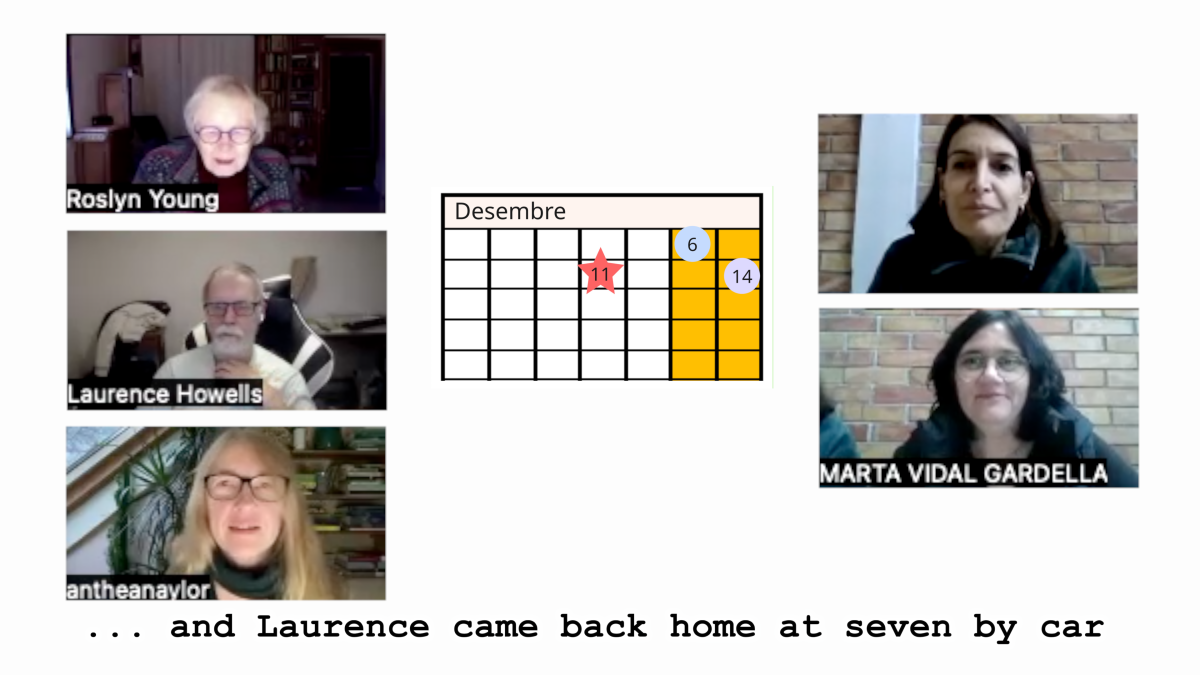
This is the stage we’re at in our Catalan course after 28 hours of lessons. Watch this short video to see a few extracts from our last lesson of 11th December 2025. We started the lesson with a picture of the calendar on screen and began talking about events in our lives: since it happened to be earlyish in December that’s where the conversation went, but it could have easily gone elsewhere.
This lesson came from our collaborative project to a) develop Silent Way materials for Catalan and the skills to use them, and b) at the same time for us students to learn to speak this wonderful language.
We started just five months ago with us students knowing no Catalan and as you can see we’ve made a lot of progress.
Now we’ve got a good grounding in the functional vocabulary, we’re ready to start talking about real events from our lives: a significant milestone in learning any language
We’ve reached intermediate level on the Silent Way progression framework. In other words we’ve started moving from talking about tangible objects in the online classroom to talking about things from our lives. We haven’t wasted time on rules or grammar exercises or textbook dialogues etc. And we haven’t used our energy to memorise lots of vocabulary. We’ve focused on talking about real tangible objects and situations to get a feel for how the language works – things like how the language expresses spatial, temporal, and personal relationships and the sounds, rhythm and flow of the language. There’s more to do on all that, but we’ve got the foundations to build on.
This lesson naturally followed on from what we did in the last one – talking about where we were going to be on which dates – a very fruitful way of allowing new learning to build on and consolidate previous work.
This video shows a sequence of clips from the lesson. Features that you will see illustrated in the video are:
we talked about the situation from multiple different perspectives
this meant there was a lot of practice and consolidation of the new language
but this wasn’t just repetition – we had to change and adjust the sentence every time the perspective or who we were talking to changed
as we practised, things got easier and we sounded more fluent
we added details as we went and gradually built up to quite an extensive narrative
everything we said was true and based on real plans, so everything either conjured up, or flowed from, real and relevant mental pictures
we weren’t thinking in English and translating into Catalan, there wasn’t time or need for that. We were just describing the situation as we knew it directly in the language
our sentences weren’t written down – so we had to recreate them from within every time. And this means the language is likely to ‘stick’ where it needs to be: in our minds.
This work is an example of how, using the Silent Way we’ve grown over 26 hours of lessons to be able to narrate a series of real events from our lives and manipulate changes in the language required depending on the context – who we were talking about and to whom we were talking.
A great return for the investment of 26 hours of our time
This is a significant milestone in learning any language: so much of normal conversation in any language is narrating sequences of events and plans of this sort. It’s the bedrock of what most of us talk about most of the time.
So feeling this confident speaking in Catalan about real travel plans like this is most satisfactory, especially after only 26 hours of work!
Watch the video in this blog to see how our skills have developed over the last 25 hours of lessons so that now we can tackle talking about some of the things going on in our lives.
After 25 hours of Catalan lessons using the Silent Way, we’ve started to move our conversations out of the classroom.
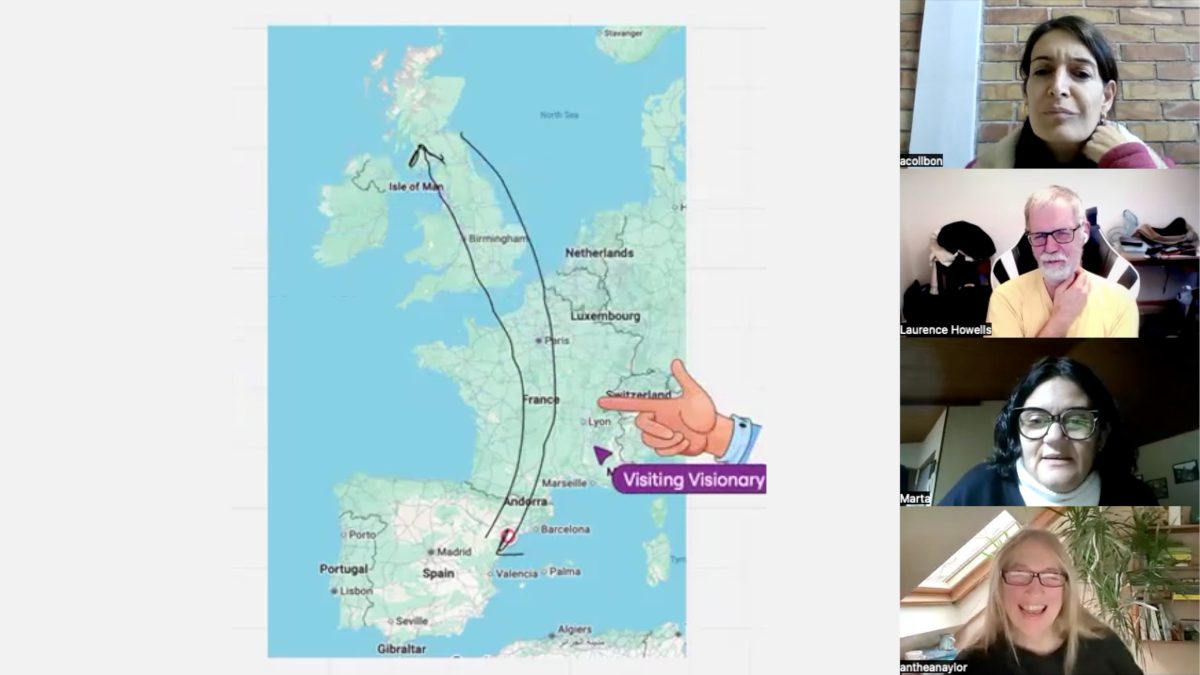
In this lesson, we were able to take control of the conversation and ask and answer questions of each other about what we’d been doing, for a whole hour. We talked about where we were going to be, or had been, and when. About half way through the lesson we needed words like « sud » (south), « est » (east), « oest » (west) and « nord » (north) to say what we wanted. Our teachers let us take the conversation wherever we wanted, giving us any bits of language that we were lacking, and giving us continual feedback.
This kind of student-led, freely-developing conversation, is typical of Silent way classes as students move from beginner towards intermediate level. There was lots of practice, but no drills, and immediate feedback on everything we said: this is how we improve. Everything we talked about was true, and everything was based on our lives.
Here’s a short video giving a sample of how the conversation developed:
Sub-skills accumulate if they are thoroughly worked on
We could talk freely like this for an hour, because we’d worked, step-by-step, towards this stage over the last 25 hours. This is important. you can’t expect beginner students to come out, unscripted, with sentences like the following (which one of us did):
« Des del diumenge catorze al dilluns vint-i-dos de disembre seré a Bouclans a l’est de França » (From Sunday the fourteenth to Monday the twenty-second of December I will be in Bouclans, in the East of France.
You can’t expect students to produce sentences like this unless you’ve enabled them, through your teaching, to develop a myriad of small sub-skills (for example, with numbers, articles, word order, days of the week, months, verbs and pronunciation etc), all of which need to be co-ordinated and put together to produce, spontaneously, sentences like this one.
This is why we work carefully and thoroughly on every tiny step until it is secure, so that everything accumulates and is available to students when they need them.
Once we are certain how to say something, we still need to work on the physical actions needed to get the sounds, syllables and words out of our mouths. And that means practice.
In our twenty-fourth lesson we extended the work we’d done on talking about the week to things like: « la setmana pasada » – last week – « la setmana pasada no l’altre » – the week before last – « la setmana vinent » – next week etc. And then we combined that with the month and date. We ended up with sentences like:
« Quin dia serà dijous de la setmana vinent no l’altre? Vint-i-set de novembre » – What day will Thursday of the week after next be? The 27th of November.
Facility with the calendar and this kind of language is an important underpinning for the ability to tell everyday stories – it gives the means to tie events to dates and times. So this is something we want to be able to do fluently, with ease and facility.
So we need practise. And it’s not just working on the mental tasks required to put together these kinds of sentences, it’s also achieving physical ease in getting the sounds and syllables out of our mouths. It’s easy to underestimate the difficulties of this latter task, until you try it and find yourself stumbling, hesitating and producing the wrong sounds. Not least is the difficulty of saying « novembre » in Catalan, where the similarities with ‘November’ mean we are all too likely adopt familiar English elements and therefore badly mispronounce the word.
Practice is vital to make any part of the language easy and automatic, freeing up our minds for the rest of the task of expressing ourselves. Once we have worked out what we need to say, we need to say our sentences again a few times to get them working smoothly and well.
Watch this video to see that process at work. At first you’ll see me ‘guessing’ how to describe the day that I decided to work on. Once I was certain that my idea for how to say it was correct, I practised it several times. As usual, nothing was written down – I had to construct it each time from my own mental resources.
Watch this film to see the Catalan language continuing to spring surprises on us: how do you say ‘Three days ago’?
In our 22ⁿᵈ lesson, we met the week in Catalan. Since the lesson took place on a Thursday, we tied our work to reality by first working on: « Avui és dejous » (‘Today is Thursday’). We already knew « avui » and « és », so this was not difficult.
But the minute we started to talk about the other days of the week, we were working on multiple ‘dimensions’:
the new names for each day
the past and the future
temporal relationships like ‘the day before’, or ‘tomorrow’ or ‘the day after tomorrow’
pronunciation and flow
So our teachers took it slowly, step by step. Every new thing introduced was worked on and practised before another thing was introduced. And after we’d met two or three new things, we practised everything again in any order, integrating together all the work so far, and only then moving on. This how to implement the ‘spiraling curriculum’ in a lesson.
Observing students is the key
Our teachers were observing us carefully as we worked so they could match the pace of the class to our progress: always making sure we were moving forward but never letting us get overwhelmed.
This is the key to good teaching. And they could observe properly because they weren’t lecturing or explaining. In fact, they were mostly silent, so we were doing the talking and they could always tell how well we were doing at any moment.
What we didn’t do
What we didn’t do, was start with ‘Monday’ and try to memorise all seven of the day names in sequence and then recite them in order. This is dull, ends up being a drill and is certain to overload students’ memory. People can’t hold seven items in short term memory: after about four items the mind will ‘overwrite’ one of them to make room for the fifth. This is why memorising lists of words usually doesn’t work.
In fact we never said the day names in the usual order, throughout the class. Although, in fact, we could easily have done this by the end of the lesson because we’d learnt them by use and familiarity and we’d related them to reality: the actual day the lesson took place and it’s place in a whole week.
Catalan always surprises!
Watch this video extract from the lesson to see us at work, having fun and being delighted by one of the many surprises that the language sprang on us!
This was a very productive lesson. There were the seven new day names to work on; new grammar for the past, the future and for temporal relationships; and continual refinement of our pronunciation. And as you will have seen in the video, a delightful experience of this remarkable language!
Our progress
It’s instructive to look back at how our course has developed since we started a few months ago.
As complete beginners to the language, in our first two lessons we worked on the sounds of the language and numbers. Then we started working on the functional vocabulary and gradually, practising everything thoroughly, we moved forward step-by-step, gradually expanding what we could do, until we reached this point.
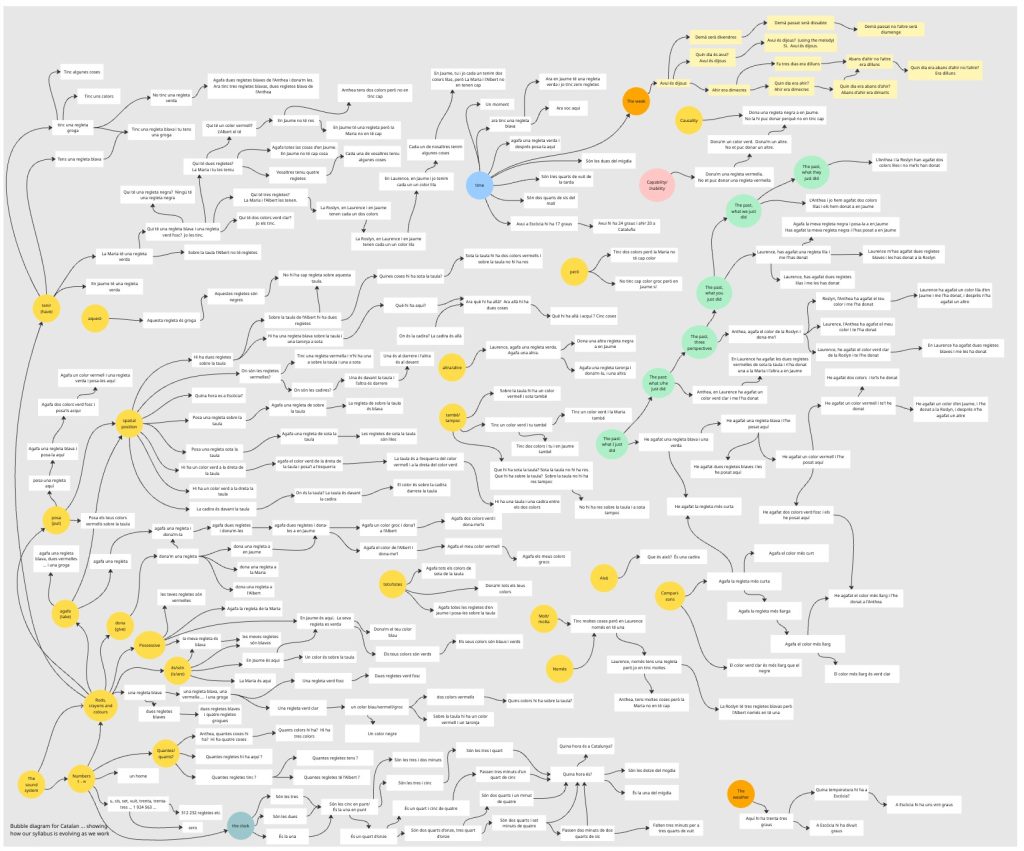
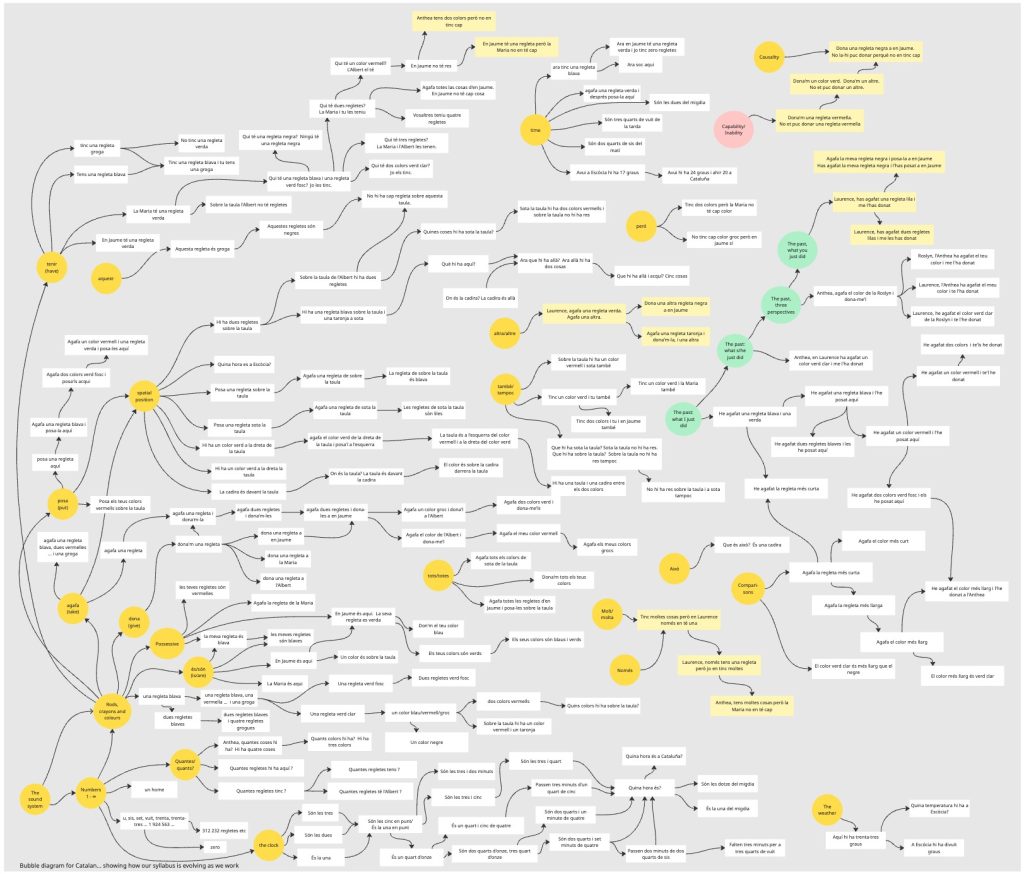
The two ‘bubble diagrams’ below illustrate our progress. The rectangles provide examples of the kinds of sentences we worked on for each of the themes. Of course, we generated many more such sentences in each lesson. And we used our teacher’s feedback to correct each one and then we practised saying them several times until we could do so with some facility.
Diagram No 1: After 3 hours of lessons
Diagram 2: After 23 hours of lessons
By this stage the diagram is a bit hard to read! So here is a high resolution PDF version.
An excellent return of learning for our time
The diagrams are illustrations of what we had learned at each stage, not what had been covered, because everything in the diagram had been properly practised and integrated together. 23 hours of learning and an excellent return for our time!
Teaching by examples, rather than rules and explanations, is extremely effective. But teachers need to take care to juxtapose examples so that students spot the patterns of similarity and difference efficiently
When we teach by examples (rather than rules and explanations) we’re relying on the universal human ability to generalise from experiences. It’s extremely effective.
One of our jobs as teachers is to help students make these generalisations by how we juxtapose the examples they work on. We want them to reliably spot similarities, so we need to group examples from the sub-systems together. But we also want them to see the differences, so, before they get too comfortable and start to ‘over-generalise’, we need to introduce contrasting examples showing the other patterns that they need to get familiar with. Judging how long to stick with similarities and just when to surprise students with a contrast is one of the skills teachers need to hone.
And we must also give students plenty of practice with each subsystem and with integrating the whole system, so that it starts to stick in their minds and becomes something they can do with facility and with confidence.
An example: telling the time in Catalan
Every language has unique and special things that are part of its essential character. Getting to know these things gives students a window into ‘the spirit of the language’. Amongst the many things of this sort that we’ve worked on in our Catalan course, telling the time certainly stands out. As far as I know, the Catalan system is completely unique, it’s certainly surprising, but at the same time it’s completely logical.
Precisely because it is so unusual and foreign, most students will find it difficult to learn. And at the same time, precisely because it is logical and consistent, it’s easy for teachers to fall into the trap of trying to teach it intellectually, imagining that this will enable students to learn to how do it. It won’t: procedural skills have to be learnt by doing and by practising.
Fortunately, teaching what’s needed step-by-step, and by examples avoids these problems and makes it easy and fun to learn. You do need to take the time necessary, but, working this way, it will become as familiar and natural to students as telling the time in their native language.
Watch this film to get an idea of how we and our teachers tackled it.
Students can only make something like this properly a part of themselves through exploring it step-by-step and through plenty of practice. But tackling it this way means it’s never a chore and the surprises always keep it interesting!
If we pitch language lessons right, we can rely on humans’ ability to generalise from a few examples so that students get to build their own inner sense of ‘what sounds right’.
When we speak a language we start with a perception or idea and then produce the words and sounds needed to express that idea. The ideas and the meaning come first; the words come after.
When we are teaching, we have to get students working on this whole chain of language – right from thoughts, all the way to sounds – and we have to do it in such a way that everyone in the class is learning all of the time.
The video below is a perfect example of teaching this way. As you watch it ask yourself questions like:
one student launched each sentence starting from whatever they decided to talk about, somehow always venturing a bit beyond what they could easily do. But not venturing so far that it became impossible. Why do you think the lesson stayed at that ‘sweet spot’, the most fruitful place for learning?
no one was ever in doubt about the meaning someone was trying to get across before any work was done on the sentence. What had the teacher done to make sure this was the case?
the teacher didn’t do any of the things conventionally associated with ‘teaching’. What did she do instead? What did she do to get the students’ sentences correct? How much did she say? What impact did the process of correction have on the students?
how engaged was the whole class? Were they all learning? Were they helping each other?
why aren’t all language classes like this one? What could you do in your classes to evoke this kind of purposeful, but fun atmosphere?
In the Silent Way approach, we rely on students’ ability to generalise from the example sentences they produce and work on. And we do all this work orally. This means we can bypass all the tedious, and largely ineffective work on rules, explanations and exercises. And this approach means that students build their own inner sense of ‘what sounds right’. And they have fun whilst they are doing it.
To reach fluency and ease in a language requires thousands and thousands of small steps and each one needs to be practised till its secure. Working superficially is just not efficient and usually leads to people feeling insecure.
20 hours ago we started this course in spoken Catalan by learning how to say ‘one’, then ‘six’ then ‘seven’ etc. Numbers are a good place to start in a language you don’t know at all.
We started from nothing – literally only working on the word « u » (‘one’) – and then added one small thing at a time, practicing each small thing and integrating it with all that we’d done before. All the way through the course our teachers have insisted that we work on every sentence until its correct and we can say it with some ease; and then they have pushed us on to the next small step. And we’ve never used a text book or taken notes or read out sentences: everything has been done orally. And we haven’t studied rules or exceptions: we’ve learnt from generating and correcting our example sentences.
In this extract you’ll see us in our twentieth hour of learning Catalan reaching this interesting sentence and practising it.
« La Roslyn i l’Anthea han agafat dos colors i no me’ls han donat però els han donat a en Jaume »
‘Roslyn and Anthea took two purple crayons and didn’t give them to me, but they gave them to Jaume’
It’s worth thinking about just how many small steps were needed for us to get from the start ie saying « u » (‘one’), to creating sentences like this one. We could, I suppose, count how many steps there have been to reach this point, but its clearly a rather large number: there are pronouns and conjunctions and verb forms and pronunciation and word order and plurals and gender and a few nouns and a few adjectives etc etc that all have had to be mastered.
There aren’t any short cuts … but it needn’t take for ever
To reach fluency and ease in speaking a language requires thousands and thousands of small steps and each one needs to be practised till it’s secure. Working superficially is just not efficient and usually leads to people feeling insecure. Most courses expect students to take too many steps and steps that are too large at a time and don’t make sure students properly consolidate all of them.
But as this example shows, if you work methodically and thoroughly on every step, you can make great progress and have fun while you’re doing it.
There’s lots more for us to do in learning Catalan, but using the Silent Way approach, everything just snowballs.
If you want to learn to speak a language, taking notes isn’t particularly efficient. It’s hard work, distracting and unecessary. Read this blog to find out what you can do instead.
One of the secrets of our success on our Catalan course is that we haven’t used a notebook, or anything, to write down new words and phrases.
It’s something that’s commonly recommended to language students, but unfortunately, it’s a recipe for forgetting: if you write words and phrases down in a notebook, you can put them out of your mind. Perhaps you imagine you’ll re-read your notes sometime; and perhaps you believe that will help. Perhaps you say to yourself: ‘At least these words and phrases are somewhere permanent; at least I’ve got something to ‘take away’ from my lessons.’ But that’s not really how the mind works.
A more efficient way
Instead, in our Catalan course, we’ve taken a different approach: we’ve cut out the labour and distraction of writing notes and instead used that time and energy to practice properly in our lessons.
We’ve cut out all that busywork and instead done what’s actually needed to put language directly into our minds: practice. We’ve really had to work on the language in our lessons. We haven’t had the option of switching off and hoping that something will sink in. Nor the option to just copy things off the board, or take a photo. And we haven’t been distracted from the lesson by the chance to doodle or by desperately trying to keep up whilst writing notes.
The place where language has to be stored is in students’ minds and the only reliable way to put it there is practice: by students generating example sentences, making sure they’re accurate and correct, saying them to classmates a few times, working to make them more fluid and more automatised, and then moving on to generate and work on the next example or attend to someone else’s.
It doesn’t take many examples, worked on like this, for the students in a class to generalise, make the new language part of their repertoire and build their skills in speaking. And whilst it’s hard work, it’s also fun.
Watch these processes at work
You’ll see these processes at work in the extracts from our twentieth Catalan lesson shown in the video below. We’d just opened up a new aspect of the language – how to speak about the ability or inability to do something, and our teachers had shown us the new language we needed. As always we talked about a real case: I asked my classmate to do something in the classroom that was impossible for her:
Laurence: « Dona una regleta groga a la Maria »
Laurence: “Give a yellow rod to Maria”
Anthea: « No la-hi puc donar perquè no en tinc cap »
Anthea: “I can’t give her one because I don’t have any”
The language we were working on was more sophisticated than we’d worked on before and rather tricky for us: the way the pronouns are constructed, the word order and the pronunciation details are very unfamiliar, markedly different from anything we’re used to. You can see that in the video: we tried, we got feedback, we started off hesitant and improved as we practised. This is how we advance in a language: trial and error, feedback and practice.
Being able to talk about the ability (or inability) to do something cropped up naturally in our course from situations like the one in the video: it’s the natural response when someone asks you to do something impossible! And it’s an example of how, with simple, tangible objects like Cuisenaire rods, teachers can get students exploring almost every aspect of a language.
What’s more, because the situation was clear and because we weren’t over-burdened and distracted by lots of vocabulary, the really difficult parts of a language stood out: in this case, how to use the pronouns and where to put them.
And with objects like Cuisenaire rods, it’s easy to generate lots of different examples to practise with. The students can just try things out, interact and see what the other person does next. That makes it always interesting. And there isn’t any spoon feeding and students aren’t limited by the teacher or the textbook.
Learning from examples
Our whole approach is based on learning from examples: using examples to get students to correlate the things they want to say with the language to say it accurately and well. The examples provide the raw material students’ minds need to generalise and invent their own implicit ‘rules’ and patterns. The teacher’s job is:
to keep students’ experimentation within the bounds of what they can manage at any one time
to give feedback, attempt by attempt
to make sure students do enough practice, and then
move the class on to the next step forward in their exploration of the language
This means the lesson is constructed in the moment by students and teachers working together. And as this video shows, the range of things students can say, and the nuances they can express expands lesson-by-lesson.
Here’s the updated version of our ‘bubble diagram’ illustrating the ‘syllabus’ that has emerged over our 20 hours of lessons. Each box contains an example sentence generated in our lessons and the arrows illustrate broadly the sequence of how one aspect of the language has built on another. The yellow boxes show the new things that emerged in our most recent lesson.
This diagram is getting rather extensive, so here’s a downloadable high-resolution PDF version.
One step at a time!
Working steadily, step-by-step; and consolidating everything by thorough practice means you can make surprising progress in learning a language. And you don’t need to take notes on paper or on your phone: you just need to pay attention, try things out and do enough practice.
Sentences change depending on who you are talking to, and your part in the action being described. In this post you’ll find us describing one event from three different perspectives in our Catalan lesson.
We continued our exploration of ‘time traveling’ in Catalan in our nineteenth lesson (see my previous blog post). We were lucky in this lesson to have a third student, Roslyn, joining us. Roslyn has been following all our lessons on video and therefore learning ‘by proxy’. But this was her first time actually joining a Catalan lesson.
Half way through the lesson I tried out this instruction:
Laurence to Anthea: « Anthea, agafa el color de la Roslyn i dona-me’l »
Laurence to Anthea: “Anthea, take Roslyn’s crayon and give it to me”
It needed a bit of work before it was correct, but once I’d said it properly, Anthea did what I asked.
Three perspectives
Then we each decided to describe what had happened from our own perspective. And with help from our teachers and each other we worked until our sentences were correct. Here’s the resulting dialogue.
Laurence to Roslyn: « Roslyn, l’Anthea ha agafat el teu color i me l’ha donat »
Laurence to Roslyn: “Roslyn, Anthea took your crayon and gave it to me”
Roslyn to Laurence: « Laurence, l’Anthea ha agafat el meu color i te l’ha donat »
Roslyn to Laurence: “Laurence, Anthea took my crayon and gave it to you”
Anthea to Laurence: « Laurence, he agafat el color verd clar de la Roslyn i te l’he donat »
Anthea to Laurence: “Laurence, I took Roslyn’s light green crayon and gave it to you”
This is grammar in action: changing your sentence depending on who you are talking to, and your part in the action being described. And mastering this kind of thing is essential if we are to speak the language well and understand what others say.
Simple sentences, maybe, but difficult work
On the face of it, these sentences were simple. But to beginners like us, they weren’t simple or easy at all: we had to reconstruct the sentence from our own mental resources each time. You can tell that this was difficult just by watching us working in the video: we were right at the cutting edge of what we were capable of at that moment. That’s exactly the right place to keep students working: it’s where their learning is the most efficient. Not too hard to be impossible, but not too easy either.
Experienced teachers know that students are likely to find pronouns in romance languages – their formation, their position in sentences, their interaction with verb forms – difficult to master. That’s why they need to be worked on one-step-at-a-time, with plenty of practice, over several lessons.
And precisely because they are difficult, this work should be started early in a course: the things students are going to find difficult are the ones where they need teachers’ help the most. Starting working on them early means students get more time in the course working towards mastery of them with their teachers.
The power of limiting the content vocabulary
Because the content words were deliberately limited to just a few, our focus was automatically thrown on to the part of the language the teachers wanted us to work on: the functional vocabulary. Plus, because our minds weren’t burdened with a lot of content words we had the mental space to do this work.
The power of pointing on the charts
Throughout our lessons we pointed our sentences on the charts. This has all sorts of benefits. Not only does it help us slow down and be really precise about the sentence we are constructing, it also helps everyone be certain what is going on.
For example, because « la » and « l’ha » sound identical, if someone says « l’ha agafat », neither teacher nor other students know whether that’s what they are trying to say or whether they are confused and actually intending incorrectly to say « la agafat ».
The visual technique of pointing on the charts clarifies what is going on for everyone. Once the correct sentence has been pointed then students can practise saying it, speeding it up and making it more automatic.
A micro-pronunciation lesson
Every sentence offers the opportunity to work on improving students’ pronunciation. As you can see in the middle of the video, one of our teachers showed us how to position the tongue to make a proper Catalan /t/ sound: very different from the /t/ sounds used in English or in French. Pronunciation (in any language) is another of those things that students nearly always find most difficult to master by themselves.
Grammar, but without being a ‘drill’
This didn’t feel at all like a drill or ‘fill in the blanks’ exercise because:
we’d started from an action that we’d seen carried out. So we started from something we’d experienced: a meaning, not abstract words in a worksheet.
we each of us chose to describe it from our own perspective. We didn’t have to do that. We could easily have decided to take the conversation in a different direction. And if we had, our teachers would have helped us work on whatever sentences we’d happened to say
none of these sentences were ever written down. We had to generate them from our own minds, each time they were said. This means that our work is much more likely to leave a mental trace in our minds: speaking to learn!
everybody could see everyone else working, so we learned from each other’s successes and mistakes. And we helped each other. Quite different from filling in an exercise and getting it ‘marked’
feedback was immediate, so it had it’s effect on our thinking: that’s the way the human mind works. Feedback delayed, by even a few minutes, is of very little use at all.
What are we aiming for?
We’re aiming for certainty. The kind of certainty that natives have.
We want students to be able to generate sentences like this spontaneously and know for themselves that they ‘sound right’. This is why we work the way we do: we work at the cutting edge between what students can do easily and what’s just a bit too difficult for them. Students try things out and get feedback, and try again. And then they consolidate what they’ve learnt through practising. This way they become familiar with the language and develop their inner sense of how it ‘works’.
And this is what gives confidence in speaking a foreign language.