Time travelling in Catalan

It’s always a significant moment in a language course when students start to be able to talk about the past. Find out how we started to be able to ‘time travel’ in Catalan.

It’s always a significant moment in a language course when students start to talk about the past. Suddenly a new dimension opens up, and the things we can express expands into this new dimension, And that’s what we experienced in our last Catalan lesson.

It was a lot to take in and work on. We had to:

  • get used to the new verb form
  • find out how it operates with pronouns
  • work on the word order which is rather strange to English speakers
  • pay attention to pronunciation, rhythm and flow
  • integrate talking about the past with the things we’d learned before
  • begin to get some kind of sense of how this verb form fits into the way the Catalan language structures time.

This was indeed a lot to do, and that’s why, as we are doing throughout this course:

  • we started with tangible and visible meanings: we performed an action and then talked about what we’d just done
  • we used a very limited amount of content vocabulary, keeping our focus on using the functional vocabulary well
  • our teachers helped us with the language we hadn’t yet met and gave us feedback on any mistakes
  • we limited ourselves to just one perspective: what did I just do (ie the 1st person perspective)

Here’s an example from our lesson of us working on this new part of the language:

One perspective only

It might have been tempting to introduce ‘what I did’ and then ‘what you did’ and then ‘what she did’ etc etc. In other words the common grammar/textbook approach of introducing the whole conjugation more or less in one go. Something like this, perhaps?

This doesn’t make sense as soon as you consider the cognitive load on students that just coping with one perspective requires: just look at the list above of things that we had to cope with for just that one perspective. Not only that, this kind of approach disconnects the language from meaning and presents it out of the context of whatever else belongs in a sentence.

The ‘snowball effect’

Constraining what we work on, working one step at a time, starting from meaning, keeping the work interesting and varied, and practising each step properly is why:

  • little of the work we’ve done in this course has been wasted or has had to be redone – it had already started consolidating into our long term memory systems by the time each class had finished
  • we haven’t needed or wanted notes or any aides-memoires
  • we’ve been able to grow and grow the language we can use

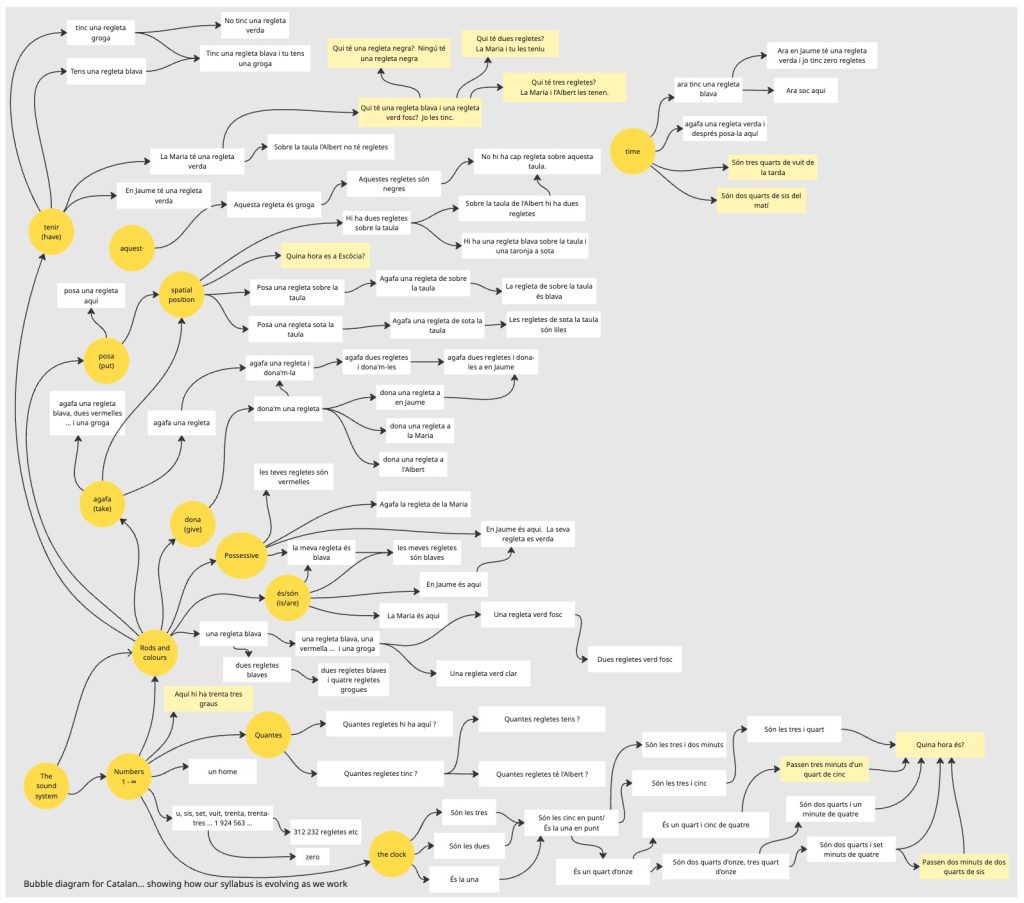
Just look at this diagram that shows how what we’ve learnt has snowballed over our 18 hours of lessons so far:
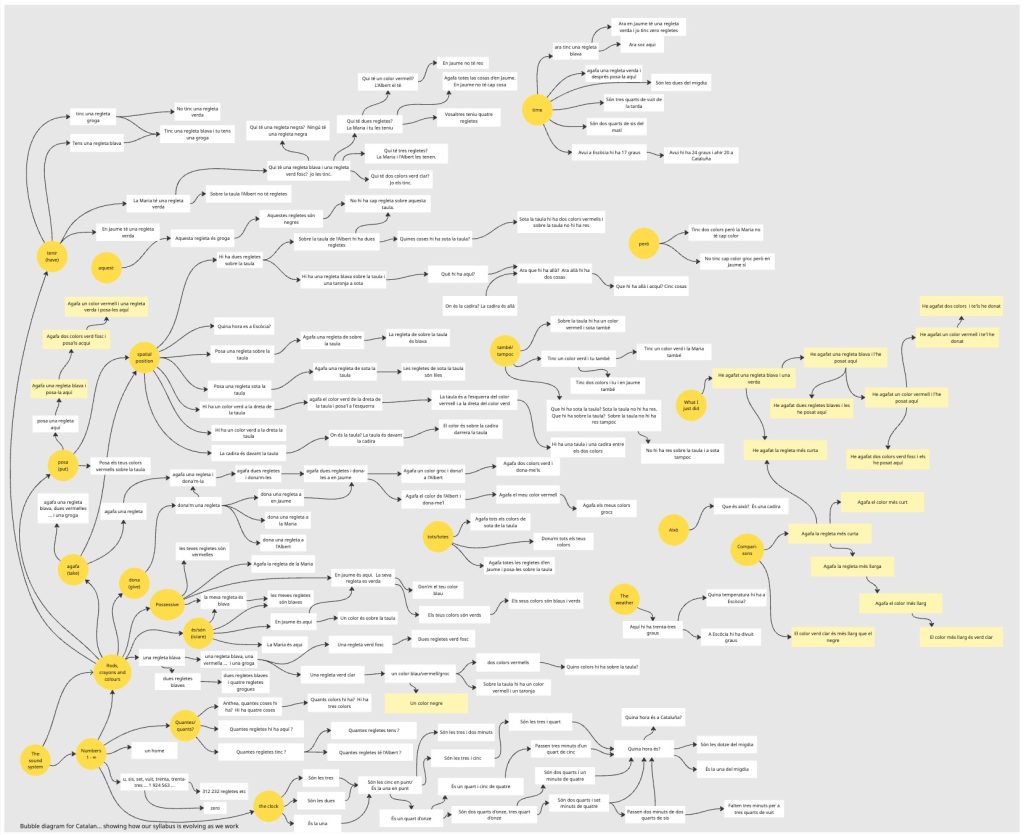
Each box represents an example sentence from our lessons. The yellow coloured ones represent the new things introduced in this most recent lesson. And every tiny step in this network was properly practised so it could be available for and could support future learning. So this isn’t a theoretical description of the syllabus ‘covered’, it’s a picture of things we actually learnt. Click here for a full resolution version of this diagram.

Speaking to learn

We’re each building, from scratch, our own mental model of the Catalan language, through speaking it, and getting feedback. And this schematic gives some kind of clue to the richness that these mental models must already contain. Working one tiny step at a time, working on that thoroughly and letting the mental connections grow has snowballed from nothing just a few months ago to this exciting moment: linguistic time travel!
Sounds and letters aren’t the same thing

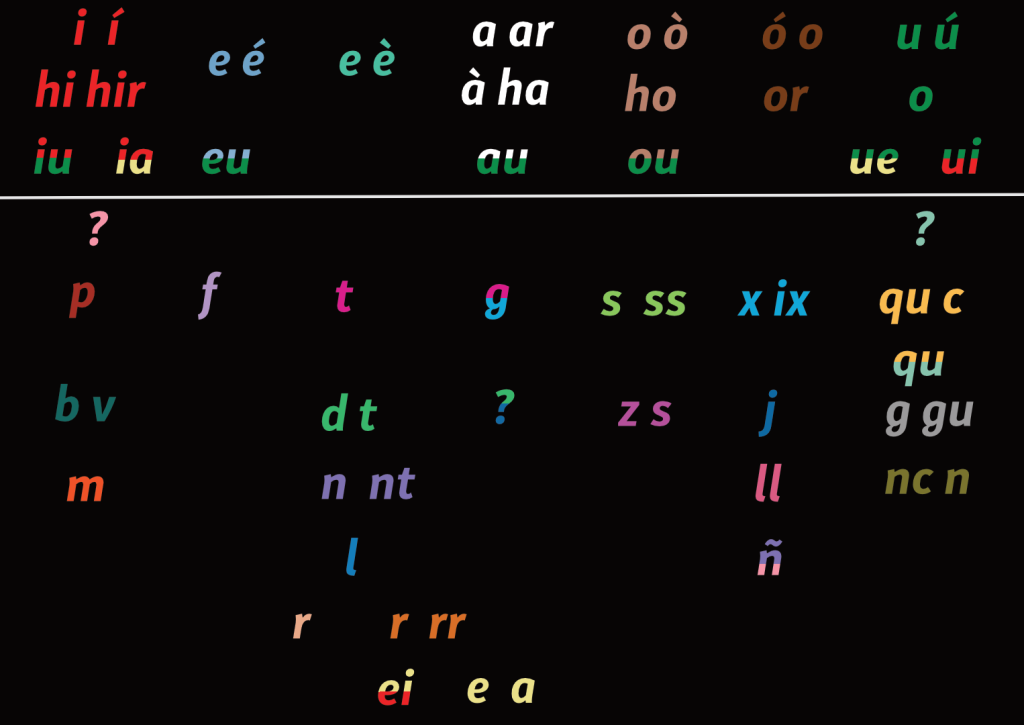
How do you construct a ‘map’ showing how the sounds of a language relate to the possible spellings of each sound? Watch the video in this blog to see two students doing it for Catalan!

We don’t really have ‘homework’ in our Catalan course: everything gets properly worked on and practised in our lessons, so homework isn’t necessary. But working on a ‘map’ of how sounds and spellings relate was something we could usefully do at home.

We had the data to work on it:

  • a set of words we’d said in our lessons and therefore knew, at least in principle, how to pronounce
  • a chart with all the sounds of Catalan (the sound- colour rectangle chart)
  • a set of word charts with the familiar words printed using the same colour-coding as the sound-colour chart

So all we had to do was look for colours and all the unique spelling patterns that we saw.

Watch the video to see how we got on.

This was much better than being told about it by a teacher, or shown a list of spellings and expected to memorise it, because:

  • we were active and we really had to look carefully at the charts
  • at the same time as searching for new spellings we were practising saying these words
  • we were discovering and intuitively absorbing these spelling patterns, and noticing the ambiguities and differences
  • we were creating something we ‘owned’ and understood, and which we could see would be useful for us in the future
  • this work gave us some of the prior awarenesses we’ll need later when we start working on reading

Its certain that there will be other spellings in the language not on our chart (shown below): we’ve only met a few words so far. But more spellings can easily be added as they crop up.

And we might have made some mistakes but these will become obvious when we use the sound-spelling chart in our lessons, and we’ll learn even more from finding any mistakes through that process.

This was a super experience as part of our course, and one that I’d recommend to any one learning a language which uses this kind of alphabetic writing system.

But before anyone tackles this, they need to be absolutely clear that sounds and spellings are completely different things: it’s suprising how many people mix the two things up in their minds!

Working out what we want to say… and how to say it.

If we want to get good at speaking a foreign language we have to work on the whole chain of language: starting with thinking about what we are going to say; then assembling the words to say it, on the fly, and in our heads; and finally saying it out loud.

After sixteen hours of Catalan we’ve gained a lot of language and we’re getting a lot of experience of expressing what we want to say about the things we see in our shared classroom.

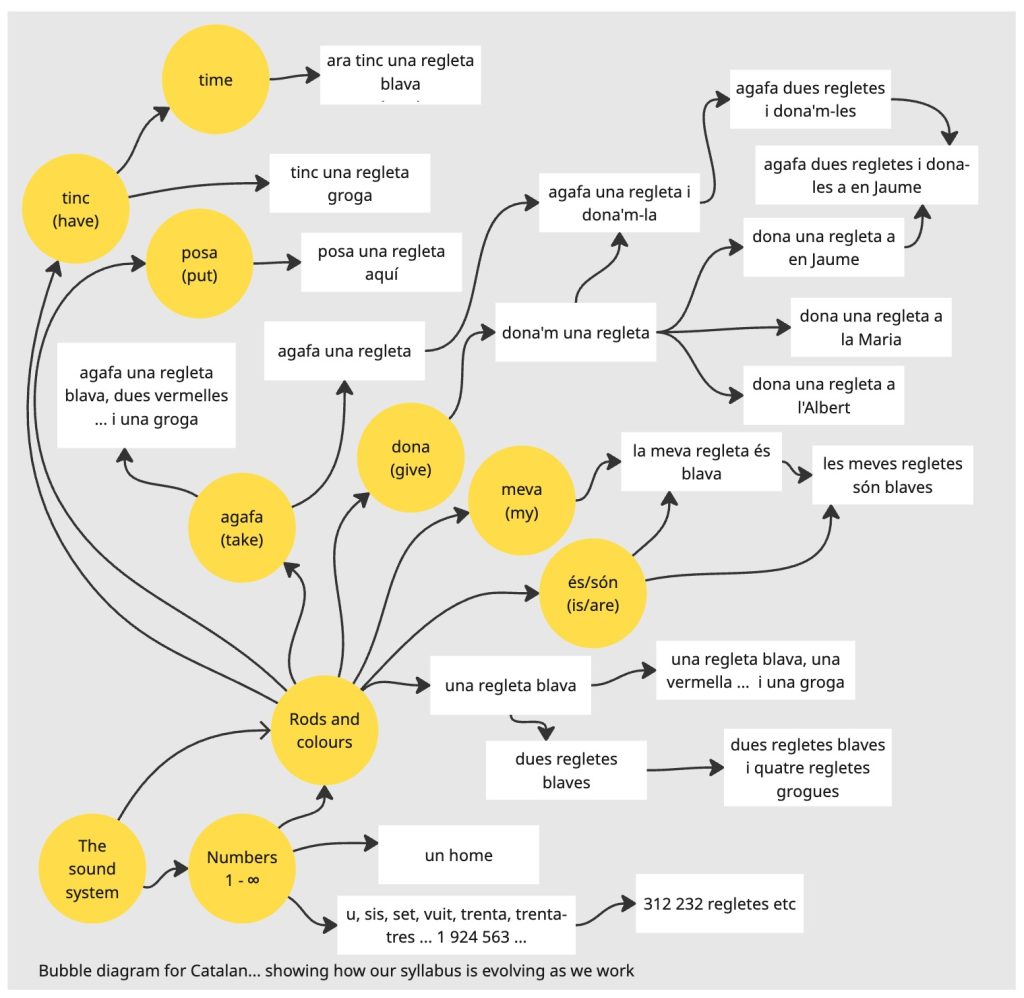
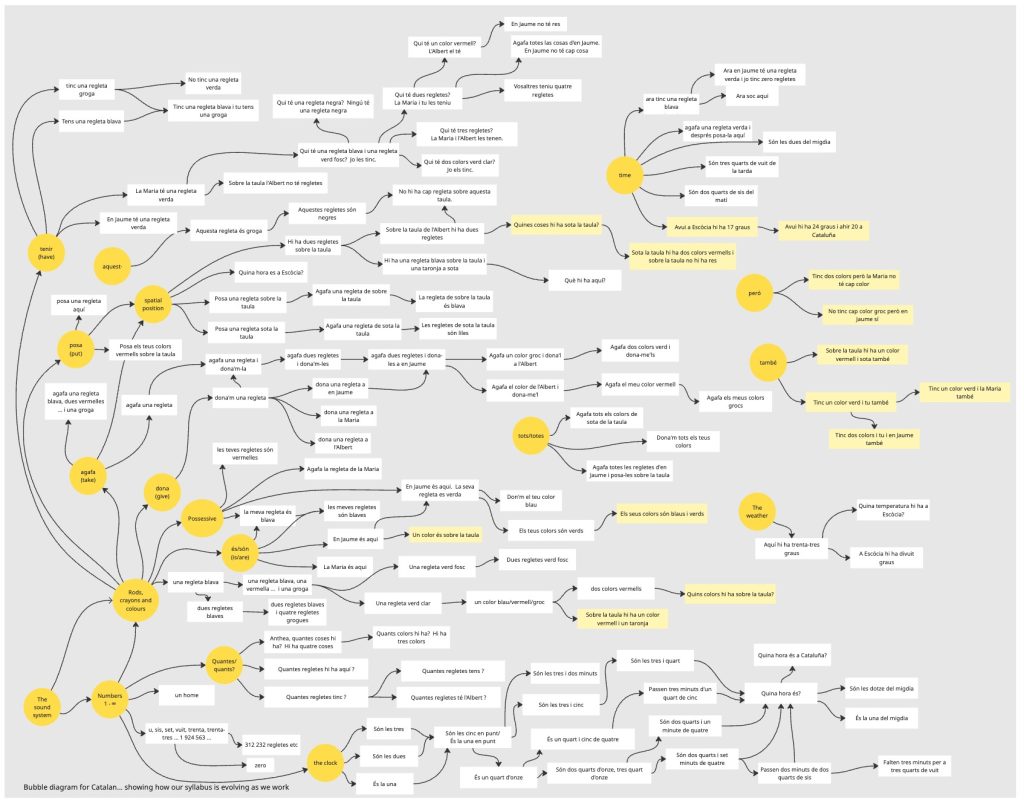
Here’s a ‘bubble diagram’ outlining how our curriculum has evolved over the sixteen hours of learning. The boxes contain example sentences from the lessons. The yellow boxes illustrate the new language we learned in the most recent, our sixteenth, lesson. This diagram shows how the range of language we know has grown opportunistically and one step at a time over the lessons.

Click here for a full resolution version of this bubble diagram.

A very efficient way of working

A statistic: in our most recent 60 minute long lesson, after 16 hours of Catalan, we said 54 different sentences. Each of these sentences originated in the mind of the student who said it to express whatever they chose to say about the situation. Each of these sentences was worked on until it was correct and accurate and then it was practised. That’s just over one minute per sentence. This is a very high yield of learning, in return for our time in class.

This is working on the whole chain of language:

  • starting with what we personally intend to say. Of course, often, we don’t know exactly what that is until we have already started talking
  • then assembling the words needed in the right order, done on the fly as our thought crystallises, and finally
  • using our muscles to make the right sounds, rhythms and melodies flow out of our mouths

If we want to speak a foreign language freely, independently and well, we have to develop the skills needed for the whole of this chain, each of its parts, and all of them together.

This is a lot to do, and that’s why beginners like us need our teachers to constrain what we talk about to match our capabilities, and then gradually, one step at a time, widen our scope. Once we reach upper intermediate level these constraints can come off and we’re into freer Class Conversations.

How did our teachers make our progress possible?

After only 16 hours of learning Catalan from scratch we were able to create so many unique sentences freely and spontaneously because our teachers:

  • haven’t wasted time with explanations or rules
  • have efficient ways of correcting
  • have always introduced language step by step; small steps which accumulate
  • haven’t overburdened our memories with content words, focusing instead on the ‘generative’ parts of the language
  • have made sure that every sentence starts from a meaning that the speaker wanted to express
  • have improvised our classes minute-by-minute, opportunistically seizing each moment when we were ready to be pushed forwards
  • have always made sure we generated our sentences from our own minds every time, without notes or reading

Here’s a video from towards the end of this sixteenth lesson showing how these processes work in practice. You will see a student thinking about, and finally settling on, what she wanted to say; trying to say it and getting feedback and guidance; and then trying again. Towards the end of the clip you will see her using her fingers to ‘hold’ the words of the sentence whilst practising it.

Very efficient learning!

Catalan – speaking to learn project: I want everything!

Students need to get good at practising if they want to learn to speak a language. And teachers need to train students to do it well.

If you want to speak a language well you need to:

  • assemble the words needed to accurately express your idea or intention
  • physically move your muscles to make the sounds required

Both these processes need to move smoothly and without much conscious control. Practice is the mechanism the mind uses to learn how to do this: to automatise and make easier these processes.

In this video you’ll see us practising both these aspects of speaking Catalan. We’d only just met the words ‘tots’ and ‘teu’, and the word ‘cap’ just a little before, and we were still at the stage of getting familiar with how to use them.

You’ll see us doing things like:

  • trying to say sentences expressing what we saw or what we wanted to happen
  • getting feedback from our teachers
  • correcting ourselves because our sentences didn’t match the situation or our intentions
  • using the word charts to practise our thinking and grammar
  • once the sentences were correct, saying them several times to practise and to smooth out the physical movements required

It is noticeable that:

  • the teachers said almost nothing, simply guiding us and managing the lesson
  • we went through several cycles of trying things out, slowing them down, making sure they were accurate and then speeding them up again. This is how we improve any skill: playing a passage on the piano, kicking a ball, executing a dance move, and saying a sentence
  • we were having a lot of fun because we were learning and discovering suprising, interesting and meaningful things in Catalan

Students need to get good at practising if they want to get good at speaking a language. And it’s one of a teacher’s jobs to teach them how to do that practice well.

Catalan – speaking to learn project: asking each other questions

We’re asking each other questions to test and explore the language: it’s learning grammar without ‘grammar’!

We’ve now had our 13th lesson. We’ve added telling the time: a little more work to do on that, it seems, since Catalan tells the time in a completely unique and delightful way!

And now we’ve started to ask each other questions. This is interesting because:

  • the meanings are clear before new words or structures are introduced: our conversation is about things we can see and manipulate on screen
  • we can test our intuitions about the language and do experiments
  • we’re active: we’re not wasting time or passively listening to ‘teacher talk’

And, this way, we get one hour’s learning in return for one hour of our time.

It’s nothing but grammar

No-one is pretending that there are grammar ‘rules’ or reasons for the words, forms and structures of the language; but nevertheless we’re doing almost nothing else but working on grammar: creating our own implicit internal model of how the language works. Grammar without ‘grammar’!

Watch this video extract from the lesson to see us at work:

It’s particularly noticeable that the word « ningú » meaning ‘no-one’ only got introduced ‘at the point of need’: when we needed it and not when a teacher happened to want to teach it. What’s more we immediately practised using it.

Here’s a ‘bubble diagram’ showing how what we’ve learnt has been growing since we started the course.

Click here for a full resolution PDF of the diagram.

Catalan project: How well are we progressing?

Our Silent Way Catalan course is giving us the secure grounding we need to speak the language well in the future. We’re working the right way around: from the foundations up.

Here’s some more analysis of the progress of our Catalan lessons. Our focus is gaining an intuitive grasp of the grammar of the language, through working on its functional vocabulary.

We’re doing this by our teachers making us aware of the connection between the visible meanings we see playing out in our shared online classroom and the language required to talk about them. And we’re taking one tiny step at a time, with each step getting practised and integrated with what went before. And this is all accumulating surprisingly rapidly.

We checked our progress against the syllabus for a typical communicative course set out in a standard textbook, looking at what that course covers in the same amout of time as we’ve spent. Of course there are things that that course covers that ours hasn’t (eg many social greetings, and things like ‘I speak language x and y’ etc), but these are more than balanced out by the things we’ve learnt that that course doesn’t include.

More importantly, as you can see in the video which follows, we can freely use everything we’ve learnt to say long, correct and accurate sentences. There is none of that hesitant, unwillingness to talk that so often results from textbook learning.

So its down to priorities: we’re laying down the basis for long term confidence in speaking the language well. And we’re having a lot of fun doing so. Personally, I wouldn’t do it any other way.

Catalan – Speaking to learn project, week 5: small steps cumulate!

We’re working intensively on the functional vocabulary of the language gradually expanding the range of what we can talk about with confidence and certainty. Watch the video to see how far we’ve got.

This blog updates on our project to develop the materials and skills needed to teach spoken Catalan to beginners, using the Silent Way. We’re pooling the team’s skills and knowledge of the language; how languages are learnt and should be taught; and our experience of teaching to both learn the language and to create the materials needed at the same time!

Here’s how far we’ve got with our spiralling, one-small-step-at-a-time curriculum. The important point is that these small, secure steps – just one function word at a time – each properly practised, cumulate over time into the ability to speak freely, spontaneously and accurately.

We’re deliberately working exclusively on the functional vocabulary – the words and endings that carry the grammar of the language. And this means we’re learning intuitively how the language functions.

And you can see the results in the video. After just nine hours of lessons, we’re able to confidently improvise a whole series of correct and accurate sentences about what we see in our shared online classroom. None of this was rehearsed or pre-prepared – we just expressed whatever occurred to us in the moment. And you can see, we could correct ourselves and we were certain about what we said. Sure, we both know we need to up our game on pronunciation, but that takes time.

We’re building a secure ‘core’ of the language from which, once we’ve done a bit more, we’ll be able to expand as far as we want to take our Catalan skills in the future.

Catalan – expanding what we can do one step at a time

Trial and error is central to learning any skill. Watch this video to see how to use it in a language lesson to connect meaning and new grammar without rules of explanations.

We’re using trial and error, feedback and correction to explore the language. Here’s an example. The character ‘Maria’ had just appeared on the scene, so we didn’t know how to say ‘Give something to Maria’.

So, I guessed, based on what I already knew. Watch the video to see how the teacher gave me feedback and taught us the correct grammar, without explanation or rules.

The first time I said the new grammar (in the middle of the clip), my pronunciation was awful! But notice how I consciously improved it as I practised until I was able to say the sentence quite fluently and quite well. This is what practising is for: getting things we know to be correct to flow out more automatically and with less conscious control.

After the clip we continued practising, giving each other whatever instructions we wanted, and thereby integrating together the new with whatever things we’d done before. And a bit later we extended another step further, by asking each other to give things to Albert: which required another new bit of grammar.

The functional vocabulary

Our focus at this stage in the course is on gaining facility with the functional vocabulary of Catalan and we’re doing that through connecting visible or tangible meanings with example sentences and then practising what we’ve learned. This is the way to get an intuitive sense of the way the language works – how to use its ‘grammar words’ – so that the language just starts to flow out of our mouths in response to the meanings in our minds.

So, we’re continuing to move forward, step-by-step, using the ‘spiralling curriculum’. The diagram below gives a sense of where we’ve got to after seven hours of Catalan lessons: good progress in return for the time we’ve spent!

Of course, the examples in the boxes in the diagram are just examples to make the diagram clear. In fact, we, the students, have improvised many, many sentences exploring these parts of the language. And all this work has been done orally with no text book, notes or worksheets. We’re learning to speak the language – reading and writing can come later if either of us decides that’s what we want to do.

Catalan – week 3 making meanings clear

This extract from a lesson shows how you can make the meaning of a phrase clear to beginner students without translation or explanations.

This extract came from the end of our fifth lesson ie after almost five hours. We’d been using the word « tinc » (I have), but just before this clip our teachers had introduced the word « ara ».

They introduced it by showing us its sounds and where the stress was and getting us to practice it as just pure sound. They didn’t give a translation or an explanation: as you’ll see, we just used the changing situation to make it’s meaning in this context clear. And then we practiced.

Now, we still can’t be certain of this word – it may have many significances and it may be used in different ways from how a word like this is used in other languages we know. But we are pretty certain that if we want to describe the sort of changing situation depicted in the video in Catalan, we can use this word in this way. And this will be confirmed or refined in future lessons.

Tolerating this kind of uncertainty and avoiding translation, whilst the teacher makes sure students gain a sense of the meaning, is key to beginning students forging a direct connection between what they experience or want to say and the words they need to express it in a foreign language.

Catalan – Week 3, using the ‘pronunciometer’

Pronunciation is such an important aspect of learning a language. Find out how to use the ‘pronunciometer’ to improve students’ pronunciation skills.

Here’s the ‘pronunciometer’:

It’s simple: 10/10 means native-like, around 5 means kind of OK, and 1/10 means awful. It gives teachers a way to give students feedback in a precise, non-judgmental way about that all-important aspect of speaking a language: pronunciation.

Here’s how we used it in our Catalan lesson:

The purpose of having some kind of scale against which to judge our pronunciation is to remind us, we’re all aiming to get our students’ pronunciation as good as possible: as close as possible to native-like. And to give us an impetus to change something about how we say a word or phrase.

Put it another way, we, as students, really, really don’t want to end up around 4 or 5 on the scale – comprehensible but still sounding very ‘English’. That’d be awful and embarrassing. So, working word by word to improve from mediocre to better to good is what we want to do.

The scale on its own is of no value. The teacher has to follow it up with guidance on what the student needs to do to improve: where the flaws are in the student’s attempt, what to work on, where the energy balance between the syllables needs to be adjusted etc.

This is best done by directing the student’s attention to whatever changes they need to make to what they are doing with their voice and their muscles. And once the student has made an improvement, getting them to practice: ie say the word again a few times.

We’ll be using this tool in our future lessons to improve how we sound. And to build really good pronunciation skills.