Writing and reading in a foreign language

Speaking comes first; and writing lags behind. Writing sentences I have already worked on in my lessons helps me to learn Japanese writing painlessly

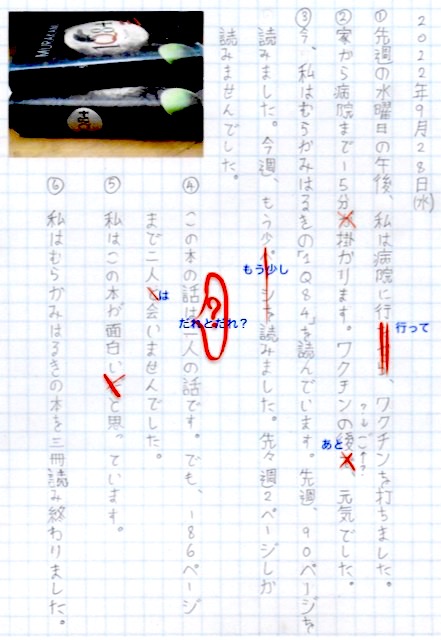
In my lesson, we’d been discussing my progress reading (in English) Murakami’s 1Q84. That’s what this writing is mostly about. Feedback like this, shown in red and blue, helps me improve every aspect of my Japanese.

In a previous blog entry, I wrote about how I was working on writing (and therefore reading) in Japanese.

I’ve continued working on this, by writing sentences based on things I’ve talked about in each of my Japanese lessons. I email this work to my teachers, who give me feedback. I usually write something after each lesson. (Incidentally, I never write any notes or anything during lessons. It’s better to give the lesson one’s full attention and that is impossible when you take notes.)

The process

I freely use the online dictionary to remind me of any kanji characters that I’m not certain of, thus reducing any memory burden. (Kanji characters are the ideographic characters originally from Chinese that Japanese uses as part of its writing system.) But:

  • because my writing desk is a couple of meters away from my computer I have to hold the characters in my mind for a moment or two after I have looked them up
  • to help me ‘encode’ these symbols I pay attention to the ‘radicals’ they contain—’radicals’ are subparts of these characters that are reused in different combinations across many different kanji
  • to help this process I also ‘write’ them in the air with my finger. This seems to help me hold the whole shape in my mind whilst I’m getting familiar with them
  • because I’m writing by hand I have to look carefully at the shapes and can’t cheat that process
  • before I email them to my teacher I read what I’ve written, making any necessary changes that I notice. And I read my work again when I get feedback.
The characters for ‘read’, ‘talk’ and ‘language’. Note how the ‘radical’ shown in red repeats

Benefits

This way of working means that:

  • because I’m sticking with vocabulary and grammar from my most recent lessons, I’m always reinforcing the oral work in class
  • I’m certain that I’m practising characters for familiar words and that any new characters are guaranteed to be limited in number, and relate to words that I already know how to say and know what they mean
  • as this work cumulates day-by-day and week-by-week I gradually discover that there are more and more characters I now ‘happen to know’
  • the more characters I know the easier it is to learn new ones because I’m already more familiar with more of the ’subparts’ (radicals)
  • I’m practising both writing and reading.

In fact I’m avoiding the process of ‘memorisation’—which is hard work, tedious, frustrating and yet unreliable—and instead using the process Gattegno called ‘retention‘. This is the same mental power that we use to remember without any special effort where the things are in our local supermarket, or the shops on the high street of a town we are familiar with, or the layout of our primary school etc etc.

Progress

I’m very happy that I can write anything that I can say, and I can read anything that I can write! This feels in balance. What I would like, though, is to improve my Japanese handwriting … it doesn’t yet ‘flow’ … but I console myself with the thought that when I was 6 or 7 my English handwriting didn’t ‘flow’ either.

You can see more of my progress by watching my video series Learning Japanese using the Silent Way.

Whilst Japanese is an extreme case, with its particularly difficult writing system, in fact, for an English native speaker, similar problems—in principle, if not in degree—crop up when we try to write French, for example, with its unfamiliar spelling system.

As it happens, I know that the same remedies apply to French as well, because I’ve adopted exactly the same approach to practise my French after each of the French lessons I’ve also been taking. Here’s an example of my practise for French:
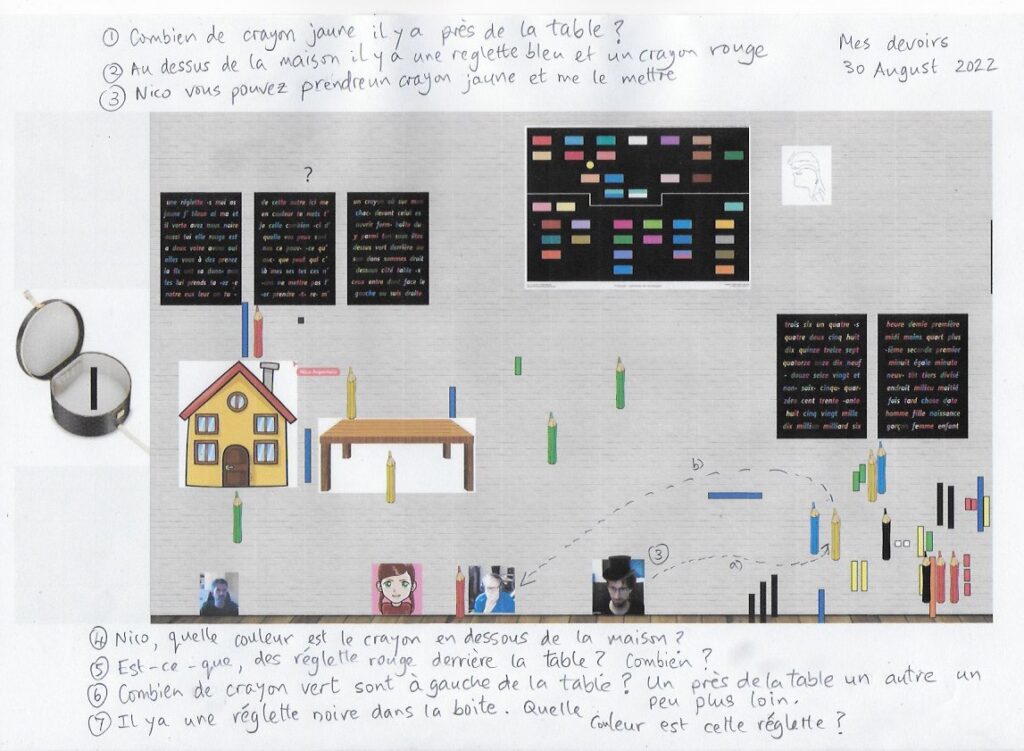

Screen shot from a recent French lesson with my French writing practice … I got feedback separately by email

Making it comprehensible

Everything is incomprehensible to beginners, so how does the ‘comprehensible input’ hypothesis apply?

The hypotheses proposed by Stephen Krashen imply that learning a foreign language is a subconscious process resulting from exposure to the language, and that explicit instruction in grammar doesn’t have much effect.

So far, so good.

But Dr Krashen also argues that ‘production’ ie speaking and writing should wait until we have acquired enough of the language. And that all that is required to acquire a language is sufficient exposure to enough ‘comprehensible input’ (by ‘input’ he means listening and reading). And, even better, if that input is ‘compelling’ as well as ‘comprehensible’. In fact, ideally, so compelling that the student forgets they are listening or reading in a foreign language.

Actually, this makes sense when you are reasonably advanced in a language. At that stage it is indeed possible to ‘pick up’ more language from any encounter with the language. Indeed we do exactly this all the time, even in our native language: a few years back ‘cool’ simply meant that something had a low temperature, but now all English speakers know that the word also has another meaning. No one taught us this, did they?

But what about beginners?

Right at the beginning of learning a language, when the student knows nothing, how are teachers supposed to provide ‘comprehensible input’? And what is the student supposed to do? Simply sit and passively listen?

In a Silent Way classroom we use Cuisenaire rods and other objects to show the class situations that we then coach the students to talk about. The meaning is obvious from what everyone can see, and the teacher works with the students, giving them the new things they need, until the sentences they say are correct, accurate and as well pronounced as possible.

This means everything is comprehensible, we can avoid translation, we can avoid grammar explanations, and the students are active. It is possible to work on almost every aspect of the language in this way. And, once the students have the basics of the language, we move on to coaching the students to talk about their lives; where, of course, they already know the meaning of what they want to talk about.

A different way of thinking about language

In fact, this suggests a different way of thinking about learning a foreign language.

The words ‘comprehensible input’ suggest that meaning lies in the words and the student’s job is to extract meaning from what someone else has said or written … whereas meaning really lies in the situations people talk about.

Our job as teachers is to give the student the ability to express the meaning that they perceive, in the words of a foreign language. And, of course, once someone knows how to express their intent accurately in a foreign language, they stand a chance of understanding what other people say to them.

So, until people are reasonably advanced in a language, I’m not sure ‘input’ has that much to do with the process of learning.

If you want to see how this works out in practice check out my video series Learning Japanese with the Silent Way.

Is the Silent Way the fast way to learn a language or the slow way?

Learning to speak a language well takes time

Someone I know recently started learning a new language in a conventional language class.  Let’s call them X. They’re enjoying it!  And they just had their 5th weekly lesson.  One of the activities they did in this lesson was: each student picked a famous person and pretended to be them.  Then the others asked them questions: What’s your profession?  How old are you? What nationality are you? What languages do you speak?

But X got completely stuck because she couldn’t think of a famous person she wanted to pretend to be, so the teacher said ‘Oh! you just be Marilyn Monroe, because you’ve got blonde hair’.  But that didn’t really help because X got Marilyn Monroe and Bridget Bardot mixed up (easy mistake to make) and so, when asked for her nationality, she replied ‘I’m French’.

Firstly, this raises the pedagogical question of why ask students to adopt fake identities?  Surely it would make more sense for students to talk about themselves?  After all, everyone knows who they are and what nationality they are, and talking about themselves is something that everyone is likely to do at some point.  Far more likely than talking about Marilyn Monroe simply because you happen to share the same hair colour.

Secondly, how realistic is it for people to be able to talk about these things in their fifth lesson?  Or perhaps more precisely, how realistic is it for people to be able to talk well about these things in their fifth lesson?

After about five lessons in Japanese, I had laid the foundations for the pronunciation, sounds and melody of the language, I was confident in numbers and counting, and I could do, albeit haltingly, sums like 1÷2 = 0.5 or 150,000÷3 = 50,000 in Japanese.  Indeed whilst I wasn’t fast at answering these sums, some of that was because I’m not that fast at arithmetic in English either …

But there is no way I could have attempted the questions posed of my friend.  Indeed, six months on, I still have no idea how to say ‘film star’ or ‘profession’ in Japanese. 

So was I learning Japanese fast or learning slow?  It depends on what you think is important in learning a language and what you think should be mastered first.  For me, I would far rather:

  • start by laying the foundations for great pronunciation: you can’t say anything well in a language unless your pronunciation is good
  • take the time to develop facility in whatever tiny bit of the language I’m working on.  That way, I will be able to rely on that aspect of the language whenever I need it, and it will be available to me to build other parts of the language on

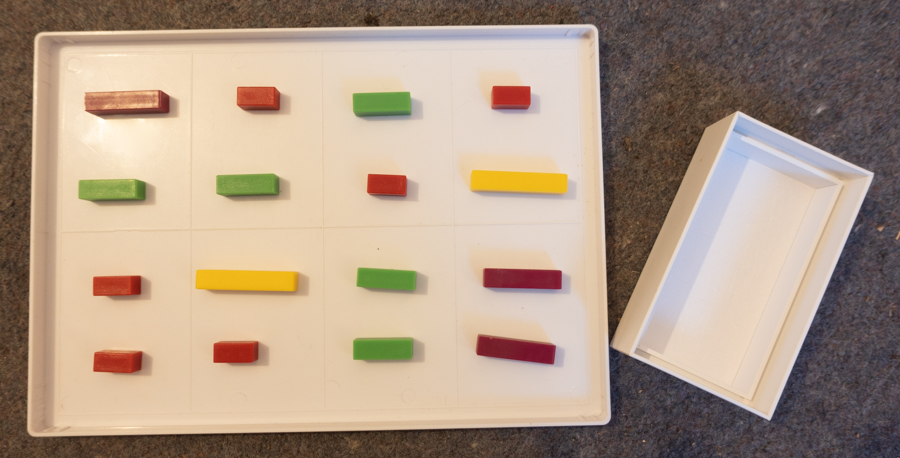
6 months on, I still don’t know the Japanese for ‘film star’ or ‘profession’ but I’m really not bothered about this.  What I can do, for example, is: faced with any situation like the below, I can spontaneously and confidently say anything I want like:

Take the 3rd rod from the left, 2nd from the top and put it in the box.  Then take the first rod from the bottom, second from the right and put it in the box.  What colour rods are now in the box?  Did you put a red rod in the box? There isn’t a blue rod in the box? etc etc (I could go on for hours like this).

You could see this as just a narrow part of the language: who wants to talk about rods after all?  But the feeling of being able to do this spontaneously, precisely, and at length and the confidence that, simply by substituting the odd noun and adjective, I now have the ability to express any of these kinds of relationships in any normal circumstance is extraordinarily empowering. For example, if instead of rods I had pictures of film stars then I could choose whichever I wanted, and say who I’d got, and ask you which ones you had etc.

Of course, I don’t know what X will have achieved after six months of her language class.  But, if my experience of learning in conventional language classes is anything to go on,  I suspect she will have a wider vocabulary in the language she is learning than I do now in Japanese.  But I doubt she will have the freedom to use that vocabulary as creatively and spontaneously as I do in Japanese now.

So my answer to the question in the title of this article is: it depends what you value. Would you prefer 1) knowing a lot of vocabulary or 2) a good accent and knowing how to use well any vocabulary that you have.

Languages are arbitrary

Why is it that people seem to feel that it’s OK for vocabulary to be arbitrary, but that there should be some reasons behind grammar?

This kind of dialogue happens often.  And sometimes students get quite annoyed that the teacher can’t give them a reason why the English language works the way it does.  

And, despite what grammar books or text books sometimes seem to imply, there really is no reason why English uses the word ‘to’ in this situation—the peoples who, over many, many years created the current English language could have made many other choices.  And the English of the future may, perhaps, eventually say this kind of thing differently …

For grammatical points like this, people often expect there to be an ‘answer’—some kind of ‘rational’ rule or explanation.  But, for vocabulary, no one expects there to be a reason why Spanish people say ‘perro’, and German people ‘hund’, and French people ‘chien’, and Japanese people 「犬」for the creatures English people happen to call ‘dog’.  Which leads me to the question below.

Why should it be OK for vocabulary to be arbitrary, but not grammar?

Maybe people are looking for a rule of thumb to help them deal with those difficult little words like ‘in’, ‘on’, or ‘at’ in English; or ‘en’, ‘por’ and ‘para’ in Spanish; or 「は」、or「が」、or「に」in Japanese etc.  And perhaps people are misled by their experience of their native language, where it’s so obvious (to them) how to use these little words that they never really think about them but somehow feel there is, in fact, a rationale behind what they say? 

Personally, I like ‘being a baby again’ in Japanese—noticing, by experience, how Japanese people say things; trying out different sentences and getting feedback; and gradually growing a clearer, but unspoken, mental model for the way the language works.  

But if anyone has any answers to the question above, I’d be interested to hear them.  Please use the comments box.

The place of grammar in learning a language

Most explicit grammar teaching, whether interesting or not, is almost entirely irrelevant to learning the skill of expressing yourself in a foreign language

I remember distinctly my primary school teacher attempting to teach us English grammar.  She repeatedly told us: 

“A noun is a naming word and a verb is an action word, and you should never begin a sentence with ‘and’.”

I can recall very clearly her hectoring tone of voice.  I guess she was frustrated by the lack of impact these instructions seemed to have on us.  I also know that she more or less told my parents that they might as well give up on me as far as English was concerned … I suspect this might have been because my written work was exceptionally untidy—I certainly recall everything near me being consistently splattered with black ink. (This was in the days of real ink and actual penmanship …)

It turns out that, later in my life, I became rather good at writing.  Working in an environment where we all wrote thousands and thousands of words every day, and got immediate, and vivid, feedback about what we wrote; gave me the chance to practise and get better at this skill.  

Unfortunately, I don’t ever recall saying to myself “A noun is a naming word and a verb is an action word etc …” in relation to any of the thousands and thousands of sentences I have ever written in my life.  And indeed, experience rapidly taught me that her advice about the word ‘and’ was significantly off the mark: beginning a sentence with ‘and’ can be a very useful device to make writing racier and easier to understand.

In fact, almost the only grammar ‘rules’ that I’ve ever used are: 1) ‘if I read out loud what I’ve just written, does it sound OK?’ and 2)  ‘is there a shorter and plainer way of saying what I want to say?’.  (To tell the truth, there is one actual rule that I do use, and that’s when to use an apostrophe, and in fact this is one of the things that I do rather badly …)

I suspect that if I want to speak a foreign language well, then I need to get to the point where I can use the test ‘does it sound OK?’ to know if my grammar is correct.  

And to start with, I have my teacher as the ‘ear’ to tell me if what I say ‘sounds OK’.  And if she gives me, or another student, feedback—for example, ‘a word is missing here’, ‘change the order of these words’, ‘there’s a word too many’, ‘you need to change something at the end of this word’, ‘that’s OK’ etc etc—then, gradually I will build my own inner criteria for what’s correct and what isn’t.  And that’s the way to develop my own ‘ear’ for the language.  You can actually see this process at work in this short film of me learning some French.

In my case, my primary school teacher’s grammar lessons were totally irrelevant (and quite annoying) to improving my English.  You might argue that what she tried to teach us wasn’t a particularly good example of English grammar, but I remember many years later, being ‘taught’ the Congiuntivo Imperfetto by my Italian teacher in our class one week.  Maybe it was a good description of this structure, but sadly, it had no more effect on my Italian skills than my Primary School teacher’s lesson: the following week the teacher said to me tartly ‘You should know this, because I taught it to you last week’.  

Unfortunately the same is true of most explicit grammar teaching: interesting or not, it is, for the most part, entirely irrelevant to learning the skill of expressing yourself in a foreign language.

(Thanks to Cédric Lefebvre for inspiring this post) 

Grammar icons created by Freepik – Flaticon

始めまして — ‘Nice to meet you’

Social expressions like this are best learnt later in a course, once you are ready to get the most out of working on them.

I’ve been learning Japanese for about six months using the Silent Way and only now have we come across this phrase.  

In many language courses, social phrases like this are taught very early on, presumably on the grounds that they are ‘useful’.  But is it a good idea to give priority to these kinds of things?  And why did it feel so good for ‘Nice to meet you’ to be introduced at this stage of our progress in Japanese?

Here are some of my reasons:

  • we genuinely needed the phrase, because we were welcoming someone to observe our online class.  So the exchanges:  “Nice to meet you Keita.  I’m Laurence” “Nice to meet you, Laurence” felt real and important things for everyone to say. (I’ve changed the name of our new colleague for obvious reasons.)
  • after 6 months of work, we are now good enough to be able to say our names and Keita’s name and the word 始めまして with good Japanese pronunciation and pitch accent—at least after some coaching by our teacher.  In our first few lessons, if we’d tried to introduce ourselves in Japanese using these phrases, we’d have completely mangled them.
  • I now know enough Japanese to have some intuitive sense, from the ending of the word, that it fits somehow into the Japanese verb/politeness system.
  • in fact, I can recognise from its sound, that this expression probably relates to the verb 始める, which I’ve heard endlessly on Japanese TV, and sufficiently often to know what it means—to begin.  So learning this expression, at this point, means that it fits into my developing ‘mental model’ of the language, rather than it being an isolated, unconnected phrase to be memorised in its own.

In fact this kind of expression is not a particularly ‘productive’ one: it’s far more important to learn how to use the function words of the language, since these are a) more difficult to learn and b) fundamental to every sentence we say. Whereas an expression like this is only used infrequently.  This is not to say that expressions like this are unimportant, just that it’s better and easier to learn them once the foundations of the language have been well laid.

So, that’s why I’m really happy that this cool expression was introduced, opportunistically, at this stage of my learning when we really needed it. I wouldn’t have benefited so much if it had come earlier.

Starting to learn the kanji—an ideographic script

Learning an ideographic script—starting from what I can already say, and avoiding memorisation means that the task no longer seems daunting

When I started learning Japanese my goal was to learn the spoken language and its syllabic writing systems.  At that time I thought that learning kanji (the ideographic script) would be too much of a challenge, and, in any case, I was more interested in speaking and listening.

But I’ve now realised that I was ‘framing’ the issue in completely the wrong way.

Memorisation or retention?

Firstly, the idea of ‘learning the kanji’ paints an image, for me, of Japanese school children diligently drilling every day, for years and years, to memorise the several thousand characters required to be considered literate in Japanese.

‘Memorisation’ is hard work, exhausting, boring and fallible—not how I want to spend my time learning a language, and particularly not one I find as entrancing as Japanese.  

But, I know there is an alternative to memorisation: the human capacity we can call ‘retention’.  This is the capacity which effortlessly enables me to call to mind, for example, the route to my first primary school, the layout of its rooms, the name of my first primary school teacher and her assistant, and a thousand other details.  I can do this infallibly after more than 60 years despite having spent no effort on memorising any of these things.

What comes first?

Secondly, ‘learning the kanji’ implies that what comes first is the vast list of arbitrary, confusing graphic symbols—the kanji—and that the task is to learn them and what they signify.  

But there is an alternative way of thinking about this too—thinking of the task as learning to express, in written form, the things I want to, and can, say in Japanese.  This way of thinking has huge advantages:

  • the task becomes about me and expanding my capacities to express myself in Japanese
  • the task starts with the spoken language and the things I can already say.  This puts me in a similar position to Japanese children, who already know the words that they are learning how to write
  • at any moment I only need to concern myself with the kanji I need, to write what I can already say.  Since in my first steps in the language I can only say a limited amount, I only need a few kanji
  • as I gradually expand what I can say, I only need to add at any moment the very small number of new kanji I need for each new sentence

And since I’m not seeing this as a memorisation task, I can freely use charts like the one below to find the kanji I need.  

This chart includes the kanji for the first words we’ve worked on in our lessons (in random order).  So, I can simply point to the kanji I need on the chart, as I say my sentences.  I know which one to point to, because, very soon, I recall where it is on the chart. And then I can write my sentences, using the charts to remind me of the shapes.  And then I can read back what I’ve written, getting feedback from my teacher on every aspect of my work: grammar, pronunciation, and the quality of my writing and reading.  

All this means that as the sentences I can say gradually become more and more complex, my kanji ‘vocabulary’ will grow, lagging slightly behind my oral vocabulary.  This seems to me getting the order of these skills exactly the right way around.

Conclusion

Working this way I’m gradually getting familiar with a gradually widening number of these signs, in the same way as I built an infallible mental image of all the details of my primary school, and the countless other similar things I have become familiar with in my life.

Here’s a nice, true sentence I said, and then wrote, the other day using this approach (kanji in red):

箱の中の緑色の棒があります。(There is a green rod in the box.)

The first steps in learning a new language—re-sensitising yourself

When we start learning a new language, we need to become sensitive to all sorts of things things that are important in that language but are irrelevant in ours. Native speakers unconsciously rely on these things to express clearly and precisely what they want to.

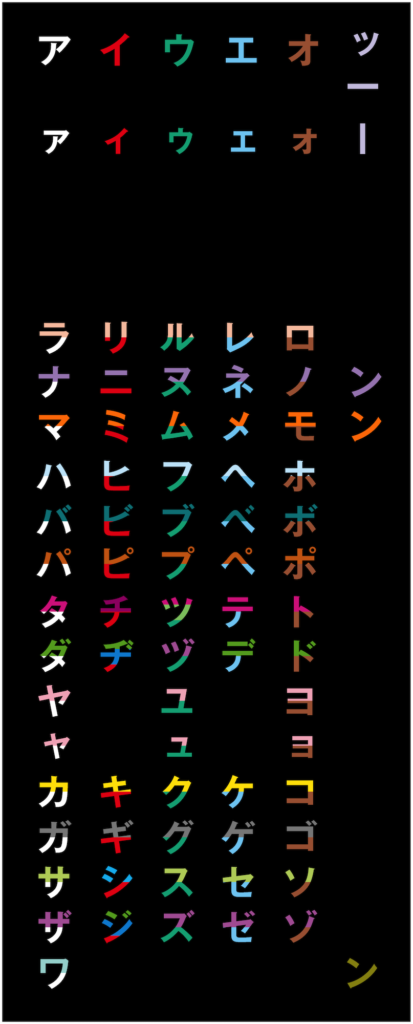
Katakana syllabary

I’m learning Japanese at the moment, online, with Silent Way Tokyo   [https://silentway-tokyo.jimdofree.com/japanese-course-with-the-silent-way/].  

We started our lessons with working on the simplest of things—humming patterns of lower and higher pitched sounds.  It turns out that one of the key things that makes Japanese sound Japanese is the pattern of high and low pitches used for the syllables of words and phrases. 

These pitch changes are irrelevant to English, so I am well-trained to ignore them; so much so, that I could hardly hear that this feature of Japanese even existed when I first listened to Japanese speech.  And even now that I know that ‘pitch accent’ is as essential for Japanese as stress and reduction is for English, I still find it hard to catch the pattern that Japanese speakers are actually saying.  I’m getting better at this with practise but it’s still elusive.

In fact, this experience of having to become sensitive to strange new things, irrelevant to my English sensibility, but vital to the Japanese sensibility that I’m trying to develop, is a key theme of my experience so far with learning this language.

For example, I’ve started to become aware that:

  • as well pitch differences, Japanese speakers are very sensitive to the number of, and regular timing of, syllables—quite different from English
  • Japanese speakers are very sensitive to the social situation and the words and grammar they use changes depending on who they are speaking with—a feature, little present, in contemporary English
  • Japanese people are sensitive to tiny differences in the shapes of characters.  At first, I’m almost blind to these differences even though they are vital for correctly interpreting these marks on a page.  For example look at: ソ and ン which look very similar but represent completely different—sounds /so/ and /n/ in katakana 

So one of the first things we should do, when we start out learning a new language, should be retraining our sensitivity to these types of things: the underlying things that are important to speakers of that language, but which, because they are irrelevant to our native speech, we would normally be oblivious to. 

Otherwise, we’ll never even realise that these things exist and are important; we’ll miss all kinds of things that natives unconsciously rely on to express what they want to; and we’ll probably make all kinds of errors without ever realising. 

On the other hand, if we train ourselves in these new sensitivities then, because we will come to know what’s important to listen for and look out for, and how to listen and look out for them; we will get more learning out of every encounter we subsequently have with the language.  

Working with advanced students

Helping an advanced student sound more English with ‘The Gruffalo’

I’ve been working with an advanced student whose English is very good.  Virtually all of what she say is grammatically correct, with appropriate vocabulary, and it’s perfectly understandable, but … it just doesn’t sound English – it retains the fundamental character of her native language.  And she’s living in an English-speaking country and wants to ‘sound English’.  

It’s a pity, because, had her teaching at school worked on the fundamental mechanisms of English speech, then most of these problems would have been dealt with long ago:

  • rhythm and melody
  • individual sounds
  • the relationship between English sounds and English spellings

Fortunately we’ve found a perfect text that gives us just what we need to work on these areas: The Gruffalo by Julia Donaldson and Axel Scheffler.

Why is this such a perfect text for this advanced students?

  • the story is of no consequence and neither vocabulary or idiom are a problem 
  • the text has a slightly heightened, but very characteristic, English rhythm
  • it contains sentences – questions, answers, statements, exclamations, reported speech – all of which need their own particular melody
  • there are plenty of words where the correspondence between spelling and sounds isn’t obvious
  • she is more than happy to read the story many, many times – indeed she is going to, because it is a bedtime story for her young kids

So, paradoxically, the very inconsequentiality of the story frees this advanced student to work exclusively on rhythm, melody and sound.

We’ve been working through the text, sentence by sentence, focussing on how she is using her body to:

  • make a breath-push on stressed syllables
  • say unstressed syllables on ‘the remnants of the breath’
  • activate an appropriate melody for each phrase
  • change the shapes she’s making with her lips, jaw, and tongue to improve the individual sounds she’s making
  • strengthen her criteria for sounds <=> spellings where this is misleading her

This is patient but fascinating work: we have to get these fundamentals right; and then practised with full attention; and then left for the mind to do its job of integrating what we’ve worked on.  And, of course, these fundamentals apply to any English sentence, so working in a detailed way on this text is retraining her for anything else she wants to say.

The beauty of working on a text like this is that the fundamentals are met anew on every page; giving lots of varied practise, which gradually cumulates.  And, step by step, this work is starting to influence the student’s spontaneous speech.  There are some deeply ingrained habits here, which won’t be rectified overnight, but with sustained work, we see (or rather hear) progress.

The very simplicity of a text like this lets us focus on the most fundamental language skill of all – the use of the body.

Teaching with the Silent Way in virtual classrooms

We wanted to find out if it was possible to create interactive virtual classrooms for the Silent Way using gaming technology. It is! And we now have virtual classrooms for British English, American English and French

At the beginning of April, Roslyn Young and Piers Messum of Pronunciation Science Ltd and I started work on the possibility of creating virtual classrooms using gaming technology, to teach online using the Silent Way. None of us had any experience of the online gaming world, but it clearly had possibilities.

We now have virtual classrooms for British English, American English and French, designed to be used alongside video conferencing such as Skype or Zoom.  These classrooms accommodate up to eight people and are completely interactive – everyone can move or manipulate the objects in the classroom together: they really are shared, virtual spaces.  These classrooms can be used to work on every aspect of the language:

  • pronunciation 
  • every aspect of the functional vocabulary (ie grammar)
  • spatial relationships, temporal relationships, family relationships etc
  • the calendar, the clock, comparisons, numbers, doubt, guessing etc
  • free conversation led by the students
  • spelling

They have been thoroughly tested for use with a student 1:1 and we’ve started testing them with groups of students with promising results.  My report on this process and the lessons learnt, Teaching with the Silent Way in Virtual Classrooms/Enseigner en silence dans des sales de classe virtuelles, June 2020 is available, please click here.

Just one example

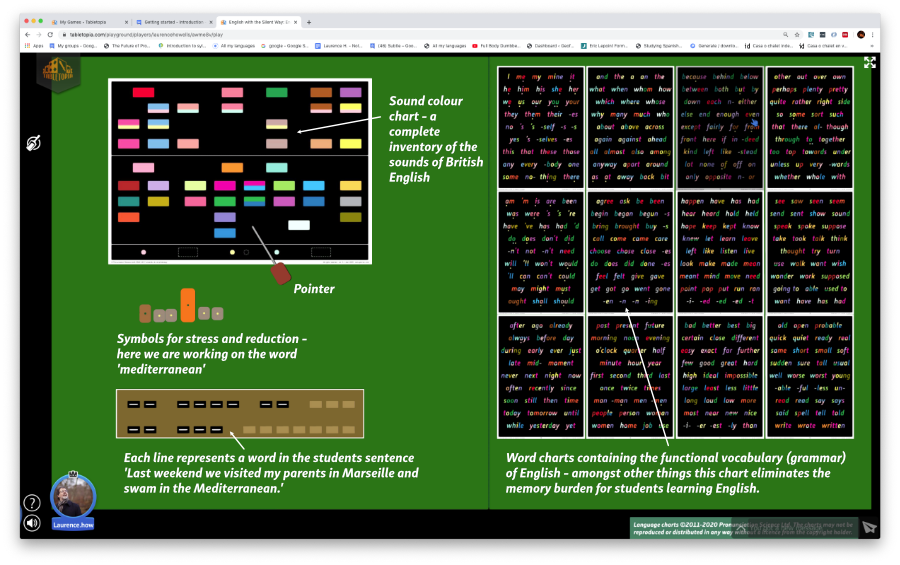
Below is a screenshot from the British English classroom in use.  In this case we were working on a student’s sentence, which after the process described below became something like: ‘Last weekend we visited my parents in Marseille and swam in the Mediterranean’.  (NB. This has been adapted from the student’s actual sentence to preserve anonymity.)

All the elements you see in the classroom, except for the green background, can be dragged in or out of the view as required, and in response to whatever need becomes evident for the class.  These are just a few of the tools available, but they are some of the most useful.  In fact the pointer is the most used tool – it is used all the time to draw attention to an object or sound or word, point to where there might be errors, for looping gestures inviting the students to change the rhythm of what they are saying, or for gestures inviting the student to slow down and work on every single syllable one by one etc etc.

We started with the student’s original version, represented it as ‘word lines’ on the brown tray, used pointing on the relevant word lines and on the word charts to enable the student to correct any grammatical mistakes, used the sound colour chart (which was already familiar by this stage in the course) plus actual gestures (using the Zoom video) to work on any sounds that needed improvement and to solve most of the problems with stress and reduction.  One word ‘Mediterranean’ needed more detailed work, so we used the syllable symbols to work on how many syllables it had, where the main stress was, where the reduced sounds were and where the full but unstressed vowel was.  

An image of on of the virtual classrooms in use.

Once these details were  established, the student practiced saying the complete sentence, trying to keep all these elements sounding native-like.  Holding the whole sentence in the mind and using their vocal apparatus to say the complete sentence required a lot of presence.  But practising in this way charges the mind with correct grammar and good pronunciation and, cumulatively, as the students work on more and more sentences, grows their intuitive know-how of how to express themselves in English.

A shared virtual space

The key thing that these classrooms create is a shared, but virtual, space, where teachers and students can see, manipulate and point to objects and charts, wherever the participants actually are in the world.  Why is this important?  Because:

  • we can avoid writing or aural imitation to teach pronunciation: by pointing to the charts in the classroom and gestures, we can train students to use their muscles in the way natives do to make the sounds and energy patterns of that language. This makes it much easier for them to escape the grip of their own native speech and spelling patterns.
  • meaning comes first: students’ perception of what they see in the classroom means that meaning can be established unambiguously before the language is introduced – a far faster, easier and more reliable way of establishing the association between meaning and language for beginning students than alternatives such as translation or explanation.  In the case of the lesson described above, where the student was sufficiently advanced to launch his own sentence, meaning came first from their memory of the events of last weekend and we used the tools in the classroom to shape language to express their thought accurately and correctly.
  • memorisation is minimised: instead students acquire the language through familiarity.  That’s why the word charts are so useful – students can get used to the entire functional vocabulary of English without any need to memorise – by pointing on the charts and saying their sentences out loud they gradually become familiar with all these words and their use.
  • trial and error, feedback and self-correction builds students’ mental models of the language: by pointing, the teacher can visually guide the student to where a correction is needed and where to seek for the solution.  And once it is corrected the student can practice the correct version until they have charged their mind with accurate and correct language. Not only that, everyone else can see and contribute and learn from the same process.  And, of course, students can point too and this is invaluable in showing their thinking and in reinforcing how the language works.
  • everyone is working all the time: because nothing is written down, everyone has to hold the sentence that is being worked on in their mind, and that leaves a much stronger trace in their minds.

Each virtual classroom contains a lot of different tools designed to make it easier to teach different aspects of the language, but it is the interactive space, virtual, but shared amongst the participants, rather than the plethora of tools, which makes it so effective.  

There is potential here both short term – to mitigate the current constraints of the pandemic on people sharing real spaces together – and longer term – to make it possible to teach remotely using the techniques and resources developed by Silent Way teachers over the last half century.

Please contact me if you would like to find out more, or if you would like to learn English or French remotely using the Silent Way.  My email is laurence@allmylanguages.com.