Using our muscles the way natives do

Changes of pitch are essential in Japanese in just the same way as stress is in English.  And, for me, it’s the hardest thing to learn.  I get more feedback from my teachers, by far, about this aspect of my Japanese than any other.

On the face of it, it shouldn’t be too difficult.  Broadly there are only two pitches to worry about — higher and a lower.  

Nevertheless, my pitch accent tends to be inaccurate even when I’m certain of what I’m supposed to be doing.  And I find it hard to retain a mental image of the pitch pattern for a particular word.  Probably the reason it’s difficult is that Japanese pitch accent is alien, or perhaps even contradictory, to English.

I’ve been helping myself by using my finger to ‘conduct’ the ups and downs of my words and phrases. ‘Embodying’ the patterns like this has helped me get closer to what I’m aiming for.  Here’s what that looks like:

Using the finger for pitch accent – not recommended!

But … 

A few weeks ago I decided I was still too inaccurate, and I felt I was continually getting ‘stuck’ half way through a phrase and  that I’d reached a ‘speed block’.  By ‘speed block’ I mean the same thing that musicians experience when they can’t increase the speed of a passage without errors creeping in.  Usually this happens because they are using the wrong physical mechanism — one that might work at slow speed, but is impossible at the target tempo.

Knowing this made me think that perhaps I’ve been doing the same thing. Maybe I’m using a mechanism which is poorly-adapted to the task of stringing together Japanese-shaped sounds and syllables?

Now it’s blindingly obvious that no Japanese speaker uses gestures with their finger to control the pitch of their voice.  And it is equally blindingly obvious that they probably use the same mechanism as we all use when we sing.  

So, I decided to stop using my finger as ‘conductor’ and instead use the kinaesthetic sense of my vocal cord muscles to ‘embody’ the pitch patterns I’m aiming for.  And after a bit of practice several curious things emerged.

I realised that I had been using more than a hint of English ‘breath push’ to raise the pitch on the high syllables.  Something that is impossible to sustain: these breath pushes are designed to stress one syllable and allow the rest of the utterance to be mumbled.  Trying to use it for Japanese pitch is certain to be exhausting.  Also the pitch changes that resulted were a lot wider than they needed to be, making my voice seem choppy and spoiling the flow.

I couldn’t help thinking that the apparently-helpful hand gesturing was occluding my awareness of the language and what I was actually doing.  And once that was out of the way, I might see things more clearly.   

Did it work?

For my next lessons I decided to relocate my pitch awareness from my hands, to where it ought to be — in my vocal cord muscles. And, yes, I got far less feedback on pitch accent from my teachers. What’s more, I noticed that more cognitive capacity seemed to be available to me to think about what I wanted to say.

I noticed that the ‘mental trace’ left by hand gestures was weak and vague compared with that left by consciously-exercised vocal chord gestures, which seem very definite, very efficient and clear.

One thing that should be said.  I suspect that many people might find it difficult to locate and become aware of their vocal cord muscles.  I was lucky because I had already trained myself in this skill for singing.

It isn’t completely straightforward to control the voice in real-time in this way.  It requires a degree of heightened concentration but once its been practised I’m expecting it should start to operate automatically.  And I should only need to exercise conscious control for new things or things I find difficult.

Some things to think about

  • putting our attention on physical/muscular gestures can help us improve our pronunciation 
  • it’s better to seek the actual mechanism that natives use (or one close to it) to ‘embody’ those patterns
  • concentrated work over a period is needed to establish new patterns of use like this
  • hand gestures especially should be kept for what they are actually for — helping organise our ideas, empathetic gestures, pointing, accompanying our meaning with mime-like movements, emphasis etc

Mastering vocabulary might not be as difficult as it seems

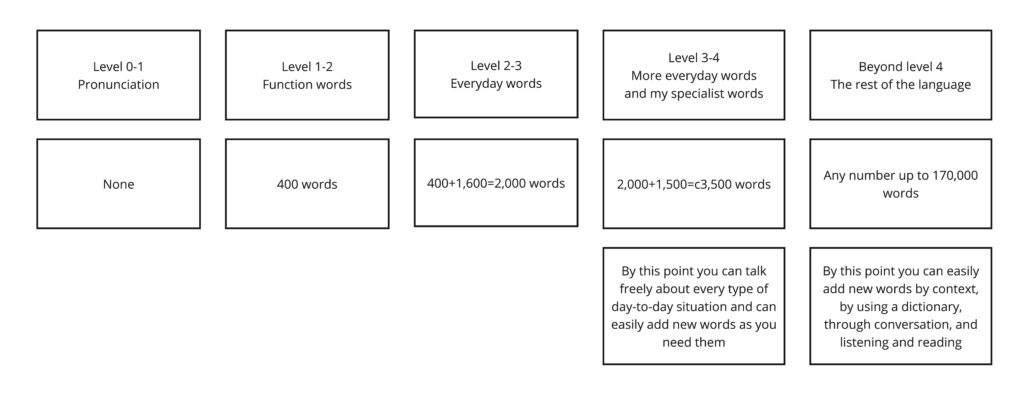
Mastering the vocabulary of a foreign language might seem a daunting task, but if you tackle it in the right way, then gaining the vocabulary you need to talk about the everyday shouldn’t be too overwhelming. 

Prioritising reading in a language course biases what students spend their time and energy on towards the time-consuming, energy intensive, fallible and frustrating process of attempting to memorise large numbers of words.  And it biases their expectation of what success in learning a language is — towards having to have a large vocabulary.

Given that, according to the Oxford English Dictionary, the English language has some 170,000 words in current use, if we aim for a large vocabulary and aim to tackle that head on — eg through things like making vocabulary lists or using spaced repetition — then we are setting ourselves a pretty daunting task, and one that most people will fail at.

But if we change our point of view slightly and set different priorities then we can avoid this.  The trick is to:

  • prioritise speaking – which means students only need a much smaller vocabulary and one that contains mostly very common words
  • at every stage only give students manageable challenges — usually just one new thing at a time. Trying to work on too many things at once isn’t a good idea, students’ memory very quickly gets overwhelmed and so most of their effort is wasted. 
  • sequence what students work on carefully.  And this is where the statistics help us: the most essential and the most common words and structures are few.

Work systematically in sequence

Step 1: Start by working on the functional vocabulary:  In English this is just 450 words (and other languages have similarly small numbers of function words).  These words are few, but very common.  In English about 55% of the words in every sentence come from this small set of 450 words.  This makes these words essential and the first priority for any language learner to work on.  But they can’t be learnt from a list or in one go: they are untranslatable and require special work and more time to master because:

They serve quieter, supporting roles – connecting, shaping and organising the content words. […] By themselves, they don’t have much meaning. Whereas a content word such as “table” can trigger an image in everyone’s mind, try to imagine “that” or “really” or “the”.

Pennebaker, J. W. (2011b, September 7). The secret life of pronouns. New Scientist.

Step 2 (which overlaps a bit with Step 1): Start to expand your vocabulary to enable you to talk about the everyday situations that you encounter.  Native speakers use about 2,000-3,000 words in their daily life.  And most of these words are very common, and repeat and repeat. This means they are easy to learn: repetition and review is built in automatically.  Also whilst you’re working at this level you’ll also be deepening your skills with the functional vocabulary.

In fact it is not as difficult as it might sound to master these everyday words if you pick them up through a series of Class Conversations or ‘Tell me’ classes.

Step 3 (which also overlaps a bit with Step 2): start to add the specialist words that reflect your own personal interests, work, or situation.  It’s much easier to learn the words that you need to express your own ideas than arbitrary lists prepared for any one else’s syllabus.

Step 4: Once you are able to speak about your day-to-day concerns with facility and ease then adding new vocabulary becomes easier and easier.  The more you know the easier it is to learn more words.  This is because your brain works associatively and once it has grasped the underlying patterns of the language and has a firm base of every day words, then you will be able to fit new words into your mental lexicon mostly without special effort.

Conclusion

It’s like when we start a new job in a new environment.  At first you don’t know ‘how things are done at round here’.  Then gradually as you find out more and more about your new work environment, confusion gradually gives way to certainty and confidence. 

Learning Japanese with the Silent Way: ‘Tell me’ lessons

‘Tell me’ lessons are one-to-one lessons where intermediate language students talk about whatever occurs to them, and the teacher helps the student express their ideas in correct and natural language.

In my case, usually the topic is completely spontaneous and I always talk about something that’s real and important for me at that moment.

My teacher works with me sentence by sentence.  She uses the feedback cycle to help me correct my sentences.  And sometimes I ask for vocabulary that I don’t know. That means that at the end of that process for each sentence, I can express what I wanted to in correct, well-pronounced Japanese, and do so with a degree of facility.

It’s worth saying that my sentences don’t get written down: each sentence remains something spoken—ephemeral and created in the moment. 

One of my teacher’s jobs is to keep pushing me forward, so, if she notices that I’ve become reasonably confident with a basic way of expressing an idea, then that’s probably the moment she’ll decide to ‘version up’.  Or, as my pronunciation improves, she will ratchet up the standard she’s looking for.  That way I’m always expected to move forward.

The process of moving from initial attempt to final version can take a considerable amount of time, but this is to be expected, and this is where the learning lies.  It’s the work I do to correct my sentences, reassemble them and practise saying them that drives my learning.

One of the main advantages of working this way is that the content of the lessons is provided by me, and the language—grammar and vocabulary—is entirely driven by what I happen to decide to talk about.  Another advantage is that the standard of what I’m expected to achieve keeps rising, so I’m always moving forward.

But these advantages also make it difficult to have a sense of my progress.  (Having said that most of the text book ways of students judging their progress are a bit stupid “we’ve ’done’ the present perfect”; “we’ve ’covered’ unit 3”; “I got 6/10 in a grammar test”.)

So the purpose of producing a series of videos of these lessons is to make it easier to see my progress.  

By editing the final versions of each sentence into a watchable video, and omitting all the work of correction and practise, I’ll show just the final ‘story’ that I told in each lesson.

What I hope is that, over the months and seasons, this will show how, gradually:

  • I can speak more and more freely about a widening range of things
  • the expressive range of what I can talk about widens and deepens
  • that I can use the more complex sentences that genuinely talking about these things requires
  • that my pronunciation and my facility improves

As a by-product, editing these videos will mean I get to review each of these lessons and it’s likely that this will help to further embed the learning from each one.

I’ll be adding these videos as I make them to the series ‘Learning Japanese with the Silent Way’. Please check them out!

Does ‘immersion’ advance your language skills or consolidate what you’ve already learnt?

I reflect on the experience of visiting Japan for a documentary we’re making and the effects I think it’s had on my Japanese.

Street scene with Tokyo Tower

For most of October I was in Japan working on a documentary project we have in hand. This gave me an opportunity to see how I could manage my everyday business in Japanese – buying basics, talking to the host of my Airbnb room, getting from A to B, buying tickets, asking for directions, conversations with friends and strangers.

I was pleased that I managed to get by quite well in Japanese for these everyday practical things. Summing it up, I got lots of opportunities to practise my Japanese, I had to think on my feet and I gained some confidence from experiencing that my Japanese did actually ‘work’ in practice.

But there aren’t many new things that I feel I learnt from the experience … a few new words, some new uses of words I’d used before, and familiarity with a few new kanji (Chinese characters).

In fact talking Japanese in Japan felt pretty unremarkable—just something I seemed to know how to do—not particularly hard work or demanding. Thanks to the way I’ve been taught by Silent Way Tokyo.

So, this makes me question the commonly held view that ‘immersion’ is the way to improve your foreign language skills. Is ‘immersion’ as efficient as it’s made out to be? It feels to me much more like my experience was what Anders Ericsson described as ‘naive practice’ ie just doing what you do anyway, as opposed to ‘purposeful’ or ‘deliberate’ practice.

I suspect this might be because I didn’t get much, if any, linguistic feedback from natives—they either worked out what I meant from what I said (sometimes after a couple of tries), or they didn’t. And if they didn’t, then mostly they resorted to body language and pointing or they ventured into English … Except for rare occasions, I don’t think I got much of the kind of feedback that would be needed to ‘version up’ my Japanese.

That’s not to say that visiting a country or this kind of ‘naive practice’ is a bad thing—it clearly isn’t—it’s just that if your goal is to improve, then there probably are more effective ways of using your time.

Why taking notes in a language class is a bad idea

Taking notes in a language class is a bad idea. It is a distraction and it doesn’t store what you are supposed to be learning where it should be stored – in your mind

The work to learn a new language needs to happen in students’ minds: it’s here that new mental connections need to be made, meanings stored and new implicit criteria built.

Written notes may seem to have some permanence, but they aren’t where you need them to be—in your mind. And teachers sometimes encourage students to take notes so they ‘have something to refer to’ later.

This is a mistake. Teachers are better working in such a way that students start to develop knowledge and skills in their minds directly, there and then in the classroom. And if students forget some of what they worked on in previous lessons, that is simply a sign they need more exposure and more practice with these things until they become familiar and automatic.

Note-taking is a distraction

‘For optimal learning, the brain must avoid any distraction.’ (Dehaene, 2020, p162)

If students are taking notes in class then their attention is divided and they are distracted by the task of writing from what the teacher is trying to get them to work on—so the opportunity to learn directly from experiencing the language in class is lost

Re-reading notes v Free recall

Students can start to feel that their notes ARE their learning – and therefore that learning can somehow be outsourced to a notebook, computer, phone or flash cards. Rather than taking notes with the idea of re-reading them to somehow strengthen recall, students are much better giving the lesson their full attention.

After their lessons, ideally after they have slept or had a nap, students can say over—or even say, write and draw—whatever they happen to recall. This is a far more effective way of lodging a lesson in their minds. Teachers should encourage students to do this kind of ‘free recall’ practice.

And the easiest way for teachers to discourage note-taking is simply to remove students’ notebooks. Here’s how to do it without fuss or making it an issue (see video).

Dehaene, S. (2020). How we learn: The new science of education and the brain. London: Penguin Books.

Why getting things wrong is a great way to learn

Trying and getting things wrong – even things students couldn’t possibly know – is a great way of learning. Trying first, potentiates deeper learning: providing students get immediate feedback and the chance to correct what they first tried.

Watch this video (3m 42s) from one of my Japanese lessons (click here).  You’ll see me trying to say a sentence, and making various attempts until I arrive at a correct version.  You don’t need to know Japanese to see what’s going on.  

What you’ll see is a process of trial and error, intelligent guessing and immediate feedback.  This is potent, far more potent than a teacher just giving a model and the student copying a correct sentence, or being given the correct answer straight away, or not getting any feedback on the grounds that the first attempt was ‘comprehensible’ anyway.

Intriguingly, research findings show that trying to answer a question powers learning, even when the student provides a wrong answer, and even if they could not possibly know the correct answer.  Just trying to answer is sufficient – if, but only if, feedback is provided immediately, and the student gets the chance to correct their attempt.  On the other hand, it seems that if feedback is delayed then the student’s error is strengthened (Hays, Kornell, & Bjork, 2012)

As Roediger and Finn stated in Scientific American (2010):

‘Getting the answer wrong is a great way to learn—as long as you receive the correct answer shortly afterward.’

This research helps to explain why one of the cornerstones of teaching languages using the Silent Way – trial and error and immediate feedback  – works so well.  And why delaying (or not even giving feedback) is a poor idea.

It is sometimes argued that teachers shouldn’t correct students’ attempts, presumably because people think this will stop students’ ‘flow’ and may demotivate them.  And Krashen argues that error correction is ineffective for acquisition and should only be used in very limited circumstances (written work and grammar exercises). 

‘Acquisition occurs, according to the input hypothesis, when acquirers understand input for its meaning, not when they produce output and focus on form.’

Krashen (1982, p117)

But done the right way it is the most powerful tool in a teacher’s pedagogic tool kit.  

Have another look at the video.  And ask yourself questions like: What was the teacher doing? What was the student doing? What was the other student doing? How much time was being taken? Was it well spent?

For example, you might see some of the following:

  • in the space of about 3 minutes, I launched my sentence and over the course of eight attempts eventually arrived at a correct version
  • As well as body language and tone of voice, my teacher used her fingers to pinpoint where the problems were, showed me where to look on the wall charts to find a word I needed, and hummed the rhythm and melody of a phrase
  • The process of arriving at the correct sentence was one of discovery, with me sometimes introducing new incorrect possibilities as we proceeded
  • Nothing was written down and my teacher didn’t give me a model to copy

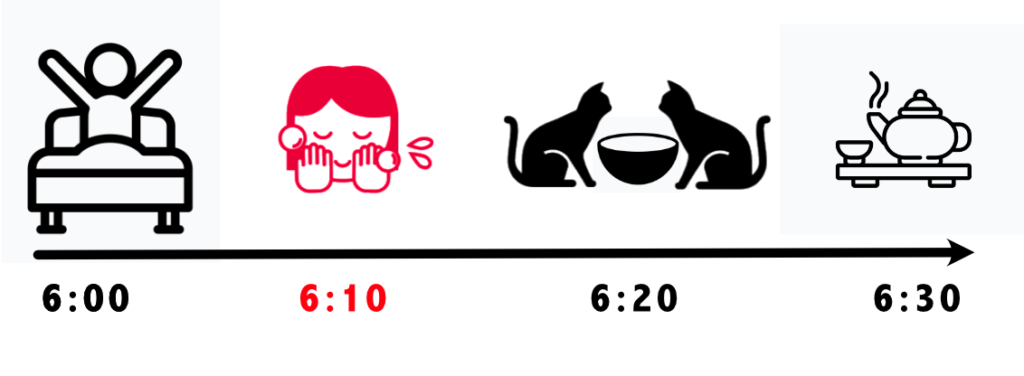
What you don’t see in this short extract is what happened afterwards.  As a result of this few minutes work, both my fellow student and I were confident saying this kind of thing, and we easily extended the descriptions to encompass all the items of Yoko’s typical morning and our own.

What’s more, my fellow student then felt emboldened to try experimenting with ‘before drinking Japanese tea …’.  Which meant that we discovered this doesn’t work in quite the same way.  But it didn’t take long, through exactly the same kind of process, for us to grasp how to say things like ‘before drinking Japanese tea/before feeding the cat/before washing her face …’.

All of this is now ‘obvious’ to me – indeed, watching the video again it seems weird to me that a few days ago I should have had such bizarre ideas about how this kind of thing might be said. In other words, the process of exploration, feedback and discovery has added another firm detail to my Japanese mental equipment.

References:

Hays, M. J., Kornell, N., & Bjork, R. A. (2012, May 14). When and Why a Failed Test Potentiates the Effectiveness of Subsequent Study. Journal of Experimental Psychology: Learning, Memory, and Cognition.  https://bjorklab.psych.ucla.edu/wp-content/uploads/sites/13/2016/07/Hays_Kornell_RBjork_inpress.pdf (accessed May 29 2023)

Krashen, S.D. (1982). Principles and Practice in Second Language Acquisition. The Modern Language Journal, [online] 67(2). doi:https://doi.org/10.2307/328293.

Roediger H. L. III, Finn B., Scientific American, (March 1, 2010) https://www.scientificamerican.com/article/the-pluses-of-getting-it-wrong/ (accessed May 23 2023)

Are babies really slow at learning languages?

We shouldn’t be surprised that it takes time to learn a language: even babies and young children take several years to master their native tongue.

Probably everyone who starts learning a language has unrealistic expectations about how long it takes. Especially when you see people advertising ‘fluent in x months’ or ‘learn a language fast!’ … if you were to believe these adverts then you’d have to conclude that babies are really, really slow at learning their native language.

By the time young children can speak their native language they have spent three or four years of development. Adults and children don’t learn in the same way but it’s instructive to reflect on what has to happen for someone to learn a new language, and the fact that making the necessary changes to yourself is a substantial task.

First, retraining yourself to make the vocal movements needed to pronounce the new language well. Secondly, becoming familiar with how the language ‘works’: how it expresses spatial, temporal, personal and causal relationships etc. And practising these skills (and sleeping on what you’ve practised) until they become automatic capabilities which you can call on with little effort when they are required. And once you are at this stage, allowing your vocabulary to expand into all you need for daily life and your interests.

So, just like babies and small children, we should expect our journey to learn a foreign language to take a few years. Not a few months … but equally, not forever.

Intuition

Becoming expert in a foreign language is developing our intuitive sense for that language. It takes time and experience. We have to have reasons to trust our intuition … and getting us to that point is precisely what we should expect of our teachers.

Speaking our native language, we rely on a ‘mental model’ of that language which encompasses its words and grammar, the processes that are needed to convert thoughts and ideas into sentences, and the instructions our muscles need to actually say those sentences. This mental model is, of course, nothing like what you’d find in a grammar book.

It’s tacit knowledge – not something we are conscious of, nor something we can access directly. We only notice it, and know that it’s there, when we hear something that ‘doesn’t sound right’ or read something that ‘doesn’t look right’ or, rarely, when we’re uncertain of how to say something and mentally test out options to see which ‘feels right’. If you speak English well, you probably reacted this way to the image at the start of this article …

It’s our intuition that we use, mostly infallibly, and unhesitatingly as ideas come into our minds and automatically trigger the words which pour out of our mouths.

So teaching a foreign language is, or should be, helping students to train their intuition to generate those same kind of feelings for ‘what feels right’.

Since students can’t directly contact their ‘mental model’, and teachers certainly can’t, we have to work indirectly. And just like any other skill that operates intuitively – riding a bike, empathising with others, playing football etc – we can only become expert at it by doing.

One thing that will help us though is our attitude: once we realise that what we are really doing is developing our intuitions then we won’t waste time and energy looking for rules or explanations; and we will become more willing to allow things to be ‘pencilled in’ to our mental model and then to confirm or modify them as we get more experience. This is why feedback from our teachers is so valuable: it gives us reasons to trust our intuitions. And it tells us where they are fallible.

This is true as much for vocabulary as for grammar, pronunciation, rhythm and melody. Words need to become as much part of that implicit mental model of the language as anything else – this is why attempting to memorise lists of words generally doesn’t work except sometimes in the short term.

The more we can feed our intuitive side for every aspect of the language the sooner we’ll develop that sense of ‘rightness’ and of ‘error’.

The ‘remembering curve’

There seems to be a lot of focus on the ‘forgetting curve’ but I think a ‘remembering curve’ might be much more fun and much more likely to put us on the ‘up’ escalator

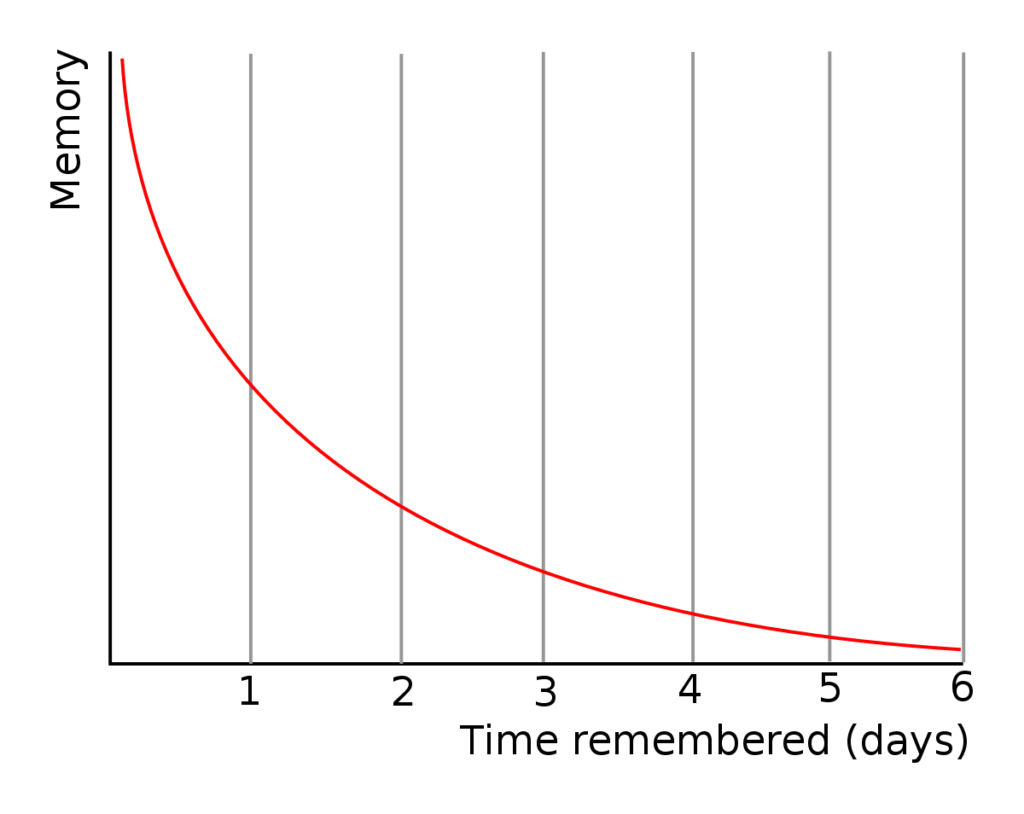
A lot of people discuss the ‘forgetting curve’ in the context of using spaced repetition systems to memorise foreign language words. The argument is that newly encountered words tend to be quickly forgotten, and periodically reviewing them slows down the rate that they are forgotten. Eventually, effectively, these words become part of a student’s long term memory. These reviews are what a spaced repetition system organises for you.

The forgetting curve

This all seems very scientific, and probably resonates with most people’s experience of trying to memorise vocabulary lists or spelling lists or history dates at school.

But it doesn’t fit with my recent experience of learning both Japanese and French. Neither ‘forgetting’ nor ‘memorising’ seem to have really played any part in those two experiences.

Does the ‘forgetting curve’ really apply to language learning?

For one thing, the original scientific studies on which the ‘forgetting curve‘ was based, researched memorisation of nonsense syllables. Surely, memorising nonsense syllables is far, far, far from what we are trying to do when learning a foreign language?

The new foreign words we are learning carry meanings, they fit into the overall phonetic and syllabic patterns of the language, they often also fit into word families, and they are inextricably imbued with the music of their sounds and rhythms. Not to mention, the contexts in which we come across them and the emotional effect they carry. So all our new words come with all kinds of connections to the real world, to our feelings and to other words.

If the ‘forgetting curve’ describes the ‘down’ escalator, is there an ‘up’ escalator?

Suppose we meet some new vocabulary in a lesson. Say, the rooms in an apartment and some of the verbs used to say what people do in their homes. And we get to say these words: we experience what they feel like ‘in our mouths’. And we get to use them in sentences: what’s in the different rooms? what’s their layout? what’s someone doing in a particular room? how do you get from one room to another?

After a lesson like this, what consistently happens to me is that, immediately after the lesson, I think ‘I don’t remember most of those words.’ This doesn’t bother me, because I know what’s likely to happen next.

The next day, after a night’s sleep, most if not all the words will have ‘magically’ become available to me. And when I turn up at the next week’s lesson, all but a very few will be pretty secure. And if there are one or two I’ve forgotten or have muddled up, my teacher or someone else in the class will help me out. And by that point these new words will seem to be no longer ‘new’. They’ve become, more-or-less, as permanent as English words, though they usually take a bit more work to actually get into my mouth, when I need them.

You can see real examples from exactly this type of lesson and the facility a few night’s sleep seems to provide in this video.

So, after lessons like these, recall seems to strengthen over time without me doing very much …

Why should these memories strengthen?

It’s well known that sleep consolidates and enhances learning. Put simply, skills we’ve practiced (especially motor skills, like speaking) improve during sleep, without any further practice. I think this is what we’re exploiting in lessons that operate like this: everyone gets an extra benefit, provided they get a few good night’s sleep.

Now, if my experience is anything to go by there are some things that make it more likely we will climb on the ‘up’ escalator and not on the ‘down’ one. We’ll increase the ‘charge’ lodged in our mind by the work done in the lessons, and therefore the benefits of sleep, if, during our lessons:

  • we stay present to what’s happening. Daydreaming, writing notes, staring out of the window, not noticing what others are doing – all of these, diminish the experience
  • we actually talk. The physical act of saying words out loud is quite different from any amount of silent, mental, or written work
  • we practise each sentence until we achieve at least a degree of ease saying it
  • we make sentences that refer to things we know are real or true, because this always gives our words a firm context. Making stuff up in a language lesson is far less effective: this is not the place to be creating fiction. Save that for a novel

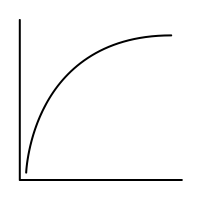
The ‘remembering curve’

Could this be the shape for a ‘remembering curve’?

So, I’d like to propose that we start talking about the ‘remembering curve’ which seems to be as much a part of our human nature as the other one. What’s more, it operates ‘for free’: providing we optimise how we approach our lessons.

A black big dog

Our minds resist using patterns required by a new language that contradict what we are used to from our native language.

In one of my recent Japanese lessons we were working on saying something like this:

「短くて赤い棒」(a small red rod)

This was all well and good, but then our teacher invited us to describe the same thing as:

「赤くて短い棒」(a red small rod)

I found this inexplicably difficult. I remember feeling pretty strong resistance to reordering the words in this way, and I had no idea why I should find this so uncomfortable. But, I pushed myself, and after saying it a few times and then shifting to 「黒くて長い棒」(a black long rod) these sentences gradually started to feel less impossible.

I thought about it afterwards, and remained puzzled as to why I had been so reluctant to reorder what are some very familiar Japanese words.

It was only a few days later that I realised that the English neural structures that govern word order in my mind must have been kicking in and making me feel uncomfortable: just like every English speaker will have felt uncomfortable reading the title of this article. And as I practised and tried variations, I must have been building new parallel Japanese neural structures that don’t care about adjective order.

This kind of thing must be occurring all the time, when we learn a foreign language. We get asked to say things that violate the patterns from our native language that are encoded in our minds. This is going to make us at the least uncomfortable, uncertain and hesitant and possibly make us reject and disbelieve what we are being taught.

Indeed, I now realise that what my French teacher occasionally hears me say – ‘You cannot be serious!’ – when he gives me positive feedback after I’ve forced myself to say a French sentence that seems impossibly weird to me, must reflect the same effect: incredulity that French could possibly be structured in such weird ways.

So, students are never going to feel comfortable speaking a foreign language until they have grown the new neural structures needed, in parallel to their well-established native ones. And it’s clear that neural structures like these are not grown by memorising a rule: no English speaker knows the ‘rule’ for the order of adjectives but nevertheless they never make a mistake and infallibly recognise when the order is wrong.

So now after a week or two, practising saying this kind of thing in Japanese and getting feedback, I no longer feel any particular resistance to describing the animal in this picture by saying things like:

「黒くて大きい犬」(a black big dog)

or

「大きくて黒い犬」(a big black dog)

Indeed, in some ways I prefer the first of these … I may be wrong about this, but it seems to me that in Japanese this way of talking, perhaps, emphases the blackness of the dog which is what strikes me most about the picture.

I found the whole process very instructive. When students are learning a language they must have to deal with this kind of thing every step of the way. And having experienced this clear example in my own learning, I’ll be more aware of it next time I’m teaching, or next time I’m faced with those ‘bizarre’ sequences of French pronouns etc.